
 THE NATIONAL UNION OF
JOURNALISTS OF UKRAINE
THE NATIONAL UNION OF
JOURNALISTS OF UKRAINE

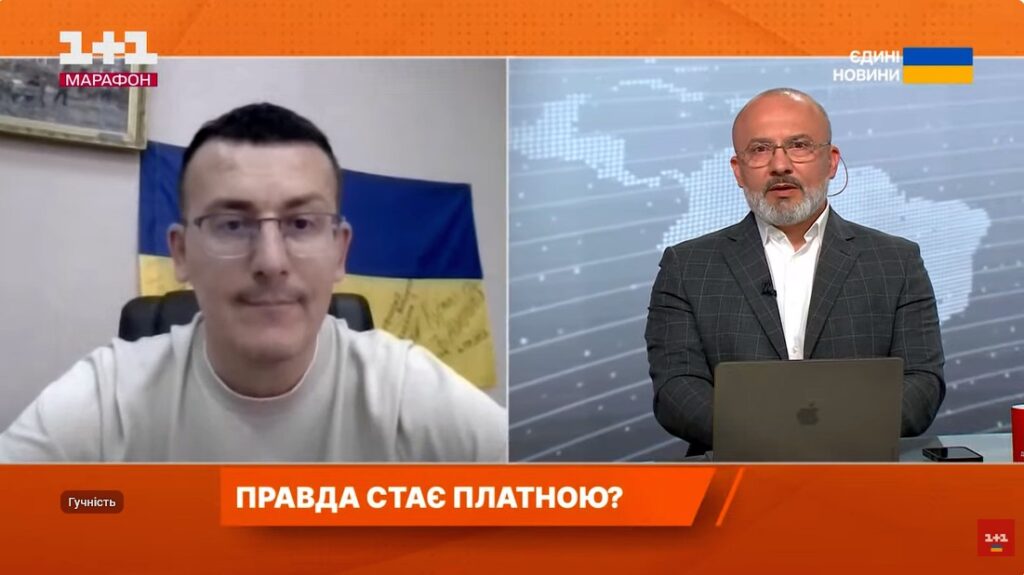
In Sweden, leading newspapers publish only short news on their websites for free. If you want to read detailed material, you have to pay either for a separate article or for a monthly subscription. It is these funds that make the work of Scandinavian newsrooms possible today. This was stated by the President of the National Union of Journalists of Ukraine (NUJU), Sergiy Tomilenko, on the air of the United News Marathon.
The conversation with the host Volodymyr Pavliuk was dedicated to the cost of quality journalism in wartime. “People are used to the fact that news is free, but in reality it is not, because news is also a business. Will the truth not become a privilege for those who can pay for it?” said the host.
According to Sergiy Tomilenko, it is not just about the increase in the price of individual components of media production, but about the complete transformation of the media landscape. Social networks – primarily Facebook and Telegram – have become the dominant channels for distributing information and consuming content, and advertisers have followed the audience there.
“Classic newsrooms, newsrooms can no longer attract advertising funds in sufficient quantities,” stated the head of the NUJU. “A journalist can be a volunteer and perform socially useful work, but each person must receive a salary, and production costs must be compensated.”
As Sergiy Tomilenko noted, the classic monetization model that has supported journalism for decades – a subscription to the printed press plus advertising revenues – is collapsing all over the world, and Ukraine is no exception.
“Paid content is not something that owners or journalists want to earn in especially difficult times,” Sergiy Tomilenko emphasized. “This is an attempt to save the newsroom, retain journalists and find funds that will encourage responsible journalism again. Because we want to consume the truth – so that someone checks the information, records it, does not distort it, and so that we can rely on it in making decisions.”
Answering the question of whether paid subscriptions are the norm in the world, the President of the NUJU gave the example of Scandinavian countries, where such models have been implemented most successfully. The NUJU cooperates with Bonnier News – the largest media company in Sweden and the entire Scandinavian region – and with the Swedish Media Business Association.
Leading Swedish newspapers maintain newsrooms precisely thanks to paid content.
“This became possible thanks to copyright protection, complex software solutions and a culture of non-pirate media consumption. This path was evolutionary, but today the model works,” noted Sergiy Tomilenko.
Ukrainian national media, according to the President of the NUJU, are studying and gradually implementing this experience, but with their own peculiarities. The phenomenon of media communities is forming in Ukraine: newsrooms do not necessarily close all materials to paid access but instead gather around themselves a club of supporters – of the brand, presenters, journalists – and ask this community to show solidarity, donate, support.
“This is an attempt to find a foothold in a world dominated by social networks,” concluded Sergiy Tomilenko. “Advertising funds actually exist, but they are received by monopolized digital giants. It is like a vacuum cleaner that sucks out funds that in previous years could have been funds for the development of newsrooms.”
NUJU Information Service












Discussion about this post