

 THE NATIONAL UNION OF
JOURNALISTS OF UKRAINE
THE NATIONAL UNION OF
JOURNALISTS OF UKRAINE
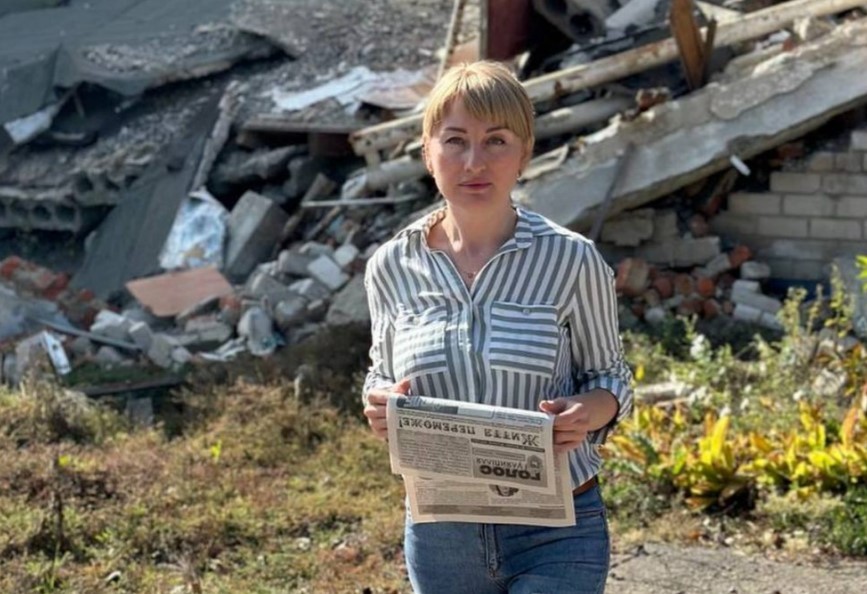
Huliaipole, a Hero City in southeastern Ukraine, has been almost completely destroyed by Russian attacks. Despite relentless shelling, the impossibility of living in the town itself, and the forced relocation of its newsroom, the newspaper Voice Huliaipillia and its digital platform Guliaipole.City continue to demonstrate extraordinary professional dedication and civic resilience.
This October, the newspaper will celebrate its 96th anniversary. Despite the war, it continues to publish and remains the voice of people whom the war seeks to silence. In this interview, Editor-in-Chief Tetiana Velyka reflects on evacuating under fire, the remarkable efforts of a small editorial team, growing the outlet’s audience into the millions, and covering urgent social issues such as compensation for destroyed homes.
A story that refuses to end: relocation and the strength of a small team
– During its nearly century-long history, Voice Huliaipillia suspended publication only three times. What challenges did your newsroom face after the full-scale invasion, and how was the decision made to evacuate?
– Yes. Founded in 1930, our newspaper has been forced to suspend publication only three times in its entire history. The third interruption came after Russia’s full-scale invasion. Mass evacuations and the devastating shelling of our hometown forced us to stop publishing for 586 days.
The final issue produced in peaceful Huliaipillia was published on 24 February 2022. Postal workers still managed to deliver it that day.
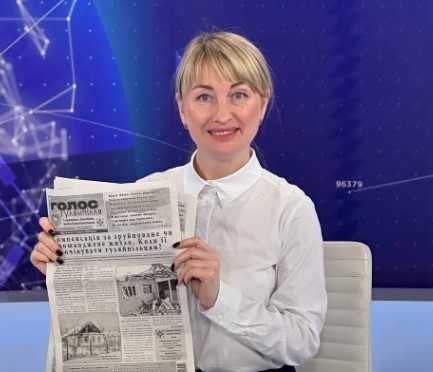
We decided to relocate on 6 March 2022, when communications had collapsed and people were sheltering in basements. My family and I left Huliaipole the following day, as the first homes were already burning after Russian strikes. My colleagues evacuated later, making their way out on their own.
The newsroom relocated to Zaporizhzhia. Thanks to the support of the National Union of Journalists of Ukraine (NUJU), its President Serhii Tomilenko, and the Zaporizhzhia Regional Journalists’ Union, led by Nataliia Kuzmenko and Valentyna Manzhura, we managed to revive the printed newspaper as an eight-page publication and restore its presence in every post office across the region.
– Who produces the content today and keeps this information front line alive?
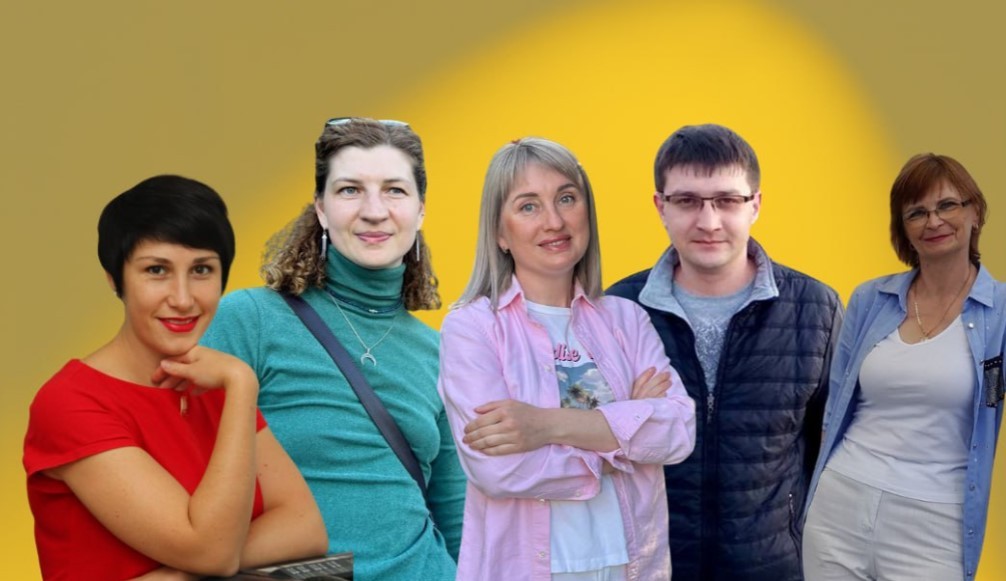
– Before the war, our newsroom employed eight people. Today, only five remain, including four editorial staff members. Our team is now spread across Ukraine in Zaporizhzhia, Dnipro, Kyiv, Rivne, and Ternopil. Every single member is invaluable. As both publisher and editor-in-chief, I have taken responsibility for managing the newsroom, securing international support, ensuring our financial sustainability, and preserving the publication through the most difficult period in its history.
Our deputy editor, Tamara Bort, is a journalist whose deeply moving stories about Ukrainian defenders, fallen heroes, and missing soldiers bring readers to tears while also giving them hope. Her reporting has become a voice for families living with uncertainty. Readers often write to her saying, “We are proud of you and your talent.”
Sergiy Savytskyi, our layout designer, uses his professionalism and perseverance to ensure that every issue is beautifully produced and reaches readers on time.
Oksana Spudka, our accountant, keeps the newsroom financially afloat despite wartime conditions and the constant search for grant funding.
Liza Kudynenko, a journalist based in Rivne, has worked remotely since the first days of the full-scale invasion and contributes to our work every single day.
– Were you able to preserve your equipment and newsroom?
– Unfortunately, very little survived. My husband, Dmytro, managed to rescue some computer system units, but the equipment was already outdated, so today most of our journalists work on their own personal computers. Our camera and other newsroom equipment were stolen by looters after the windows and doors of our office had been blown out.
Finding office space in Zaporizhzhia has also been a challenge. Initially, my husband allowed us to work from his rented office. However, his farming business ended up under Russian occupation, the office had to close, and our newsroom simply cannot afford commercial rent. Even after repairing premises damaged during a missile strike on Zaporizhzhia, we are still searching for rent-free office space.
Grants have become our lifeline. Over the past few years, we have received support from the Association of Independent Regional Publishers of Ukraine (AIRPU), the Academy of Ukrainian Press, the Public Interest Journalism Lab, the Embassy of Lithuania in Ukraine, the Institute of Mass Information (IMI), and the National Union of Journalists of Ukraine.
One of our greatest sources of support has been the FrontlinePress programme run by the Swedish Media Publishers’ Association (Tidningsutgivarna), which has now been extended until the end of the year. We are deeply grateful to every one of these partners.
From a small newsroom to a multi-million audience
– How much has your audience grown, and what kind of stories do you focus on today?
– Our editorial focus has changed dramatically. Today, we write about the lives of Ukrainian soldiers, volunteers, internally displaced people, and communities living on the front line. Our journalists – particularly Tamara Bort – have already documented 350 stories of Ukraine’s defenders. These accounts have since been included in the three-volume book Defenders of the Huliaipole Region, published by our former editor, Ivan Kushnirenko.
Maintaining such an information outpost with only a handful of people requires tremendous daily effort, but the results speak for themselves. We have grown from a small district newspaper into a media outlet with a multi-million audience.
According to the Professional Panel analytics for the past 90 days, our digital platforms – our website, Telegram channel, and Facebook page – have generated more than 1.7 million content views. During that period, we reached 365,264 unique users seeking reliable information directly from primary sources. Our monthly performance is equally encouraging. The Huliaipole City Facebook page, with a community of more than 10,000 followers, receives nearly 830,000 monthly views (829,700 on average). The Guliaipole.City website attracts more than 80,000 monthly visits, while our Telegram channel has grown to over 5,500 subscribers.
Most notably, views of our visual content and photo reports increased by 79% in just one week. The majority of our audience consists of people between 35 and 64 years old, who account for more than 67% of our readership. Within Ukraine, our largest audiences are in Zaporizhzhia (65.6%), Dnipro (10.3%), Kyiv (9.5%), and the settlement of Novomykolaivka (3.6%). More than 11% of our audience now lives abroad – in Poland, Germany, the Czech Republic, Switzerland, Norway, the Netherlands, and the United States. These are our fellow residents who were forced to leave their homes, Ukrainian service members, and everyone who values receiving truthful information directly from the source.
Looking ahead
– What keeps your team motivated despite all the challenges?
– The greatest reward for us is the trust and appreciation of our readers. When people call us, write letters, or send messages saying, “Thank you. You preserve the memory of our defenders and honour our children,” we know that our work truly matters. For our small newsroom with a big heart, those words mean more than any award or professional recognition.
Despite the war, the newspaper continues to live on. Subscribers still receive every issue through Ukrposhta, and for many of them it has become a cherished tradition. Readers in Zaporizhzhia eagerly await the day their post carrier delivers the latest issue because, for people scattered across Ukraine by the war, the newspaper has become a small piece of home a lasting voice of the Huliaipole community.
In addition to subscriptions, the editorial team distributes the newspaper free of charge through community hubs serving the Huliaipole, Vozdvyzhivka, and Malynivka communities, as well as in shelters and dormitories where internally displaced people are staying. Every new issue is welcomed with genuine excitement. People come to ask whether the newspaper has already arrived, flip through its pages, search for familiar names, news from their hometown, and photographs of places they remember. For many, it is far more than a newspaper – it is a lifeline that still connects them to their small homeland.
Preserving the memory of Ukrainian defenders has become one of the newspaper’s most important missions. Part of each print run is sent to the families of servicemen and women who defended the Huliaipole region and whose stories have been featured in the newspaper. Every copy reaches its recipients across Ukraine – especially in the Ivano-Frankivsk region, where many families of soldiers who fought for Huliaipole now live, as well as in other cities. Families of fallen heroes, those missing in action, and defenders who continue to serve receive these issues. For them, stories about their loved ones become priceless keepsakes, carefully preserved, reread, and passed on to children and grandchildren.
“We continue searching for a permanent office in Zaporizhzhia, working to preserve the print edition, and developing both our website and social media platforms,” says Tetyana Velyka. “Our plans include launching new digital formats, particularly video reports from the frontline communities of the Huliaipole region, so that even more people can see the truth about life under constant shelling.”
“Our example proves that even a relocated regional newsroom can operate on the same level as national media while remaining close to its community. And our greatest dream remains unchanged: one day to return to a peaceful Huliaipole, unlock the doors of our newsroom once again, and produce every issue on our own land. Until then, we will continue holding the information front, because we know that words, too, bring victory closer.”
Interview by Alina Ivanenko
The Journalists’ Solidarity Centers network is an initiative of the National Union of Journalists of Ukraine, implemented in cooperation with the International Federation of Journalists and the European Federation of Journalists. Our main goal is to support media workers working in Ukraine during the war. The Centers operate in Kyiv, Kharkiv, Zaporizhzhia, Dnipro, Lviv and Ivano-Frankivsk. The project is part of UNESCO’s broader efforts to support journalists’ safety and freedom of expression in Ukraine. The Network’s activities in the summer of 2026 are supported by the Ukrainian Media Fund Nordic.














Discussion about this post