
 THE NATIONAL UNION OF
JOURNALISTS OF UKRAINE
THE NATIONAL UNION OF
JOURNALISTS OF UKRAINE
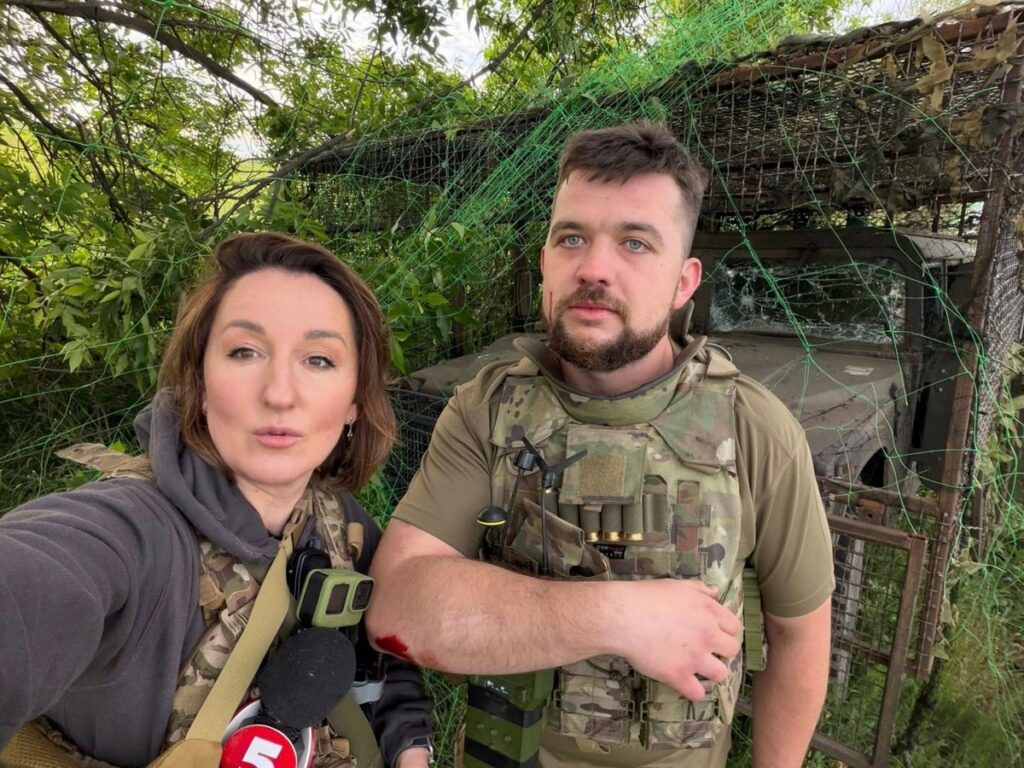
“Minus the Humvee. Plus us” is how war journalist Olha Kalinovska (Channel 5) briefly described the events of this morning after she was hit by an enemy drone near the village of Pokrovske in the Dnipropetrovsk Region.
At the stabilization center, doctors diagnosed her with ear barotrauma and prescribed treatment, because the journalist has poor hearing in her left ear after the incident. But Olha is already eager to get to work: “I need to turn on the power in the evening. And keep working. My arms and legs are fine, my head is “working” – go ahead, go ahead,” she says in a comment to the National Union of Journalists of Ukraine (NUJU).
We spoke with Olha Kalinovska shortly after the incident, when the victims were on their way to the stabilization point for medical care in an evacuation car.
The journalist went to Pokrovsk, which is located 14 km from the front line, to cover the civilians. The Ukrainian offensive is ongoing on the Oleksandrivske Axis, the enemy has been pushed back, so it was important for the newsroom to understand how the civilians in the village are feeling now and what the condition of the settlement is.
“The last time I was in Pokrovsk four months ago with the “White Angels” – they evacuated civilians from there. Even then, the city center was destroyed, everyone was being taken out – both the elderly and children,” Olha Kalinovska tells the NUJU.
The group did not reach the village. The FPV drone, which was hanging above the road, was noticed by the driver and the journalist herself, who was sitting in front.
“The drone was in the air – and it was clear that it was attacking. It was flying right at us, it was fifty meters away. The driver maneuvered, managed to turn the car around. We quickly opened the door and literally fell onto the asphalt. And at that moment, when we were falling out, there was an explosion” recalls the correspondent.
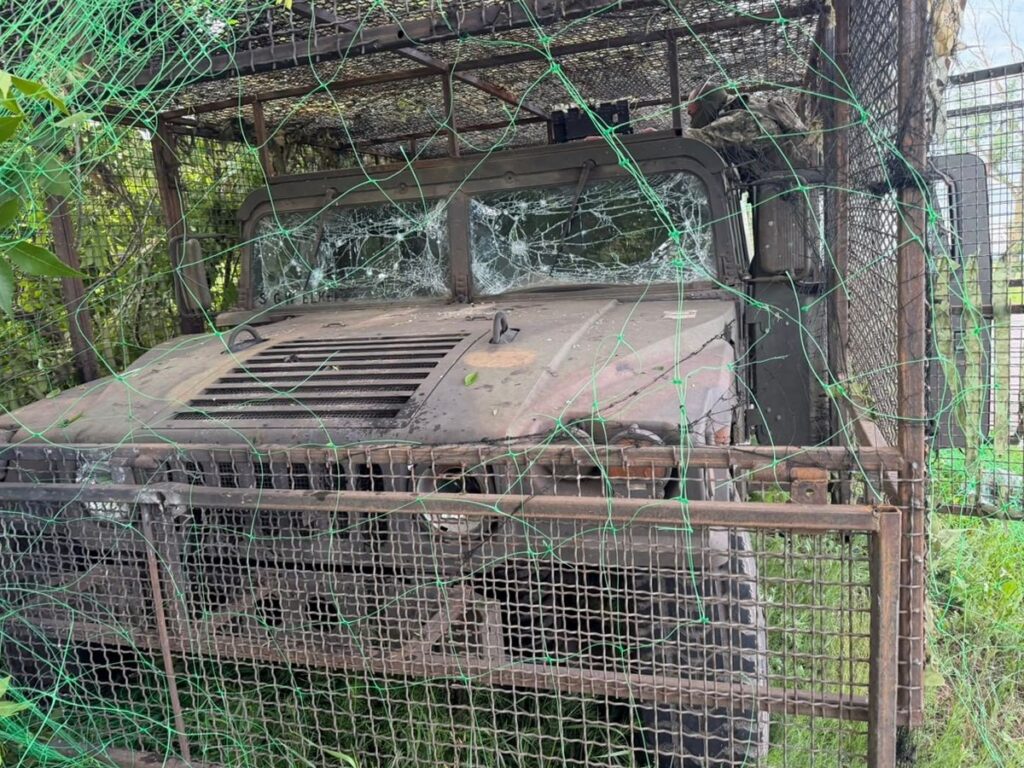
The drone flew into the net stretched in front of the Hummer’s windshield and detonated – the warhead was from an RPG. It exploded on the hood, literally, as Olha noted, under the people’s noses.
“We were shaken. I was hit hard in the left ear. The driver jumped into the car, shouted for us to jump back. We had to get out quickly – we didn’t know if it was one drone or several. We wouldn’t have had time to escape on our feet,” says the journalist.
The car began to stall: the debris probably damaged the radiator and engine. So, the car was driven away and camouflaged. The danger did not end there: the russians, realizing that they had hit a car, raised other drones into the air – to finish off the car or search for the crew.
“The “Molniya” flew over. We had a Chuika [drone detector] with us, several times we saw the “Molniyas” flying over it, and we hid. Then an evacuation car came after us,” says Kalinovska.
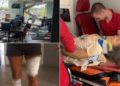
The “Hummer” had a driver, Olha Kalinovska, and the press officer of the 148th Separate Artillery Brigade, Serhii Kolesnichenko. Everyone received concussions, everyone had their knees and elbows scratched upon the asphalt, because they jumped straight onto the road.
According to the journalist, the car was attacked by an FPV drone on a fiber optic cable.
“The Chuika showed nothing. The Hummer was equipped with electronic warfare equipment – and it did not work. It was at least 17–18 kilometers from the contact line, that is, a fiber optic cable with a coil for 25–30 kilometers,” the correspondent explains.
For Olha Kalinovska, this is not the first “adventure” while performing professional duties. On September 18, 2025, near Pokrovsk in the Donetsk Region, a car carrying a Channel 5 film crew accompanied by military personnel exploded on a mine. Then Olha received a mine-explosive and ear barotrauma and ended up in a hospital in Kramatorsk, the crew was also forced to hide from russian drones:
“If the drone hit here before Pokrovsk, then I almost missed Pokrovsk by a kilometer. Somehow, Pokrovsk and I don’t get along,” Olha jokes.
* * *
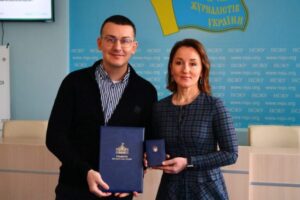 Olha Kalinovska has been covering the war since 2014, long before the full-scale invasion changed the life of the entire country. Recently, together with correspondents Iryna Sampan (Hromadske Radio) and Elvina Seitbulaeva (My Ukraine TV channel), she received a parliamentary award from NUJU President Sergiy Tomilenko. All three have been working in the most dangerous parts of the country for years. At the time, Olha Kalinovska noted that the award is primarily about the people she is filming: “For me, the greatest award is to film the best people in this country. I really want both Ukraine and the world to see these people. For me, it is a matter of pride to work there despite all the dangers.”
Viktoriya Maliovana
NUJU Information Service










Discussion about this post