 THE NATIONAL UNION OF
JOURNALISTS OF UKRAINE
THE NATIONAL UNION OF
JOURNALISTS OF UKRAINE
In the first half of 2026, NUJU recorded at least 74 verified cases of Russian attacks on journalists, editorial offices, and media infrastructure across Ukraine. Newsrooms have been destroyed. Journalists have been struck by drones while working dozens of kilometres from the front. At least 28 media workers remain in Russian captivity on fabricated charges. Against this backdrop, the Ukrainian Media Fund (UMF), an initiative launched in March 2022 by media organisations from Denmark, Finland, Norway, Poland, and Sweden, has decided to extend its support for NUJU’s Journalists’ Solidarity Centres network for three months, covering June through August 2026.
The security situation in June 2026
May 2026 was the most damaging month of the year for Ukrainian media, with 22 verified cases recorded. A single massive missile-and-drone strike on Kyiv on 24 May damaged six editorial offices, including those of UNIAN, ARD, Deutsche Welle, and Kyiv’s NUJU chapter.
As of 25 June, NUJU had registered at least 14 cases: five instances of damage to editorial premises and media infrastructure, seven cases of journalists’ homes being struck, and four episodes of journalists coming under direct drone attack during professional duties.
Among the June cases, two editorial buildings were confirmed destroyed. The newsroom of Ridne Misto newspaper in Myrnohrad, Donetsk region, where active combat continues, was officially documented as beyond repair by the local military administration. It was the second complete destruction of a local outlet’s premises in 2026. On 29 March, a Russian guided bomb flattened the editorial building of Mezhivskyi Merydian in Dnipropetrovsk region. Both teams continue working in relocation.
On 3 June, Channel 5 war correspondent Olha Kalinovska sustained a concussion when a Russian fibre-optic FPV drone struck her vehicle 17–19 kilometres from the line of contact near Pokrovske, Dnipropetrovsk region. Fibre-optic drones operate beyond the detection range of standard drone-alert devices. It was her second drone-related concussion in six months; the first occurred in September 2025. “The question of how close you are to the front is already relative. Journalists are in ever-greater danger — you don’t need to be five kilometres from the front line,” Kalinovska said.
NUJU monitoring shows that the effective danger zone for drone strikes now extends up to 30 kilometres from the front. Journalists working across Ukraine report that “PRESS” markings on body armour no longer function as protection, as operators of Russian strike drones actively target visible media markings.
Alongside physical attacks, NUJU maintains a separate monitoring database of journalists held in Russian captivity. At least 28 media workers are currently detained, some for nearly a decade, on fabricated charges ranging from alleged membership of organisations Russia designates as terrorist to invented espionage and sabotage. Combined known sentences in these cases exceed 400 years of imprisonment.
What the Centres do
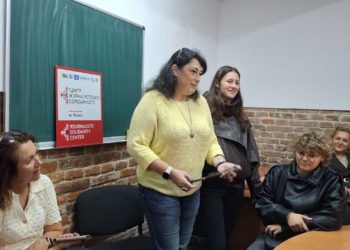
The National Union of Journalists of Ukraine operates seven Journalists’ Solidarity Centres, located in Kyiv, Kharkiv, Dnipro, Zaporizhzhia, Lviv, Ivano-Frankivsk, and Sumy, in partnership with the International Federation of Journalists (IFJ), the European Federation of Journalists (EFJ), and UNESCO. The Centres provide safety equipment including drone-alert devices, body armour and first-aid kits, as well as legal and psychological assistance and practical security training. Equipment is issued on a shared-use basis, allowing a single device to rotate across multiple newsrooms. This model is especially important for regional and local outlets that have no budget to purchase protective tools independently.
The UMF decision means the Centres’ teams can continue providing these services to colleagues throughout the summer.
About the Ukrainian Media Fund
The Ukrainian Media Fund was launched in March 2022 in response to the Russian full-scale invasion. It was initiated by the Gazeta Wyborcza Foundation and leading media organisations in the Nordic countries: Bonnier News, the Swedish Media Publishers’ Association (Tidningsutgivarna), the Association of Danish Media (Danske Medier), the Finnish Media Federation (Medialiitto), News Media Finland, and the Norwegian Media Businesses’ Association (Mediebedriftenes Landsforening). Since 2025, UMF has been operationally led by Foreningen Ukrainian Media Fund Nordic.
Since its founding, UMF has focused on four areas: financial support for local media outlets and journalists, particularly those operating in war zones; equipping journalists with protective and communication gear; supporting cooperation between Ukrainian and European media; and providing Ukrainian local media with reconstruction recommendations and long-term financing strategies.
Since March 2022, UMF has supported the operational budgets of several dozen local media outlets across Ukraine, equipped hundreds of journalists with protective and communication gear, and worked on scenarios for Ukrainian media reconstruction after the war.
NUJU Information Service










Discussion about this post