 THE NATIONAL UNION OF
JOURNALISTS OF UKRAINE
THE NATIONAL UNION OF
JOURNALISTS OF UKRAINE
The European Federation of Journalists says the expulsion of the Russian organisation from the International Federation of Journalists was “entirely legitimate and justified”
The European Federation of Journalists has strongly supported the expulsion of the Russian Union of Journalists from the International Federation of Journalists, calling the decision “entirely legitimate and justified” and stressing that it reinforces professional standards and ethical principles within the international journalistic community.
The Russian Union of Journalists (RUJ) was expelled by decision of the IFJ Congress in Paris on 7 May 2026, following a recommendation by its Appeals Commission, as previously reported by the National Union of Journalists of Ukraine. The move marked the final stage of a process launched in the early months of Russia’s full-scale invasion of Ukraine.
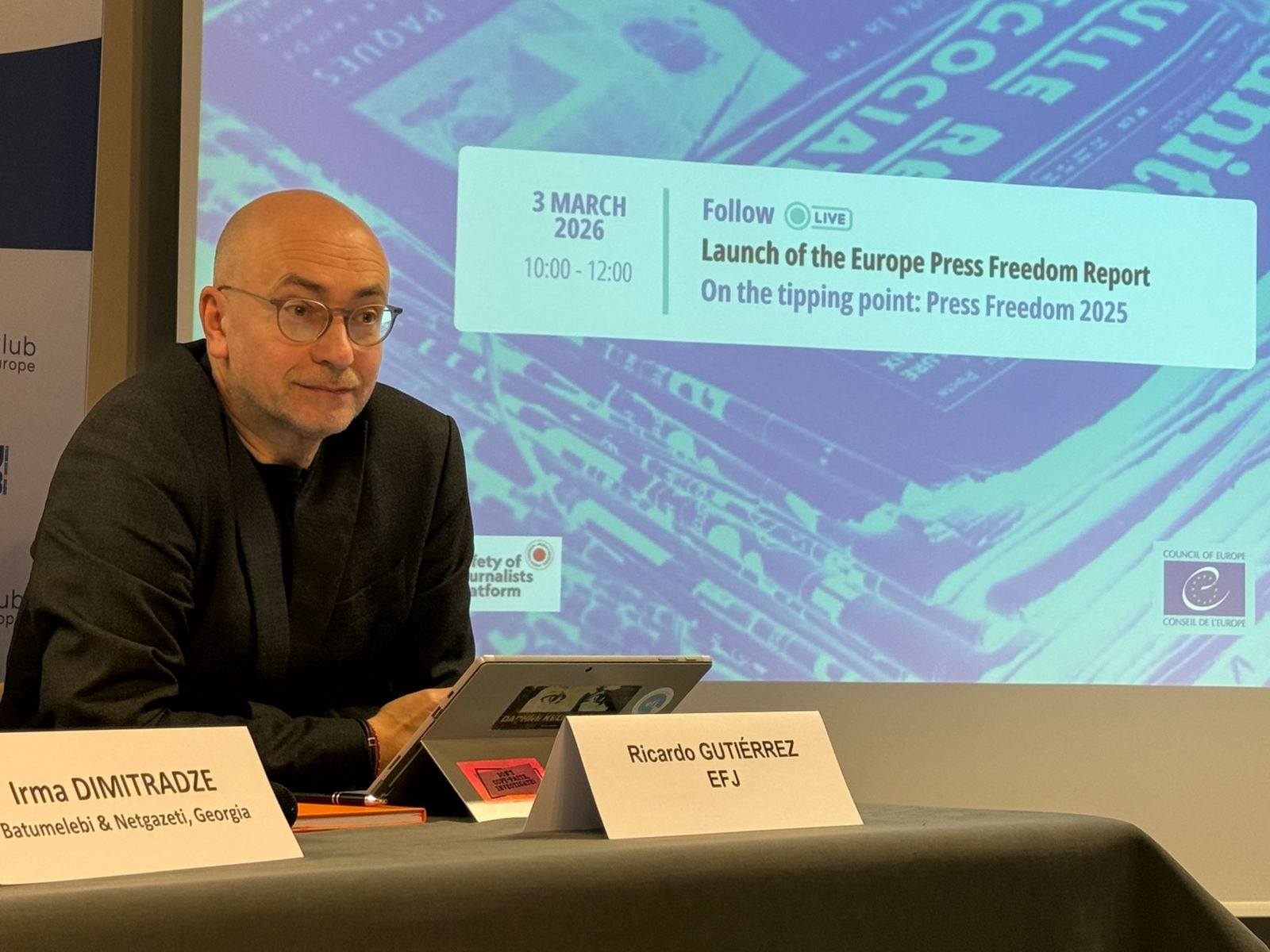
In comments provided to the National Union of Journalists of Ukraine, EFJ General Secretary Ricardo Gutiérrez said the expulsion reflects a clear line that cannot be crossed.
“This decision by the IFJ’s Sovereign Congress is entirely legitimate and justified: the international community of journalists cannot accept within its ranks organisations that place themselves at the service of an invader by opening branches in illegally annexed territories,” he said.
“This amounts to complicity in a flagrant violation of international law. Professional ethics require journalists not to act as agents of states, nor to place themselves at the service of an illegal occupying force.”
The expulsion follows sustained criticism of the RUJ over its activities in occupied Ukrainian territories, including the establishment of local structures — a key concern raised by Ukrainian media organisations since 2022.
Addressing concerns that the decision could deepen divisions within the global journalism community, Gutiérrez dismissed such risks.
“No, on the contrary: the international journalistic community has shown remarkable solidarity in condemning RUJ’s collusion with the invading state. The decision was taken without hesitation or question,” he said.
“It is reassuring to see such a show of solidarity from media professionals in the face of RUJ’s unacceptable behaviour.”
According to the EFJ, the outcome of the IFJ Congress demonstrates a broad consensus among journalist organisations worldwide.
“This united front strengthens the cohesion of the journalistic community and serves as a reminder of the ethical principles that underpin journalistic solidarity,” Gutiérrez added.
“The international journalistic community has emerged from this more united than ever.”
The EFJ also pointed to a longer history of problematic conduct by the RUJ within European structures. Gutiérrez said the Russian organisation had previously failed to meet its financial obligations.
“RUJ has also acted dishonestly towards the EFJ: in 2018, at the EFJ Congress in Lisbon, the RUJ delegation secured its voting rights in exchange for a promise to settle its debt of €11,560 to the EFJ as soon as possible,” he said.
“RUJ exercised its voting rights at the congress but never paid its debt. It never responded to our repeated requests. When one behaves in such a manner, one should not be surprised to be ostracised by the international community of journalists.”
The decision in Paris concluded a multi-year process that included the suspension of RUJ membership in 2023 and repeated calls for expulsion from Ukrainian journalist organisations. The National Union of Journalists of Ukraine first called for the move on 28 February 2022, citing the RUJ’s support for Russia’s aggression and its activities on occupied territories.















Discussion about this post