 THE NATIONAL UNION OF
JOURNALISTS OF UKRAINE
THE NATIONAL UNION OF
JOURNALISTS OF UKRAINE
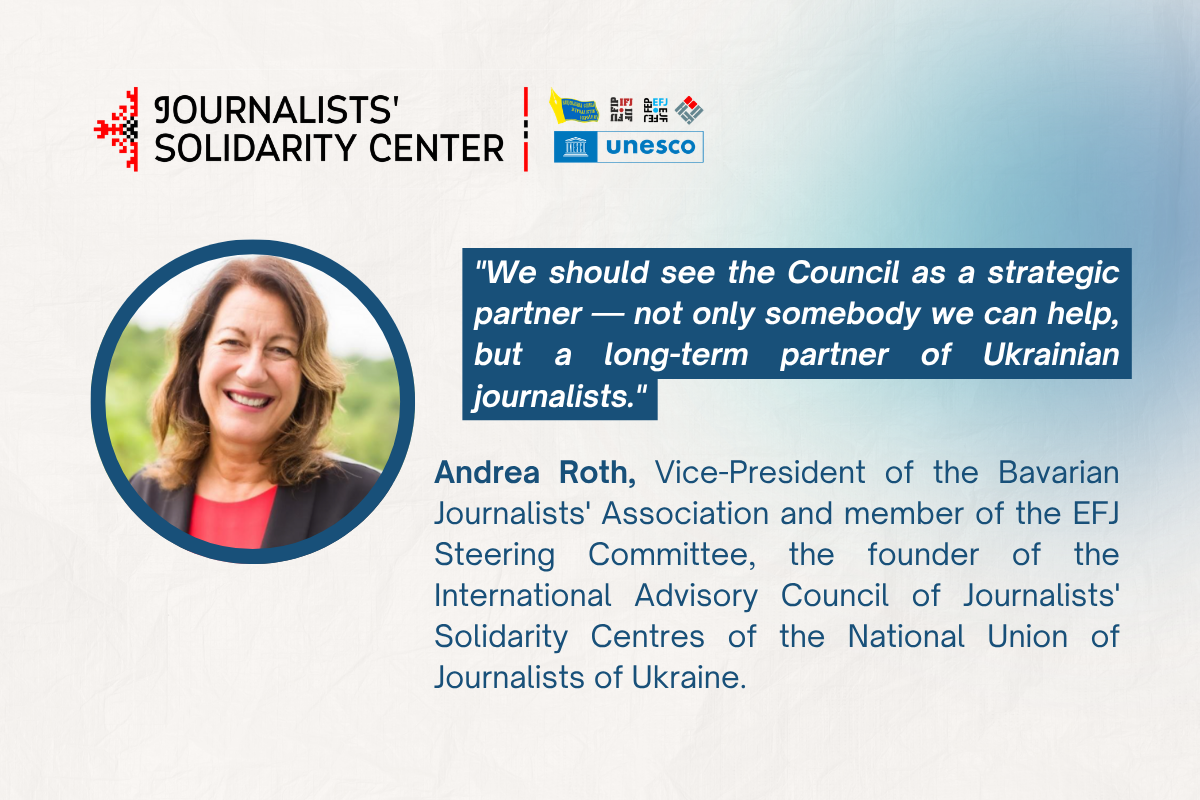
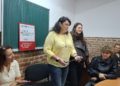
“I’m very good at building bridges” — that is how German journalist Andrea Roth, Vice-President of the Bavarian Journalists’ Association, describes her role. At the founding meeting of NUJU’s International Advisory Council of Journalists’ Solidarity Centres, of which she is now one of the founders, Roth proposed making the Council a bridge that brings the Ukrainian Centres partners, expertise and opportunities — from training and technology to legal and psychological support. This is the third article in a series about the Council’s founders — respected partners of NUJU and friends of Ukrainian journalists.
Roth proposes an ambitious definition of the Council’s role. “I would say we should see it as a strategic partner — not only as somebody we can help or support, but a partner, a long-term partner, helping the Solidarity Centre network strengthen what already works, identify where the greatest needs and opportunities are, and connect this experience of Ukrainian journalists with the wider European media community,” she said at the founding meeting of the Council, held on 24 August, Ukraine’s Independence Day. The model of the Centres, in her view, is unique because it addresses the whole chain of needs — from physical safety to professional continuity to legal and psychological support.
Roth framed her vision as complementing emergency assistance with support for long-term resilience. “When a journalist is injured, threatened or displaced, this immediate response is essential, but we should also ask what happens afterwards,” she noted. How a journalist returns to professional life, how a local newsroom continues when its office is broken or destroyed — these questions, Roth stressed, are especially important for local and frontline media. The Centres, she believes, could therefore go beyond emergency work to strengthen business continuity, digital security, professional networks and the ability of local media to keep serving their audiences.
She placed particular emphasis on the fact that the Centres not only deliver services but also generate knowledge. “I think we should turn Ukraine’s experience into European knowledge — every country’s knowledge,” Roth said. This concerns which safety measures work best, what new risks journalists face, and what European colleagues can learn from Ukraine — something, in her view, worth reflecting both in the Council’s closing statements and in exchanges with universities and journalism schools across Europe.
As an example, Roth pointed to the Bavaria-based Hanns Seidel Foundation, which has resources and experts in business models and journalist training. Such foundations could be approached through the Council, she explained, and the exchange would run both ways: “It’s not only that you help them — you get an exchange, you get models for how the Centres can work under extreme pressure, how journalists can survive.” Ukrainian colleagues, she added, could be invited to such foundations as speakers.
A third direction is broadening the network of international partnerships around the Journalists’ Solidarity Centres: media organisations, foundations, technology partners, journalism schools, professional associations. “It could mean funding, but also more than funding — equipment, technology, training, mentoring, legal and perhaps psychological expertise,” Roth added.
She describes herself as more of a connector. “I think the Council should be a kind of bridge, bringing partners, expertise, networks and opportunities to the Centres,” the journalist said, adding that she is good at building bridges and at persuading foundations and politicians to lend support. That is why Roth values her role on the Council above all as a chance to act: “To have not a title for its own sake, but grounds to get in contact with you, to ask for resources or exchange — that is what makes it really valuable to me.”
Like other members of the Council, Roth recalled Europe’s shared memory of war. “In Germany, the history of the Second World War was very present for many years — and still is. So I fully understand what you mean,” she said, addressing her colleagues.
The German journalist who has stood with NUJU for four years
Andrea Roth is a television journalist at the Bavarian public broadcaster (BR) and, since 2017, Deputy Chair of the Bavarian Journalists’ Association (BJV) — the largest regional group within the German Journalists’ Federation (DJV). Since 2021 she has chaired the DJV’s Europe Commission. In 2022 she was elected to the Steering Committee of the European Federation of Journalists, and re-elected for the 2025–2028 term. Within the EFJ, Roth co-chairs the labour-rights expert group together with the federation’s president, Maja Sever.
Support for Ukrainian colleagues is part of her long-standing work. Even before the full-scale invasion, Roth supported journalists from Ukraine and Belarus at the regional and national level, including by organising solidarity actions. Her contact with NUJU head Serhii Tomilenko goes back some four years: German colleagues raised donations through the German Journalists’ Federation and exchanged extensively with NUJU on the work of frontline media, while on psychological support they were in direct contact with NUJU First Secretary Lina Kushch.
This cooperation also has a public dimension. In November 2024, at the invitation of the Bavarian Journalists’ Association, Serhii Tomilenko came to Munich to tell German colleagues about the state of press freedom and the work of independent media in Ukraine. It was Andrea Roth who opened the evening at the PresseClub München: she introduced the guest and recalled the often life-threatening work of Ukrainian journalists.
Since June 2025, this connection has also acquired an institutional dimension: Andrea Roth and Serhii Tomilenko both sit on the Steering Committee of the European Federation of Journalists for the 2025–2028 term — that is, they are colleagues in the governing body of Europe’s main journalists’ federation.
NUJU officially presented the International Advisory Council of Journalists’ Solidarity Centres on 24 August 2026. The Council brings together international experts in press freedom, the safety of journalists, and media resilience and development. It works on a voluntary basis, holds no governing powers, and helps NUJU assess new threats, develop the JSC network, and connect the needs of Ukrainian newsrooms with international expertise and support.
The founding members of the Council are Randi S. Øgrey (Norway), Mogens Schmidt (Denmark), Ruth Kronenburg (the Netherlands), Tine Johansen (Denmark), Andrea Roth (Germany) and Anna Del Freo (Italy). Jennifer Moreau (Canada) has also been invited to take part.
The National Union of Journalists of Ukraine created the nationwide network of Journalists’ Solidarity Centres in April 2022 with the support of the International and European Federations of Journalists; UNESCO is a key partner of the network. NUJU now coordinates seven Centres — in Kyiv, Zaporizhzhia, Kharkiv, Dnipro, Sumy, Lviv and Ivano-Frankivsk. From the start of the network’s work to July 2026, the Centres processed more than 10,000 requests for help: protective equipment for temporary use, emergency payments, legal and psychological consultations, and support for regional media.








Discussion about this post