
 THE NATIONAL UNION OF
JOURNALISTS OF UKRAINE
THE NATIONAL UNION OF
JOURNALISTS OF UKRAINE
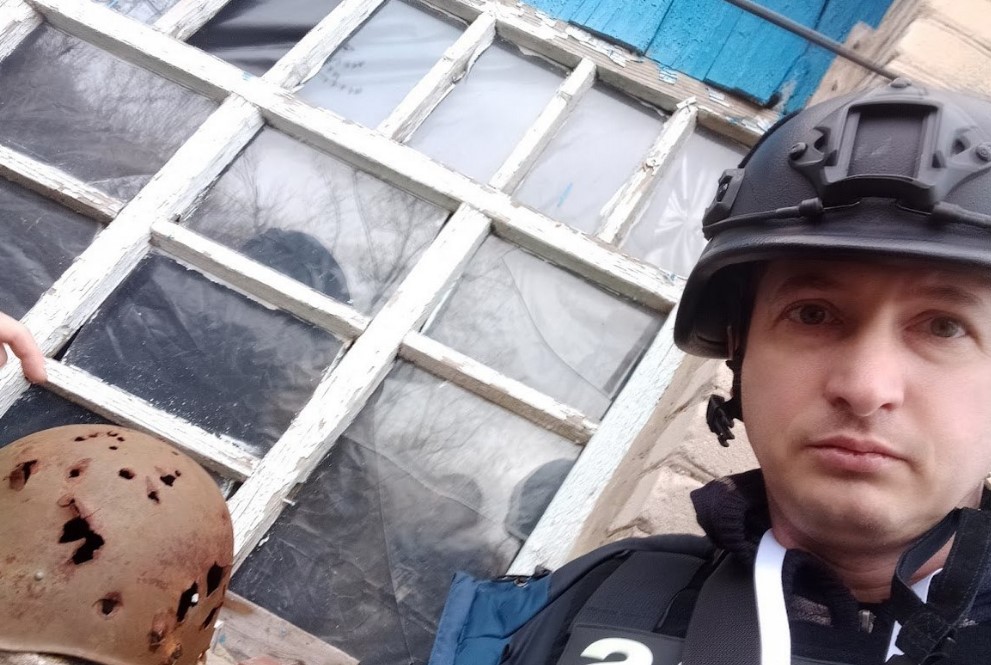
“I’ve heard it more than once: fixers go to dangerous areas not because of journalism. They are attracted by money. They make good money working with foreign journalists and have nothing to do with real journalism. So I decided to find out why some of our colleagues dislike fixers so much. I spoke to well-known Odesa fixer and local producer Artem Perfilov about money and the work of a fixer”.
Who is a fixer?
The simplest definition, Artem explains, is a person who helps foreign journalists work in a country they do not know. It is even better when a fixer has experience in the media. Then the fixer and the visiting journalist can speak not only English, but also the same professional language.
A fixer is needed in any country where something unusual happens. An earthquake hits Turkey, a tsunami strikes Japan, a huge festival takes place in Brazil and a foreign news crew needs someone who knows the area, understands the local rules and can find the right people.
In Ukraine, a fixer explains what documents journalists need, whom to contact, who can arrange access and how to get accreditation. They find people to interview, organise filming, contact local administrations and the military, translate, explain the local context and sometimes even drive the crew around in their own car.
They need to have a huge address book – almost like a thick old book – filled with contacts: mayors, military administrations, press officers, volunteers, doctors, local journalists and people at checkpoints.
Essentially, a fixer is a coordinator who does not stay in the newsroom but goes into the field with the news crew.
— Do all foreign journalists understand our mentality? Are there any stereotypes?
— Some arrive almost completely convinced that all Russian-speaking Ukrainians support Russia.
You have to explain that speaking Russian does not mean that a person supports the Russian state. A Russian-speaking Ukrainian may understand Ukrainian perfectly well, speak it and fight for their country.
Sometimes, Artem says, a visitor’s image of Ukraine can be reduced to three words: borscht, Klitschko and Shevchenko. And for them, Shevchenko is not the poet, but the footballer.
This does not always mean that a journalist is unprofessional. A journalist is not expected to know everything about a country they are visiting for the first time. Many foreign correspondents have already worked in other conflict zones and know very well how to behave in a war zone. But even experienced journalists arrive with a set of familiar clichés, and the fixer has to challenge them carefully and gently.
“Take us somewhere we can see the war”
One of the most common requests sounds something like this: “Take us somewhere we can see the war”.
But what exactly do people want to see?
Many imagine war the way it is shown in films: explosions, people wandering through ruins with dirt smeared across their faces and tears in their eyes, tough soldiers in trenches, constant gunfire and nonstop heroic action.
Films show a concentrated version of the most terrifying events, and viewers gradually start to think that this is what the whole war looks like.
Artem says: “In reality, even under shelling, people go to work, buy groceries, drink coffee, argue, laugh and try to live their lives. It was the same during the Second World War in London and Berlin. It is happening now in Odesa, Kharkiv and other Ukrainian cities”.
Foreign journalists sometimes ask to be taken “to the zero line.” But modern warfare no longer looks like the Second World War films.
A drone kill zone can stretch for 20 kilometres. In some places, there are no traditional trenches anymore. Instead, there are dugouts and shelters that soldiers have to reach on foot, carrying all their equipment. Getting to a position can take not a few hours, but several days.
No responsible soldier will want to take responsibility for a journalist who has come to Ukraine for three days and insists on seeing a real battle.
“There are very few completely clueless foreign journalists. Usually, we try to understand what picture the person has in their head and what they actually need. Then we look for a reasonable compromise”.
You can simply refuse, too. But then the journalist may find someone else who will agree to take them anywhere they want – perhaps someone who is less responsible.
To actually reach military positions, having a press card is not enough. You need to spend months living nearby, train with the unit and earn the soldiers’ trust. You need serious physical preparation and the ability to carry the same heavy equipment they do.
But most foreign journalists today come for a week, sometimes just three days. In that time, it would be good to at least have a proper conversation with the soldiers and produce an honest story.
So why don’t people like fixers?
I told Artem what I had heard from some journalists.
Fixers, they say, are people who make money from foreigners. They are not journalists, but some kind of military stalkers who serve wealthy visitors.
Artem is surprised by the very way the question is framed.
“It sounds as if making money is something to be ashamed of. Maybe that’s something left over from the Soviet mindset. Yes, a fixer gets paid for their work. So what? Should we judge them for that?”
There is another reason for the resentment.
At the beginning of the full-scale war, huge numbers of foreign journalists arrived in Ukraine, while there were not enough people who could work with them. Anyone who could put a few words together in English started calling themselves a fixer.
At the same time, many Ukrainian journalists were left out of this new market simply because they did not speak English.
Artem believes it is much harder to admit this to yourself than to accuse a colleague: “He’s not a journalist. He’s just making money from foreigners”.
“What stops you from learning the language and trying to work as a fixer? This is not a closed market. Go and try”, he says.
A translation app alone is not enough for this kind of work. A phone can help you order coffee or have a simple conversation. But a fixer has to translate full interviews, understand professional terms and keep track of the meaning. A translation mistake during wartime can lead to more than just a bad story.
There is another very Ukrainian problem, too. Artem says: “We want to be part of Europe, but sometimes we don’t even know how to receive payment in euros into a bank account. I had to explain to hotel accounting departments how a foreign newsroom could pay for a room from Europe”.
It is especially strange when people whose professional duty is communication do not speak English. A foreign journalist writes to a press office, but no one there can reply. They contact another organisation, and the same thing happens.
Where are they supposed to go?
They can hire a translator separately. Then find a coordinator. Then someone with a car. Then someone who can explain the local context and arrange filming.
Or they can hire one fixer.
That is why another, more precise name for the profession is local producer.
A local producer finds people to interview and locations, organises filming, makes arrangements, translates and sometimes conducts interviews themselves. If this is not media work, then we would also have to say that the job of a television producer is not media work.
Fixers do not come only from journalism. Some are camera operators, photographers, translators, drivers, IT specialists, sailors or former military personnel. They start with one useful skill and then expand what they can do.
Still, around half of all fixers come from journalism.
Don’t TCCs mobilise fixers too?
I had long wondered how young male fixers manage to pass through checkpoints so calmly.
Someone in military fatigues approaches the car and checks their documents. Could it be that a vest marked PRESSsomehow creates a protective shield around its wearer?
“There is no protective shield,” Artem replies. “Fixers are mobilised just like everyone else. Many of them are already serving in the military. Some have become good press officers, but that is a slightly different job”.
Some fixers have disabilities, are parents of three children or care for sick relatives — in other words, they have legal grounds for deferment. Some are wanted by the authorities and can no longer work. Others go to serve.
Fixers have no special protection from mobilisation. Relying on luck alone means playing Russian roulette.
What if the client turns out to be from Russia Today?
It happens.
At one meeting of fixers, people talked about clients whose backgrounds included work for Russia Today.
Artem says the problem is broader. Sometimes it is unclear how foreign and Ukrainian journalists receive accreditation from the Ministry of Defence. It can seem that, in some cases, a person has not even been checked against publicly available information.
At the same time, a line on someone’s CV saying they worked in Moscow does not prove anything by itself. Some foreign correspondents spent 15 or 20 years there and were later expelled by the Russian authorities themselves. They have no particular sympathy for Russia and work normally in Ukraine.
Each case has to be checked individually.
A real Russia Today employee is unlikely to introduce themselves to a fixer by saying: “Hello, I’m a Russian propagandist. Take me to the military”.
So anything is possible.
A profession that may disappear after the war
A wartime fixer, Artem admits, is a temporary profession.
The war will eventually end, the number of foreign correspondents will decrease, and today’s local producers will have to look for other work.
Artem himself is not particularly interested in returning to writing full-time, although he already works with the foreign press. He is more interested in organising work and doing something useful for Ukraine.
Foreign journalists will continue to come after the war. But this time, they will not be reporting mainly on destruction and the front line. They will be covering the country’s recovery. They will still need people who know the area, find people to interview, explain the local context and know how to make arrangements.
Perhaps a wartime fixer will become a reconstruction producer.
And, it seems to me, the dislike of fixers has a fairly simple explanation. They appeared unexpectedly. They work independently. They speak English. They communicate with some of the world’s biggest newsrooms and get paid for it.
That combination will always irritate those who have been left out.
But while people argue about whether a fixer should be considered a real journalist, the fixer gets into a car, checks their documents, body armour and first-aid kit, turns on the “Chuyka” drone detector and takes another news crew into the war zone.
Dmytro Bakaiev, journalist, NGO “Centre for Journalists’ Unity”
How NUJU supports fixers
The National Union of Journalists of Ukraine (NUJU) considers fixers full participants in the media process and provides several forms of support:
- Protective equipment and safety tools: through the Journalists’ Solidarity Centers network, fixers working in frontline areas or hotspots can borrow body armour, helmets, first-aid kits and UAV detectors free of charge to improve their personal safety.
- Training and professional workshops: NUJU organises workshops and training sessions in Dnipro, Kyiv and other regional centres. They cover safety protocols, working with foreign news crews, mental health, legal issues and journalistic ethics.
- Networking and rights protection: NUJU raises issues related to the safety, risks and accreditation of fixers and helps build dialogue between Ukrainian local producers and international media organisations.
Fixers can also become members of NUJU.
Under the NUJU Statute, membership is open to Ukrainian citizens and foreigners aged 18 and over who accept the NUJU Statute and the Code of Professional Journalistic Ethics and work professionally in journalism or a related media field.
Since the work of a fixer, or local producer, is directly connected with gathering information, organising filming, translation and preparing material for media outlets, it falls within the criteria of professional media work.
You can read more about how to join NUJU here.
NUJU Information Service









Discussion about this post