

 THE NATIONAL UNION OF
JOURNALISTS OF UKRAINE
THE NATIONAL UNION OF
JOURNALISTS OF UKRAINE

Russian attacks are destroying newsrooms, studios and equipment, leaving journalists without electricity and communications. Yet Ukrainian media professionals continue to work — often from backup premises, coworking spaces at Journalists’ Solidarity Centers, and with fully charged power banks and generators at hand.
For many regions, the summer of 2026 was yet another test of resilience. Now winter is approaching, and it could be significantly more challenging. The ability of Journalists’ Solidarity Centers to support journalists will depend not only on their own preparedness, but also on assistance from international partners and everyone willing to contribute to this effort.
The war continues to destroy newsrooms
The National Union of Journalists of Ukraine (NUJU) regularly monitors the impact of attacks on the media sector, documenting damage to newsrooms, studios, equipment and journalists’ homes. Throughout the summer — in June, July and August — a number of Ukrainian media outlets came under Russian attack.
In August alone, NUJU documented 10 cases in which attacks affected the media, with five Ukrainian media outlets directly impacted. July was even more difficult, with NUJU recording 18 verified cases involving the impact of Russian attacks on the media.
Here are just a few examples. On the night of July 6, a combined Russian attack destroyed the broadcasting studio of 5 Channel in Kyiv. The media outlet lost around 80% of its equipment and workstations, forcing it to temporarily suspend broadcasting. In Sumy, an airstrike involving five guided aerial bombs on July 17 damaged the studio and newsroom of Kordon.Media. The destruction forced journalists to change locations and relocate their operations.
Yet even when Russian missiles and aerial bombs destroy a newsroom’s physical space, journalists do not stop working. Newsrooms move to backup premises or switch to remote work. Television channels reorganize broadcasts from alternative locations and deploy mobile production facilities. Journalists in the Kharkiv, Sumy, Donetsk and Zaporizhzhia regions continue working directly in areas facing the constant threat of further attacks and guided aerial bombs.
This is work that cannot simply be put on hold. Even when a newsroom loses its premises, electricity or equipment, society still needs information — verified, timely and gathered on the ground.
That is why spaces capable of taking over or supporting newsroom operations in the most difficult circumstances are becoming increasingly important.

When a newsroom has no power, journalists still have somewhere to go
Journalists’ Solidarity Centers in different regions of Ukraine have become some of these vital support spaces. Their role was particularly important during the energy crisis, when journalists had to work through power outages and blackouts.
The coworking spaces operated by the Centers in Kyiv, Lviv, Ivano-Frankivsk, Zaporizhzhia, Dnipro and Kharkiv were equipped with high-capacity generators, charging equipment and batteries. Starlink terminals also became an important part of this infrastructure, helping maintain connectivity during disruptions to electricity supplies and mobile networks.
This support was made possible thanks to international partners, including UNESCO, the International Federation of Journalists and the European Federation of Journalists, among others.
When their own newsroom was dark and cold and there was no reliable connection — and conditions at home were no better — journalists could come to a Center, charge a laptop, camera, power bank or battery, edit a story, send material for publication or go live.
During prolonged blackouts, the coworking spaces effectively became informal “resilience hubs” for the media. For many journalists, they became a “second home” and the only accessible place where they could continue their professional work without interruption.
Support extended beyond the walls of the coworking spaces. The Centers provided journalists and frontline newsrooms with portable EcoFlow and Bluetti power stations, high-capacity power banks and mobile equipment kits for reporting and filming.
In Kharkiv alone, nearly 20 regional correspondents received power banks this summer. The equipment was purchased with support from NUJU.
“Power banks are now one of our ongoing needs. This summer, they helped us get through what were, fortunately, relatively short power outages. But they are also simply needed for everyday work — reporting trips, assignments and travel. It is one of those things you can never really have too many of,” says Anastasiia Pochernina, a journalist with the local media outlet Visti.
If many newsrooms were still able to balance normal operations with occasional disruptions during the summer, winter raises a much more serious question: will the available resources be enough if power outages once again become prolonged?
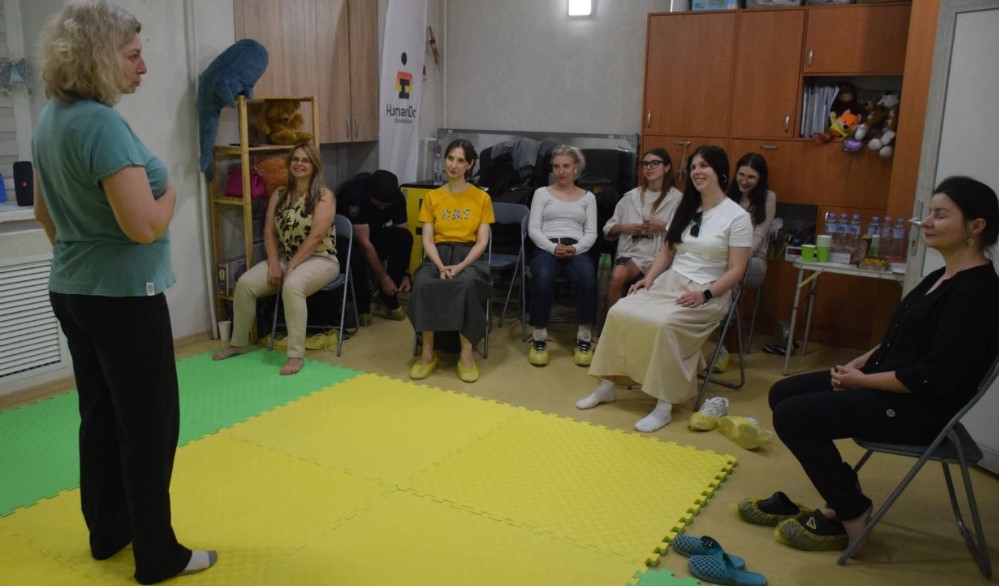
Winter could be tougher: Centers prepare for different scenarios
For Kharkiv, the summer of 2026 was relatively calm in terms of energy supplies. There were no prolonged blackouts, although Russian attacks caused local outages lasting several hours at a time. But the experience of the previous heating season showed how quickly the situation can change.
“On the eve of winter, every media outlet in frontline Kharkiv is once again assessing its ability to operate during power outages, communication disruptions and other consequences of Russian attacks. Previous winters have already given us a certain foundation for maintaining stable operations. At the same time, experience shows that this set of resources may not be enough every time, because both the security and energy situation can change,” says Hanna Chernenko, co-coordinator of the Kharkiv Journalists’ Solidarity Center.
The outlook is also difficult for Dnipro. The security situation in the region remains challenging, while Russia continues to strike energy and civilian infrastructure. The Dnipro Journalists’ Solidarity Center already understands that simply having a generator is not enough.
“According to preliminary forecasts, the coming winter will be very difficult. We already have experience of several wartime winters and understand that we need to prepare comprehensively for possible prolonged power outages,” says Natalia Nazarova, coordinator of the Dnipro Center.
The Center has a generator and a power station and can provide basic working conditions for media professionals during disruptions to the electricity supply. But there is a problem: if electricity and heating are both unavailable, staying in the office for an extended period becomes difficult.
That is why the Dnipro Center is preparing a flexible model that combines work at the Center with remote operations. At the same time, the Center’s physical space remains critical.
“The physical space of the Center remains essential. Journalists can work in the coworking space, we store and distribute protective equipment and other gear, and we hold meetings and training sessions here. For newsrooms from frontline communities, the Center can also serve as a backup workplace,” the Dnipro Center’s team says.
There is already a concrete example of this kind of support. A newsroom from Petropavlivka, where the security situation is deteriorating, moved its archived newspaper issues to the Center for temporary storage. If the newsroom is eventually forced to relocate, its journalists will be able to work from the Center without having to spend time finding new premises.
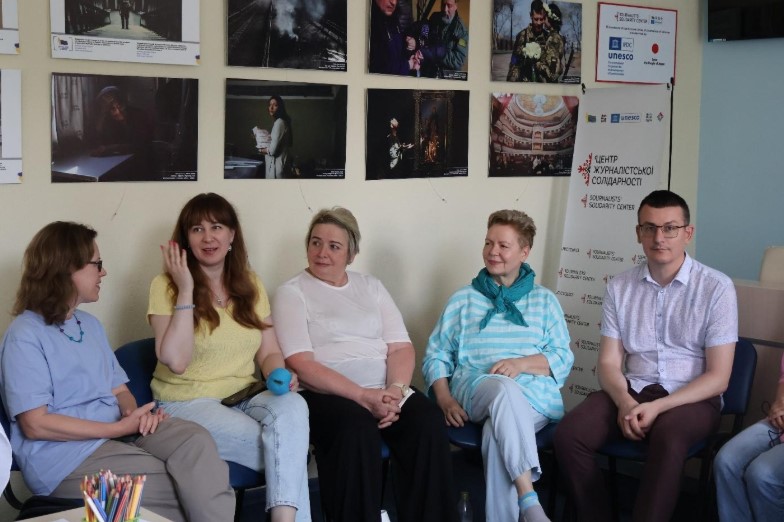
Preparing for winter takes more than a generator
Zaporizhzhia is also preparing for different scenarios.
The Journalists’ Solidarity Center rents space in a five-storey building that also houses other institutions. Under an agreement with the landlord, if grid power is unavailable, all organizations in the building will receive electricity from a high-capacity generator. If necessary, the Center can also connect its own generator.
“We have tested the generator and have a fuel reserve stored in a safe location. We also have wireless internet,” the Zaporizhzhia Center’s team says. Heating and water supply issues, should they arise, are expected to be addressed promptly with the landlord’s support.
But in Zaporizhzhia, the problem is not just electricity. The Center is located in the central part of the city, and the building is considered one of the enemy’s priority targets. This means that even a well-equipped office cannot be the only place from which the Center operates:
“We have therefore taken into account the possibility of moving the Center’s operations to other, safer locations in different parts of the city if there is a risk of shelling. At present, we have three such locations where the necessary safety measures are in place as far as current conditions allow.”
If necessary, coworking spaces can also be organized at these locations. The Center is prepared to operate more flexibly and to promptly inform journalists about available locations and working conditions. Everything needed to hold training sessions, press conferences and educational events online has also been prepared.
This means that the resilience of the media environment increasingly depends not on a single well-equipped office, but on the ability to move operations quickly to wherever it is safer.
The Zaporizhzhia Center also shared a practical tip for media professionals about equipment that can be useful during blackouts.
“Last year, through the Red Cross, we were able to provide the Center, journalists and some newsrooms with the multifunctional portable YOBOLIFE LM 3609 power station, which is lightweight and has a handle. There are more powerful models available now. But even this one can provide up to 25 hours of lighting through a high-output lamp and three additional lamps included in the kit. They can be hung from the ceiling or elsewhere. The station can also power a radio and charge two mobile phones. It can be recharged from the grid when electricity returns or via the solar panel included in the kit. Last year, this device was a major help. Different versions are now available on the market,” the Zaporizhzhia Center’s team emphasises.
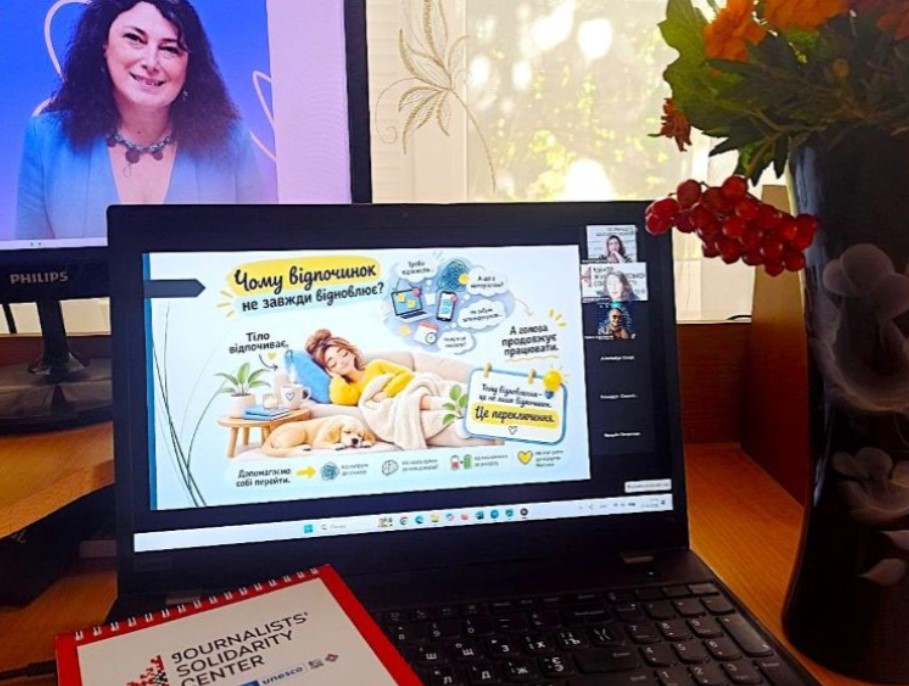
NUJU Centers need support too
Needs vary from region to region, but the underlying problem is the same: available resources may not be enough if winter brings prolonged power outages.
The Sumy Journalists’ Solidarity Center surveyed media outlets across the region to identify those without any backup power source.
“I surveyed media outlets in the region to find out who had no power source at all. Four or five newsrooms responded. All the others definitely have at least one power source. Some said they would welcome having another power station, because we do not know what the winter will bring, and the capacity of these stations is not unlimited,” says Volodymyr Sadivnychyi, coordinator of the joint Lviv–Sumy Journalists’ Solidarity Center office.
In Sumy, the Center sees an opportunity to create a network of local energy-resilience hubs.
“My vision is to secure three high-capacity power stations for the region and use them to equip resilience hubs in the three cities with the highest concentration of media outlets. These cities are also among those currently suffering the most: Sumy, Hlukhiv and Shostka. That would provide real support. But under the current circumstances, newsrooms will be grateful for any assistance,” Sadivnychyi says.
The situation is different in the Lviv region, but the need is similar.
The Lviv Journalists’ Solidarity Center remains an open space where journalists can work, hold meetings, connect with colleagues and receive psychological and professional support. The Center hosts training sessions focused on psychological recovery and maintaining mental resilience, as well as roundtables and public meetings. Students who are preparing to enter the journalism profession also take part in the Center’s activities.
However, small local newsrooms in the Lviv region are entering the new season facing serious challenges.
Some do not have generators or EcoFlow-type power stations. Large urban media outlets have access to premises with uninterrupted power supplies, while this option is often unavailable to smaller newsrooms in outlying communities.
“The main question for many newsrooms right now is what the winter will be like. Last year, power outages already had a significant impact on the work of media outlets in the Lviv region, so newsrooms understand what prolonged disruptions to the electricity supply could mean,” says Nataliia Voitovych, coordinator of the Lviv Journalists’ Solidarity Center.
In the Ivano-Frankivsk region, practical constraints may create an additional challenge.
“A few years ago, in preparation for blackouts, NUJU provided the Ivano-Frankivsk Journalists’ Solidarity Center with a generator. However, it is practically impossible to use because the generator has to be moved outside in order to start it. That is physically difficult for us — we have to carry it down several steps. So, for our Center, an EcoFlow power station is urgently needed to keep the coworking space operating during blackouts,” says Viktoriia Plakhta, coordinator of the Ivano-Frankivsk Journalists’ Solidarity Center. She notes, however, that the office has an autonomous heating system powered by electric batteries, meaning its operation ultimately depends on the availability of electricity.
The need, therefore, is not simply about getting through another blackout. It is about the longer term: technical equipment, financial support, professional training, psychological assistance, opportunities for development and the ability to adapt to changes in the media environment.
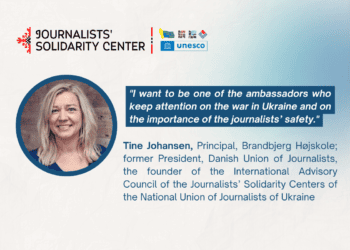
In this context, it is significant that on August 24, 2026, NUJU established an International Advisory Board for the Journalists’ Solidarity Centers. Read more about the International Advisory Board.
The board includes heads of media associations and journalists’ unions — including representatives from Norway, Germany, Denmark and Italy — as well as experts on press freedom and journalists’ safety. The board operates on a voluntary basis, with its members serving in their personal capacity.

Its responsibilities include analyzing current risks to reporters’ safety and the resilience of independent media during the war; providing expert recommendations on the strategic development of NUJU’s Journalists’ Solidarity Centers; and supporting international advocacy by connecting the real needs of Ukrainian newsrooms with international expertise and bringing accurate information about the situation to the global community. The next meeting of the International Advisory Board is currently being prepared.
“The establishment of the International Advisory Board is an important step in strengthening our cooperation with international partners who are helping Ukrainian media withstand the war. From the first days of the full-scale invasion, NUJU’s Journalists’ Solidarity Centers have served as vital support points for colleagues who found themselves in difficult circumstances, lost their jobs or work on the front line. By engaging international experts and partners, we will be able to make our support even more effective, systematic and tangible for every journalist and newsroom that needs it,” said NUJU President Sergiy Tomilenko.
Throughout the summer of 2026, a range of support measures for Ukrainian media professionals, including psychological support, were implemented with the backing of the Ukrainian Media Fund Nordic (UMFN), an international charitable initiative bringing together publishers and media businesses from the Nordic countries — Norway, Sweden, Finland and Denmark.
The fund was established to provide solidarity and systematic support to Ukrainian journalists and independent print and digital media outlets that continue operating during the full-scale war. Its partners include leading Nordic media associations, including the Swedish Media Publishers’ Association (Tidningsutgivarna, TU).
Cooperation between NUJU and Ukrainian Media Fund Nordic is multi-faceted and dates back to the first days of the full-scale invasion. In particular, 50 devices — from Cherkasy and the Sumy region to Zaporizhzhia and Kherson — have been distributed across Ukraine through NUJU’s project “Strengthening the Energy Independence of Ukrainian Media,” supported by the Ukrainian Media Fund. Read more about the energy support project.
Earlier, we reported that journalists’ safety had been identified as the top priority through the end of the year at an online meeting of the NUJU Secretariat held on September 10. Read more about NUJU’s priorities
Protecting journalists and preserving newsrooms, ensuring media professionals’ safety, defending freedom of expression, supporting regional NUJU organizations and strengthening the Union’s institutional resilience were among the priorities discussed at the meeting.
The network of Journalists’ Solidarity Centers is an initiative of the National Union of Journalists of Ukraine, implemented in cooperation with the International Federation of Journalists and the European Federation of Journalists, UNESCO and with the support of the people of Japan. The Centers’ main goal is to support media professionals working in Ukraine during the war. They operate in Kyiv, Kharkiv, Zaporizhzhia, Dnipro, Lviv and Ivano-Frankivsk.
The project is part of UNESCO’s broader efforts to support journalists’ safety and freedom of expression in Ukraine.
NUJU Information Service












Discussion about this post