
 THE NATIONAL UNION OF
JOURNALISTS OF UKRAINE
THE NATIONAL UNION OF
JOURNALISTS OF UKRAINE
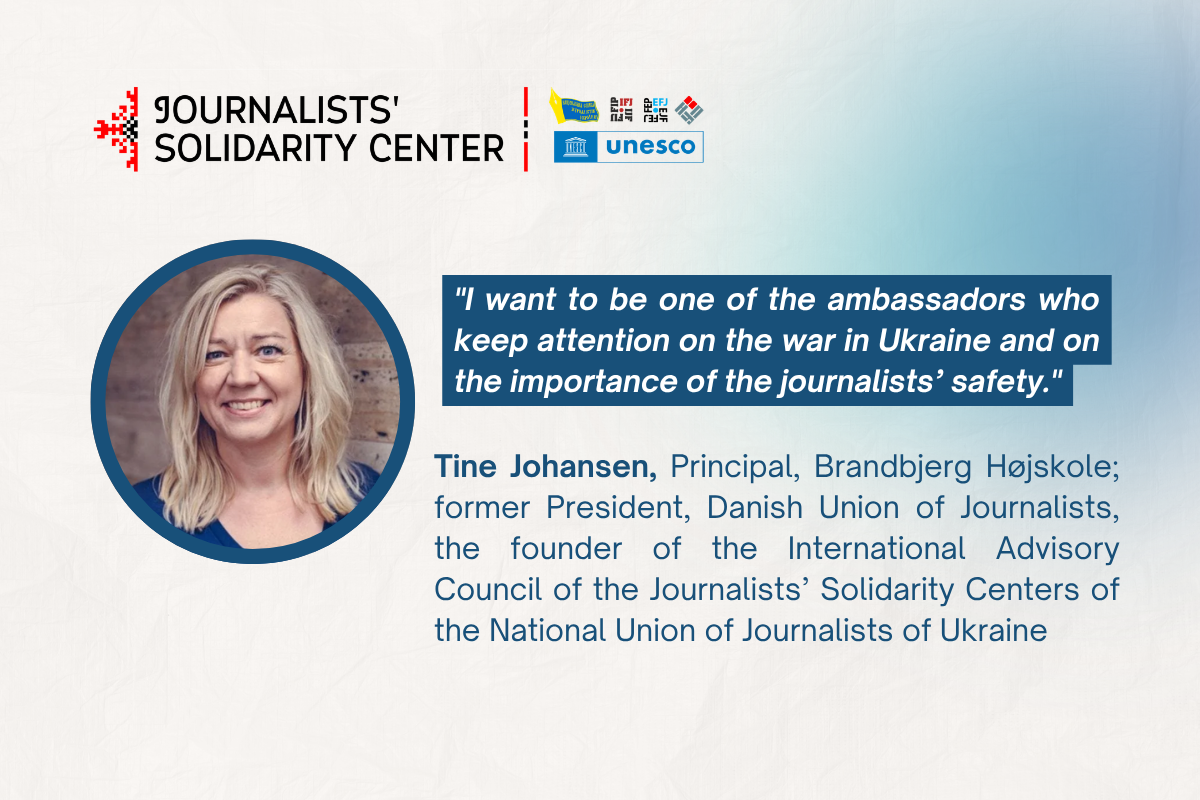
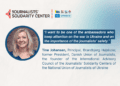
From 2019 to 2026 she headed the Danish Union of Journalists and worked closely with NUJU throughout those years; now Tine Johansen runs a Danish folk high school. But she is not stepping away from Ukraine — on the contrary, her greatest fear is that the world will grow tired of the war, and she wants to keep its attention on Ukraine. It was with this that Johansen joined NUJU’s International Advisory Council of Journalists’ Solidarity Centres, becoming one of its founders. This is the fifth article in a series about the Council’s founders — respected partners of NUJU and friends of Ukrainian journalists.
At the founding meeting of the Council, held on 24 August, Ukraine’s Independence Day, Johansen first thanked the frontline journalists who had spoken to the Council members — Hanna Chernenko from Kharkiv and Olha Zvonarova from Zaporizhzhia. “Thank you for reporting from the front line, because that’s why we are here. It’s all about hearing great journalists who, despite the war, keep doing their important work,” she said.
Johansen recalled that she is a trained journalist who led the Danish Union of Journalists for ten years. “In that role, I worked closely with NUJU throughout those years, including with the Journalists’ Solidarity Centres,” she said.
Today Johansen heads a Danish folk high school — an institution in the Nordic tradition, where students live for a semester without exams or grades, “to be formed as human beings and as participants in democracy.” Her school has a nature-and-ecology profile, with its own organic-farming operation.
She is also a board member of the Danish organisation Re:Cover Ukraine — a voluntary network that brings together Ukrainian and European journalists for practical support and cross-border cooperation.
Johansen sees her contribution to the Council in her organisational experience and her broad network in the Danish media business. But the role she called most important for herself was that of an ambassador for the Centres. “I’m afraid that at some point exhaustion and fatigue will set in. So I would like to be one of those ambassadors who keep the focus on what is happening in Ukraine and on the importance of the safety of journalists,” she said.
A Dane who has supported Ukrainian journalists for years
Tine Johansen is a Danish journalist. She trained at the Danish School of Journalism in Aarhus and worked at the newspaper Ekstra Bladet and the public broadcaster DR. In 2015 she became deputy chair of the Danish Union of Journalists (Dansk Journalistforbund), and from 2019 to 2026 she led the organisation, which represents around 18,000 media and communications professionals. Since June 2026 she has been principal of Brandbjerg folk high school.
Johansen linked her years at the head of the Danish union with support for Ukrainian colleagues: Danish journalists cooperated with NUJU and backed the network of Journalists’ Solidarity Centres. She continues this line as a board member of Re:Cover Ukraine — a network that, among other things, organises in-person seminars for journalists in Ukraine.
NUJU officially presented the International Advisory Council of Journalists’ Solidarity Centres on 24 August 2026. The Council brings together international experts in press freedom, the safety of journalists, and media resilience and development. It works on a voluntary basis, holds no governing powers, and helps NUJU assess new threats, develop the JSC network, and connect the needs of Ukrainian newsrooms with international expertise and support.
The founding members of the Council are Randi S. Øgrey (Norway), Mogens Schmidt (Denmark), Ruth Kronenburg (the Netherlands), Tine Johansen (Denmark), Andrea Roth (Germany) and Anna Del Freo (Italy). Jennifer Moreau (Canada) has also been invited to take part.
The National Union of Journalists of Ukraine created the nationwide network of Journalists’ Solidarity Centres in April 2022 with the support of the International and European Federations of Journalists; UNESCO is a key partner of the network. NUJU now coordinates seven Centres — in Kyiv, Zaporizhzhia, Kharkiv, Dnipro, Sumy, Lviv and Ivano-Frankivsk. From the start of the network’s work to July 2026, the Centres processed more than 10,000 requests for help: protective equipment for temporary use, emergency payments, legal and psychological consultations, and support for regional media.





Discussion about this post