

 THE NATIONAL UNION OF
JOURNALISTS OF UKRAINE
THE NATIONAL UNION OF
JOURNALISTS OF UKRAINE
The need for continued support for the National Union of Journalists of Ukraine (NUJU) network is discussed in a publication on the website of the National Union of Journalists (NUJ), the largest media union in the British Isles.
The author of the original material below is Tim Dawson, NUJ’s freelance journalist coordinator and former deputy secretary general of the International Federation of Journalists (IFJ).
Sergiy Tomilenko’s expertise spans emerging threats to the lives of journalists, as well as the communitarian benefits of traditional local newspapers. His vantage point as president of the National Union of Journalists of Ukraine (NUJU) gives him cause to expound on both.
“Drone warfare has totally reshaped the challenges of conflict reporting,” he says. “Journalists used to be at risk if they got within three kilometres of the front line. Drones, targeting journalists, have extended the ‘kill zone’ 20 kilometres further back.”
Part of NUJU’s response to this has been technological. Another component is rather more surprising. Tomilenko, 50, champions and facilitates local, printed newspapers of a kind that is disappearing from much of the rest of the world.
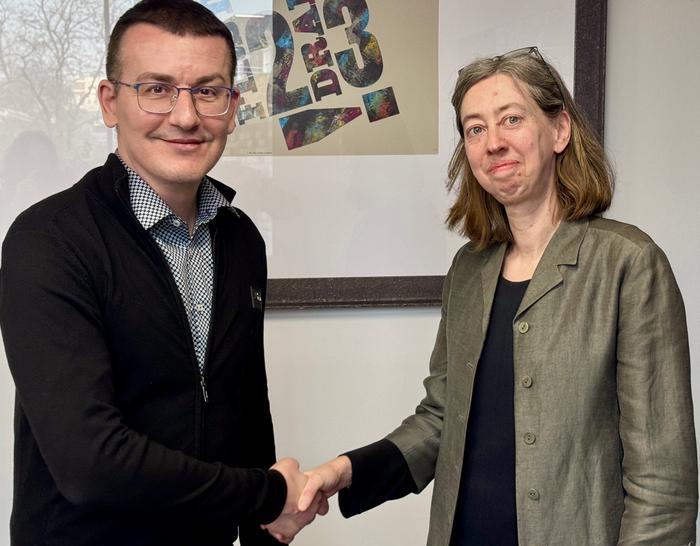
The Ukrainian trades union leader, whose organisation has around 3,000 members, was in London to update NUJ general secretary Laura Davison on the situation in his country, as well as to thank NUJ members for their support in sharing solidarity statements and donating to the International Federation of Journalists’ Safety Fund.
Tomilenko’s overall focus since Russia’s invasion of his country has been supporting reporters working under the most challenging circumstances. Seventeen journalists have been killed since the start of the war, 62 have been injured, 28 have been detained, and hundreds have been displaced. One, Viktoria Roshchyna, was captured by Russian forces, tortured and killed, before her body was returned nearly two years after her disappearance.
“We operate Journalists’ Solidarity Centres in six locations, concentrated where the threats are greatest,” he explains. “They provide somewhere to work for displaced journalists, as well as social space and equipment hire.”
Until recently, ‘equipment’ has mostly comprised protective vests and helmets, as well as Starlink internet access. The widespread deployment of first-person view (FPV) drones has created fresh demands, however.
FPV drones generally carry a kilogram of explosive and are guided by remote control from beyond the front line. So effectively have they been used to target journalists, the NUJU has recently removed the PRESS badges from protective vests, lest they make media workers easier to spot. A far more effective precaution come from hand-held devices that warn carriers of drones in their vicinity. “They give you around five minutes warning of drone attack, rather than a minute, if you are relying on spotting them in the air,” says Tomilenko. That can mean the difference between life and death, he says.
The drone detectors cost $500-$600, so supplies are limited. Reporters not attached to major western news platforms can borrow them from the Journalists’ Solidarity Centres. On 13 March the NUJU received the Media Freedom Award from the Voices Festival in Florence for the Solidarity Centres – an initiative that has also been adopted by fellow IFJ affiliate the Palestinian Journalists’ Syndicate (PJS) in Gaza.
This most sophisticated safety tool, however, is being pressed to slightly unusual ends – the production of printed local newspapers.
“Newspapers are vital to maintaining communities and keeping a sense of identity”, says Tominlenko. He argues that despite the importance of electronic media – Telegram channels are widely relied upon in Ukraine – real newspapers are far more trusted. “Only 40 per cent of people trust online news, compared to 80 per cent who have faith in content created by journalists and printed in an actual paper”.
Since the outset of the war, NUJU has supported a series of unconnected local papers, particularly aimed at communities in the frontline regions – some of which are now behind russian lines.
The papers supported by the union – but wholly independent – are mostly produced by teams of two to five journalists, who as well as gathering news will often lay them out, print them and distribute copies around their neighbourhoods. The prevalence of drones means that bicycles are increasingly used for news distribution as they are less often targets from the flying threat.
That the news is carried on actual newsprint is a response, among other things, to frequent power cuts. The last winter was the hardest of the war so far with the NUJU forced to close their office in Kyiv due to a lack of heating and water, and some households going 32 hours without energy. So frequent are these power cuts that Ukrainians are issued with a government app featuring a daily calendar of outages. The timings aren’t entirely accurate, but you can be certain that for part of each day, there will be no electricity says Tomilenko, who worked as a regional and news agency reporter before taking his union’s top job. At times like these, an old-school newspaper plugs the information gap more effectively than an app, he believes.
In an era when state propaganda can be so easily manufactured, newsprint enjoys a profound trust. Its weekly delivery provides a thread to towns and villages close to the frontline, holding parts of the country together when all other certainties have been destroyed. “These papers are not only a source of information, but a source of hope, of resilience – because people know they are not alone,” said Tomilenko.
For the moment, Tomilenko’s mission is to keep the plight of Ukrainian journalists on the agenda. “It is four years since russia’s full-scale invasion and there is a lot else going on in the world, I know,” he says.
He hopes to stage a major event in London later in the year, possibly at Westminster. Plans were also mooted for an event in conjunction with the NUJ. He is also grateful if NUJ members, chapels or branches can offer financial contributions to their efforts. Donations to the IFJ Safety Fund marked ‘Ukraine’ will go directly and without deduction to the NUJU.














Discussion about this post