 THE NATIONAL UNION OF
JOURNALISTS OF UKRAINE
THE NATIONAL UNION OF
JOURNALISTS OF UKRAINE
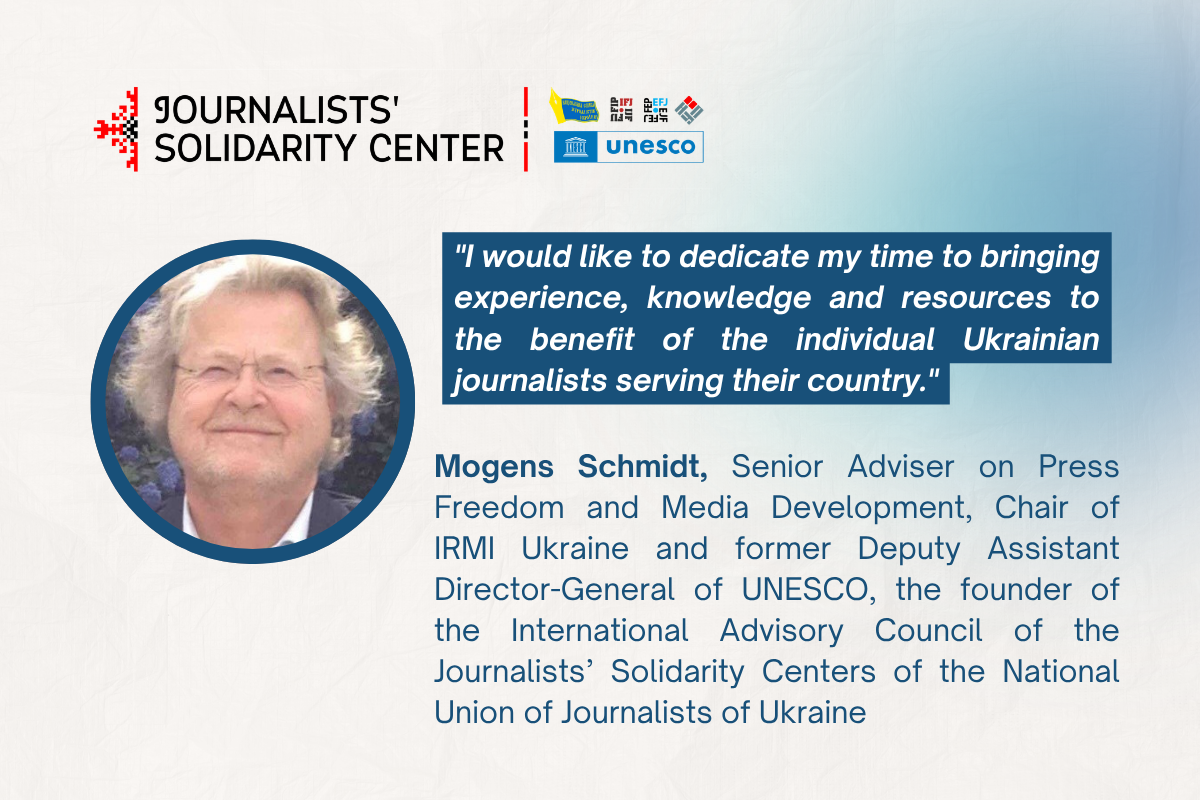
When Western organisations were flocking to Kyiv in the late 1990s to help Ukrainian media, the Dane Mogens Schmidt went instead to Kharkiv, to work with the local and regional press. Nearly thirty years have passed since then, and now he is among the founders of NUJU’s International Advisory Council of Journalists’ Solidarity Centres. This is the fourth article in a series about the Council’s founders — respected partners of NUJU and friends of Ukrainian journalists.
At the founding meeting of the Council, held on 24 August, Ukraine’s Independence Day, Schmidt recalled that he has been working with Ukrainian journalists since 1997, when he headed the European Journalism Centre in Maastricht (the Netherlands). Back then, he said, many Western organisations went to Kyiv, while he and his colleagues chose Kharkiv and work with local and regional media. He sees the Council’s main task as being useful to Ukrainian colleagues. “I think the main thing for us is to be at your service and to use the backgrounds, networks and advocacy channels we know of, so that we can raise knowledge, experience, equipment, funding — whatever is needed,” he said.
Drawing on his years at UNESCO, Schmidt proposed broadening the circle of the Centres’ partners. UNESCO, he noted, already supports the safety system for journalists in Ukraine, but by focusing on safety issues one could go beyond the traditional press-freedom organisations and build a closer dialogue with international humanitarian bodies. He named the International Red Cross and Red Crescent Movement, as well as the CDAC Network (Communicating with Disaster-Affected Communities) — an association of communication organisations working in conflict and war zones around the world. “With the focus on safety issues, we can go beyond the traditional press-freedom organisations,” Schmidt said.
Ukraine’s experience, in his view, matters far beyond the country’s borders. “What you are doing in Ukraine right now could even serve as a role model for similar organisations in other conflicts, other wars, more globally,” he observed, recalling that the network of Centres has already inspired Palestinian journalists. Unfortunately, Schmidt added, there are many places in the world where such experience would be relevant.
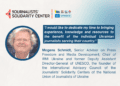
He defined his own role on the Council in concrete terms. “I would like to dedicate my time to helping bring experience, knowledge, networks and, hopefully, funding to the benefit of the individual Ukrainian journalists serving their country,” Schmidt said.
At the end of the meeting he recalled that he is in Ukraine regularly, and said that in October he would again come to Kyiv for the Donbas Media Forum.
Nearly thirty years with Ukrainian media
Mogens Schmidt is a Danish specialist in freedom of expression, media development and journalism education. For more than ten years he worked at UNESCO as Director of the Division for Freedom of Expression, Democracy and Peace, and also held the posts of Deputy Assistant Director-General for Communication and Information, Director of Global Field Operations, and head of the unit for emergency and disaster assistance. Over the past 25 years, Schmidt has held senior positions at the World Association of Newspapers, the European Journalism Centre and the Danish School of Media and Journalism. Today he advises foundations, civil-society organisations and government bodies on international media-development and journalist-safety programmes.
His ties to Ukraine go back many years. As early as the late 1990s, Schmidt joined efforts to support Ukrainian media after independence, focusing on the regional press of the country’s east and north. Today he chairs the board of the International Institute for Regional Media and Information (IRMI) — an organisation based in Kharkiv that has been training Ukrainian journalists for more than two decades and is a long-standing partner of NUJU. Schmidt travels to Ukraine in person on a regular basis.
That is why he sees the Council as a continuation of work he has been doing for decades. “I am very happy to continue supporting journalism and journalists in Ukraine — now through this advisory council,” he said at the meeting.
NUJU officially presented the International Advisory Council of Journalists’ Solidarity Centres on 24 August 2026. The Council brings together international experts in press freedom, the safety of journalists, and media resilience and development. It works on a voluntary basis, holds no governing powers, and helps NUJU assess new threats, develop the JSC network, and connect the needs of Ukrainian newsrooms with international expertise and support.
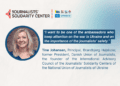
The founding members of the Council are Randi S. Øgrey (Norway), Mogens Schmidt (Denmark), Ruth Kronenburg (the Netherlands), Tine Johansen (Denmark), Andrea Roth (Germany) and Anna Del Freo (Italy). Jennifer Moreau (Canada) has also been invited to take part.
The National Union of Journalists of Ukraine created the nationwide network of Journalists’ Solidarity Centres in April 2022 with the support of the International and European Federations of Journalists; UNESCO is a key partner of the network. NUJU now coordinates seven Centres — in Kyiv, Zaporizhzhia, Kharkiv, Dnipro, Sumy, Lviv and Ivano-Frankivsk. From the start of the network’s work to July 2026, the Centres processed more than 10,000 requests for help: protective equipment for temporary use, emergency payments, legal and psychological consultations, and support for regional media.




Discussion about this post