 THE NATIONAL UNION OF
JOURNALISTS OF UKRAINE
THE NATIONAL UNION OF
JOURNALISTS OF UKRAINE
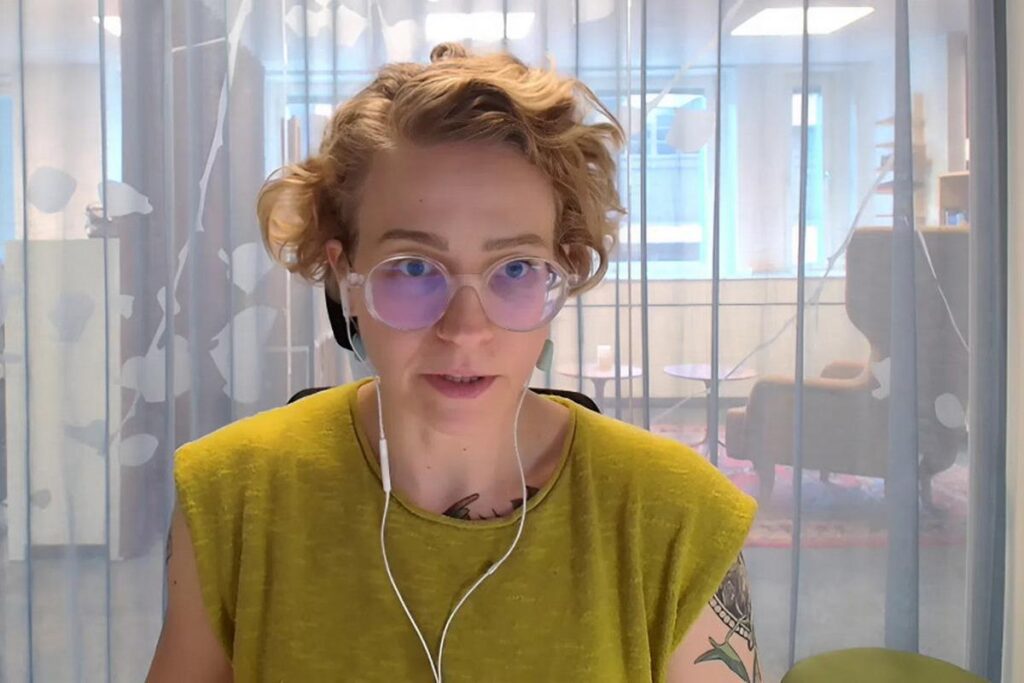
The first in the series of joint webinars of the National union of Journalists of Ukraine (NUJU) and the Swedish union of Journalists (SJF) was a speech by the international secretary of the Swedish organization, Victoria da Silva.
She told how one of the oldest journalist unions in Europe works – from the structure and membership fees to collective agreements, protection of freelancers and discussions on the digital press card.
The NUJU information service has collected the most important things from her presentation, which opened up the “kitchen” of Swedish experience for the Ukrainian media community.
An old organization that is losing members…
but for reasons independent of the union
The SJF (Svenska Journalistförbundet) was founded in 1901. This September, it turns 125, and colleagues plan to celebrate it. Almost everything has changed in more than a century: when the union was first formed, Sweden was a poor country, and today it is one of the richest countries in the world. The essence has remained unchanged – the fight for journalists’ rights.
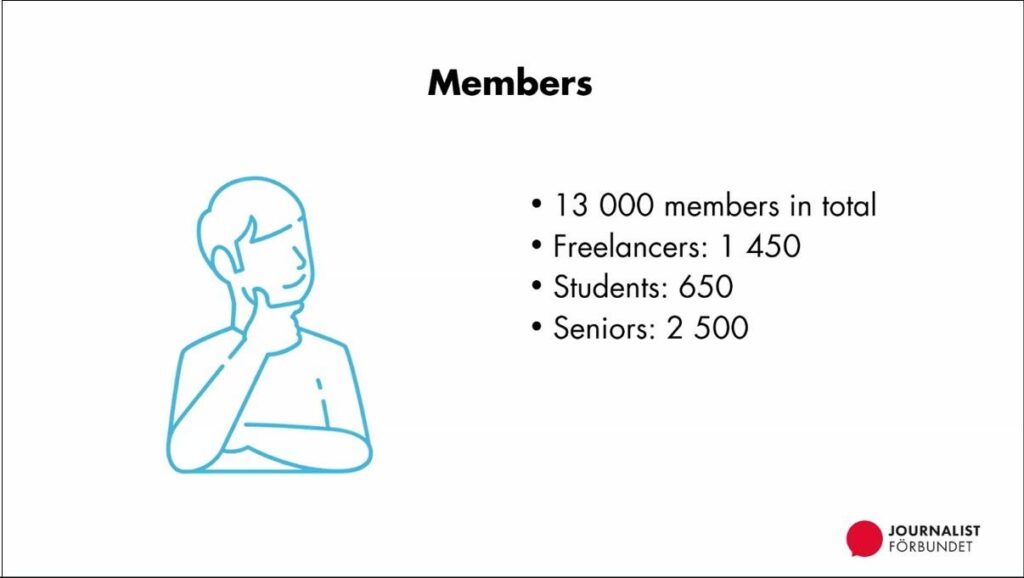
Today, the organization unites about 13,000 members. This is less than before: in the last fifteen years alone, the SJF has lost about 5,000 people. But, as Victoria da Silva emphasized, the reason is not disappointment in the membership.
“People are leaving not because they don’t like us. It’s just that there are fewer and fewer opportunities to work as a journalist in Sweden, so many of our colleagues are changing professions,” she explained.
Staff reductions in newsrooms continue, and the union does not expect a quick recovery in the labor market. But despite this, the organization remains influential and strives to be modern.
An important feature of the SJF is that it combines two natures at the same time. On the one hand, it is a trade union that conducts collective negotiations, advocates for decent working conditions and wages, and supports members in conflicts with employers. On the other hand, it is an association that protects freedom of speech, shapes public opinion, and lobbies the interests of the profession.
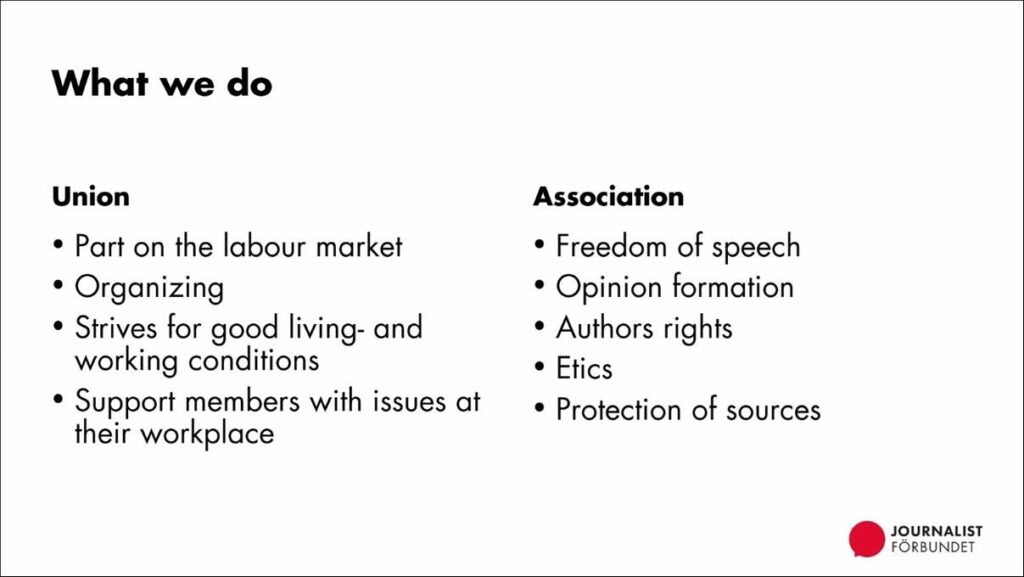
It is to the associative part of the union that the government turns when it needs the position of the journalistic community on important initiatives or investigations. In its charter, the organization has enshrined two idealistic priorities: preserving freedom of expression and freedom of the press, as well as openness of society and media diversity.
“We ensure the rights of journalists and authors, professional ethics, and journalistic integrity. We may not talk about it every day, but this is what we are actually working on all the time,” Victoria da Silva noted.
A separate and increasingly important area is copyright. A special lawyer works in the union on issues related to it, and in fact two more lawyers are increasingly involved in this topic. The reason is the rapid development of artificial intelligence, which is changing the rules of the game for the entire creative sphere. Ethics remains no less fundamental for the Swedes: in fact, the union was once created due to the need to formulate rules for journalists. This also includes the protection of sources of information.
Who can become a member and how much does it cost
Membership in the SJF is available to those who work as journalists for any Swedish media outlet or in a newsroom operating in Sweden. These are not necessarily reporters: photographers, researchers, as well as audiovisual translators working for television are also part of the union. There is also a separate associate membership for journalists who have recently arrived in Sweden – among them are Ukrainians.
It used to be much more difficult to join as you had to prove that you were really a journalist and had worked for at least two years. Due to the decline in the industry, the rules were simplified. Now, when joining, it is enough to indicate the place of work, and the union selectively checks it. The main criterion is paid professional activity; “citizen journalism” does not give membership without a fee.
Contributions to the SJF depend on income: those who earn less pay less, those who earn more pay more. The lowest contribution is about SEK 250 (approximately EUR 25) per month, the highest is about twice as much. A separate and additional contribution to the unemployment fund is paid, which is often confused with the membership fee. The union is often criticized for being expensive, but, according to Victoria da Silva, compared to some unions, it is more expensive, and compared to others, it is cheaper, and in fact it is a kind of insurance in case help is really needed.
It is worth adding that the SJF is the only journalistic union in Sweden. This is a Nordic tradition: one union per profession. It is partly competed with by a large general union with almost 900,000 members, but it does not have collective agreements specifically for journalists.
The structure of the union: from the congress to local branches
The highest decision-making body is the congress. It meets once every 3 years and 9 months (previously once every 3.5 years; the interval was changed so that the meetings would not overlap with the cycle of collective bargaining).
A total of 91 delegates, mostly elected in branches and sections, come to the congress and consider dozens of motivations and proposals from members – from ethical issues to the problems of freelancers. It is the congress that elects the National Council. The next congress will be held in 2028; the previous one, last year, was attended by NUJU President Sergiy Tomilenko.
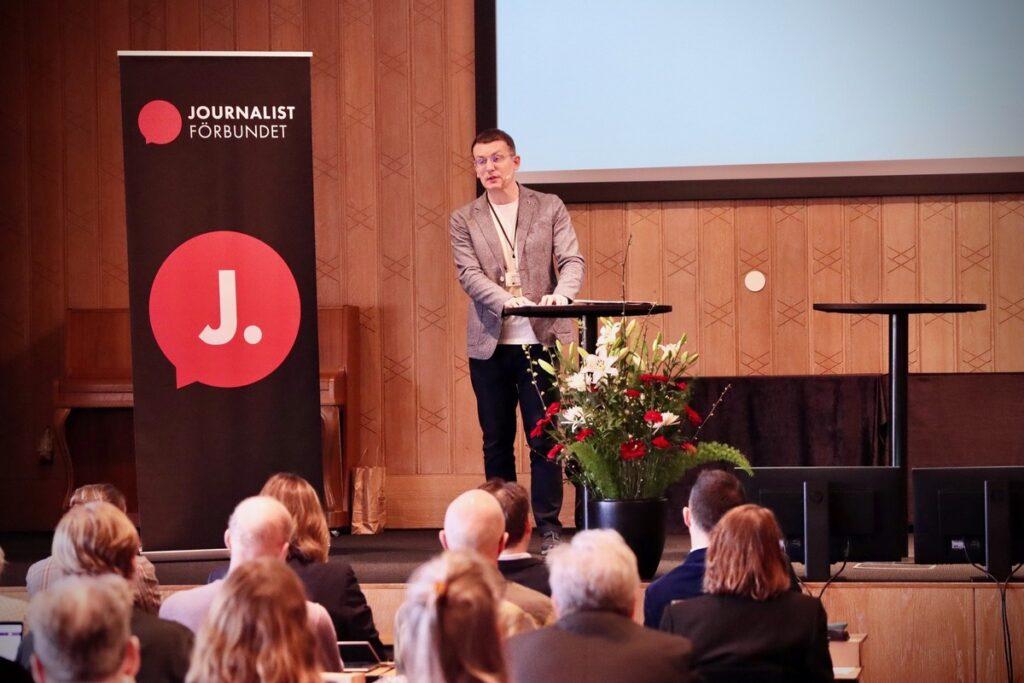
The National Council makes all key decisions between congresses and has a broad mandate for this. The union is headed by President Ulrika Hyllert. The Council meets approximately six times a year, and much more often during the years of collective agreements. An interesting detail that the speaker drew attention to: women noticeably predominate in the leadership, and there is a lack of young people – the youngest member of the council is about 30 years old.
The union’s daily work is carried out by the apparatus of 27 employees (two of them part-time). Among them are seven negotiators, a separate lawyer specializing in labor law, as well as specialists who take care of “author’s” funds, grants and scholarships. Many of the staff are former journalists.
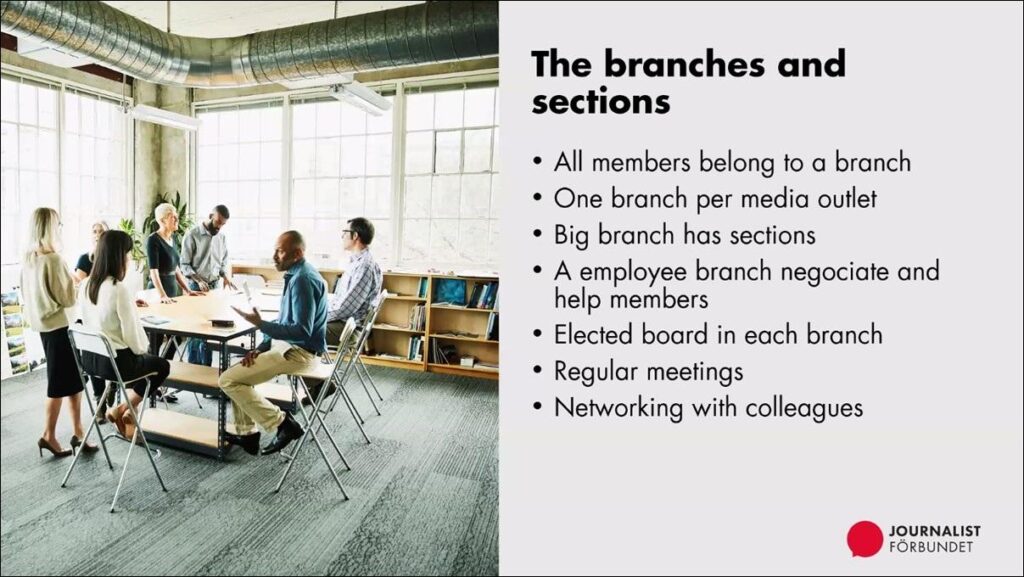
All members belong to branches, and large branches are divided into sections. The principle is simple: one branch per media outlet. To form a branch, at least three members are required in the newsroom. The largest branches – such as public television, which has about a thousand members – operate through regional sections. The organization feels confident in the workplace: in large newsrooms, 80–90% of employees are members of the union. But with freelancers it is more difficult – they are harder to attract, and the model of their organization, as the SJF admits, needs to be revised.
‘Swedish model’: contracts instead of laws
A separate section of Victoria da Silva’s speech was devoted to the ‘Swedish model’ – the foundations of the entire system of labor relations in the country. Its essence is that working conditions are regulated not so much by laws, but by collective agreements between trade unions and employers’ organizations.
There is no statutory minimum wage in Sweden – and the unions are deliberately against its introduction, because they want to negotiate their own pay. The law only stipulates basic things like vacation; the rest is in collective agreements. The agreement is not mandatory by default, but the union has the right to go on strike to achieve it.
This model was born from a tragedy. The speaker recalled the dramatic events of the early 1930s, when, against the backdrop of the Great Depression and mass unemployment, employers put pressure on workers, and they went on strike. This is the shooting in Ådalen on May 14, 1931: then, during a peaceful demonstration, the military, called to help the police, opened fire and shot five people. This event shook the country and made the state, employers and unions realize: this cannot go on like this, we must come to an agreement with each other. A few years later, in 1938, the Saltsjöbaden Agreement was signed, which laid the foundation for the Swedish model, and the country itself became a bastion of social democracy for decades.
What this model means today is well illustrated by the famous conflict around Tesla and Elon Musk, which Victoria da Silva mentioned. The company refuses to conclude a collective agreement – and the trade union strike against it has been going on for almost three years. The case is considered resonant precisely because almost all large companies in Sweden have such agreements, and thanks to this the system works.
How a union really protects employees
For full-time journalists, the foundation of everything is an employment contract. Contracts are concluded for one, two or three years, depending on the agreements with the employers’ organization.
The biggest pain is short-term contracts. According to the law and the collective agreement, a journalist can be kept on a temporary contract for up to 11 months, after which the employer is obliged to issue a permanent contract. Many companies avoid such obligations by keeping young journalists on a chain of short-term contracts. For beginners, this means uncertainty about the future, and for some it pushes them out of the profession altogether. The union is actively campaigning against this practice – and employers are unhappy with it.
Swedish colleagues have also fought against staffing companies that “loan” employees to newsrooms for lower wages. Thanks to their hard work, such intermediaries are becoming fewer and fewer.
When a problem arises in the workplace – dismissal, reorganization, conflict – the employer is legally obliged to negotiate with the union, and not only about salaries, but also about any significant changes. The first to enter into negotiations are local branches that know their newsroom best; if the situation becomes complicated, the union apparatus comes to the rescue. A prime example is the large-scale layoffs at Swedish Television, where the office actively assisted the local branch, sometimes directly participating in the negotiations.
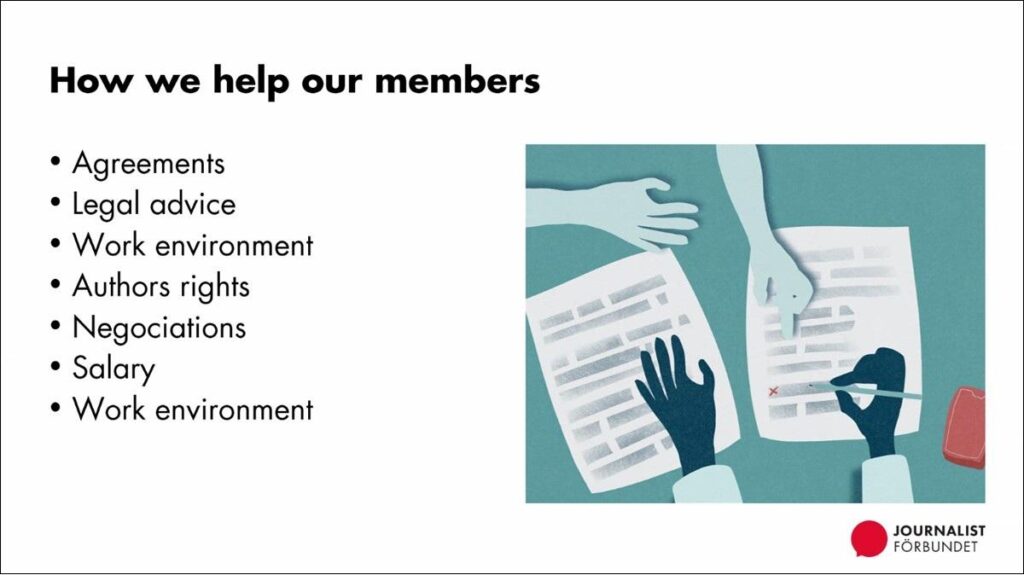
A separate major topic is work environment. This is handled by a separate specialist, as gender and diversity issues also fall into this area in Sweden. The union also provides legal advice, conducts salary surveys and checks whether the level of pay meets the agreements.
An interesting nuance of Swedish law: union work can be carried out during working hours with payment from the employer. In large newsrooms, such as public television, the head of the local branch can devote himself entirely to trade union activities – and this is paid for by the employer.
But Swedes rarely go to the labor court. The country has a separate court for labor disputes, but SJF has not applied there for more than ten years: the vast majority of cases are settled at the local or central level, seeking a solution with the employer, because litigation is expensive for both parties.
Particular attention – freelancers
Freelancers – about 1,450 people, and their number, unfortunately, is also decreasing (it used to be about 1,800). Many are finding it increasingly difficult to survive on journalism alone, so they work part-time in communications. There is no collective agreement for the self-employed – formally, these are “business-to-business” relationships. The union has secured a separate framework agreement (Frilansavtalet) and is now working to ensure that specific rates appear in such agreements, as rates for freelancers are crucial.
To support those who work for themselves, the SJF has created a whole set of tools:
- A freelance calculator that shows how much you should charge for work, taking into account taxes, VAT, social security contributions, insurance and even the pension that the freelancer must provide for himself.
- Recommended rates, which the National Council revises every year following the collective agreement for full-time employees.
- A rate database where freelancers can enter their fees from different newsrooms and share this information with colleagues. It is more often used by beginners; more experienced ones rely on their own contacts. Even if the database does not work perfectly, it has become a valuable historical document – and shows that rates have been falling rather than rising in recent years.
- Standard contracts, legal advice and insurance at a favorable price, designed specifically for freelance journalists.
- Training and seminars – from running your own business to taxation.
“Sometimes it seems to us that we do not do enough for freelancers. But when I see how colleagues from other European countries deal with this, I understand that we have come a long way,” shared Victoria da Silva, recalling that freelancers have been part of the union for 55 years.
No less important for them is the simple opportunity to communicate: many freelancers work from home and see few people, so live and online meetings become real value.
Students, Youth and Pensioners
Students are a special pride and challenge at the same time. There are about 650 of them in the union, and a separate employee works on their involvement. Why do young people join? One of the important incentives is the norm of the collective agreement: a student journalist who goes to the newsroom for an internship receives half of the salary stipulated in the contract, but only if he is a member of the union. The union does not conduct full-fledged negotiations with students, but it helps as much as possible – for example, with summer work or substitution.
There are also about 2,500 pensioners in the SJF – former journalists, some of whom remain very active. They have their own branch with regional branches throughout the country and maintain a keen interest in the profession.
Besides, the union is experimenting with formats for media managers: last year they launched something like a “branch by interests” for those who hold managerial positions and are not part of the usual local branches. Separate webinars are held for them – after all, the manager within the newsroom has a special role that must be combined with the journalistic one.
Press documents: a number against plastic
When joining, each member signs 13 ethical rules for journalists. Violations can theoretically cost membership, but in practice the union has not expelled anyone. Because of this, Victoria da Silva admitted, the ethics commission system is not working very effectively, and it is currently being reviewed.
At the same time, Sweden has a broader system in place – a media ombudsman, common to all media outlets, regardless of union membership. So, there are actually two levels: the union’s internal ethical system and the general media one. There are a lot of complaints from the public, but the union only processes those that concern its members.
A separate webinar will be devoted to the topic of ethics and self-regulation. As with the issue of artificial intelligence: the SJF already has basic guidelines for working with AI, which are constantly updated, and on a number of issues the union cooperates with creative organizations, in particular with the Writers’ union.
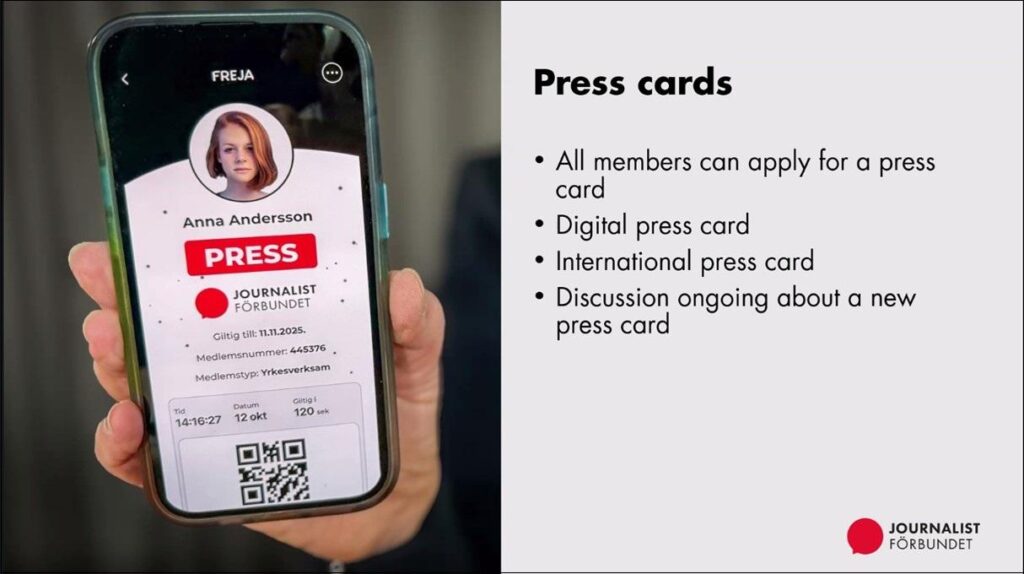
Press documents have unexpectedly sparked a heated debate within the Swedish union. All members can apply for a press card, but today the national card only exists in digital form, and only the international card remains physical. This has led to criticism: despite Sweden’s high level of digitalization, many journalists want a plastic card. The arguments are clear: a digital card can fail where there is no connection; you don’t always want to hand over your phone to show a document; and some government institutions don’t allow people with a digital press card. In addition, as Victoria da Silva figuratively noted, you can keep the physical card and show it to your grandchildren, while the digital one will disappear the day you stop being a journalist. The union is considering whether to return the physical card or not to make it “your” international one – for example, by adding your own logo to it.
* * *
The first webinar was more of an overview – a kind of acquaintance with the general structure of the Swedish system. A series of deeper meetings awaits Ukrainian journalists ahead: about collective agreements and the ‘Swedish model’, working with freelancers, involving young people, journalistic ethics, artificial intelligence, as well as about the media system in Sweden and the policy of their state support.
“Today is just the beginning. This is also a kind of test of how everything will work,” Victoria da Silva concluded, inviting Ukrainian colleagues to ask questions in the future.
The partnership of the NUJU with Swedish colleagues has been ongoing since the first days of full-scale aggression. It was the Swedish colleagues who were among the first to systematically support Ukrainian media after the start of the russian invasion: among the first aid that NUJU received in the spring of 2022 were bulletproof vests from the Bonnier News publishing house, the Gazeta Wyborcza Foundation, and Swedish friends.
Over time, this support grew into broader initiatives. In 2022, the Ukrainian Media Fund was established, uniting media companies and media associations from the Nordic countries – Sweden, Norway, Denmark, and Finland. Together with the Swedish Media Publishers Association (Tidningsutgivarna, TU), NUJU is implementing the Frontline Press program, which helps 25 front-line newspapers in Ukraine continue their work during the war.
A separate area of cooperation is supporting the network of NUJU’s Journalists’ Solidarity Centers (JSC), which since April 2022 have been providing journalists in front-line regions with emergency assistance, protective equipment, and safe workplaces. The SJF has joined the emergency aid to Ukrainian media workers with its donations after the invasion.
The ties between the two organizations are also strengthening at the leadership level. In March 2025, NUJU President Sergiy Tomilenko attended the congress of the SJF in Saltsjöbaden near Stockholm as a guest, where immediately after the opening of the meeting, SJF President Ulrika Hyllert launched a special session of solidarity with Ukrainian journalists. As a token of gratitude for the support, Sergiy Tomilenko presented the SJF with a special NUJU award. During the same visit, a presentation of the work of the Ukrainian union was held for the Swedish National Commission for UNESCO.
Ukrainian journalists perceive the Swedish experience in building a free media system as a reference point. As Sergiy Tomilenko noted, six decades ago the Swedish state created a unique system of subsidies for the printed press, designed to support pluralism and free competition of the media – later it became the basis of similar systems of press support in other European countries.
A logical continuation of this friendship was the joint project of the NUJU and the SJF to reform the union with the support of the Swedish Institute. It was within its framework that a webinar with the international secretary of the SJF, Victoria da Silva, was held.
For the NUJU, this cycle is part of a friendship that has been going on since the first days of a full-scale war, and at the same time a practical tool for transformation. The Ukrainian union plans to adapt much of what was heard to its own realities – of course, with the amendment that the SJF has been building its system for over a century in peacetime, and the NUJU is doing it during wartime.
NUJU Information Service









Discussion about this post