 THE NATIONAL UNION OF
JOURNALISTS OF UKRAINE
THE NATIONAL UNION OF
JOURNALISTS OF UKRAINE
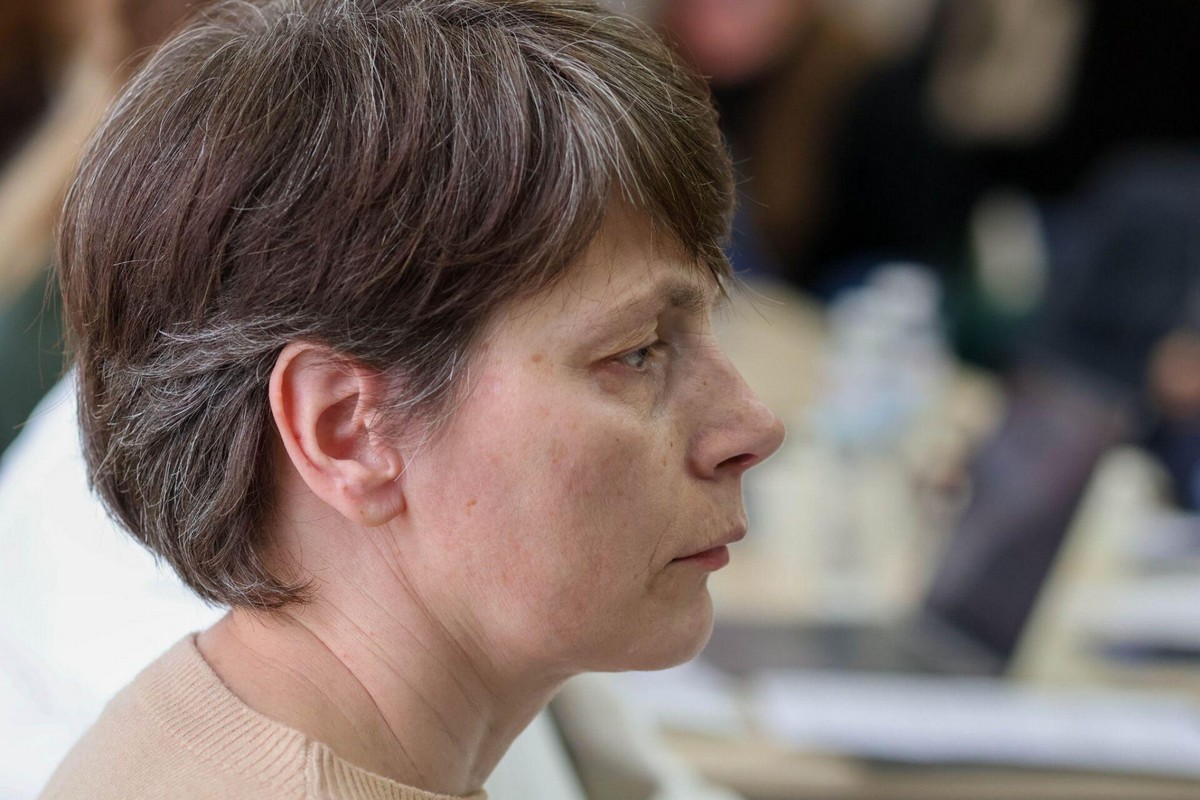
For an occupying power, a local journalist is not simply a media worker with professional experience. It is a person who knows the town, its residents, their problems and their habits. That is why, after seizing Ukrainian territory, the Russians try not only to destroy independent media but to force those who ran them to work for the occupation instead. Lidiia Tarash, editor-in-chief of the newspaper Nashe Slovo (“Our Word”) in Volnovakha, Donetsk region, lived through all of it.
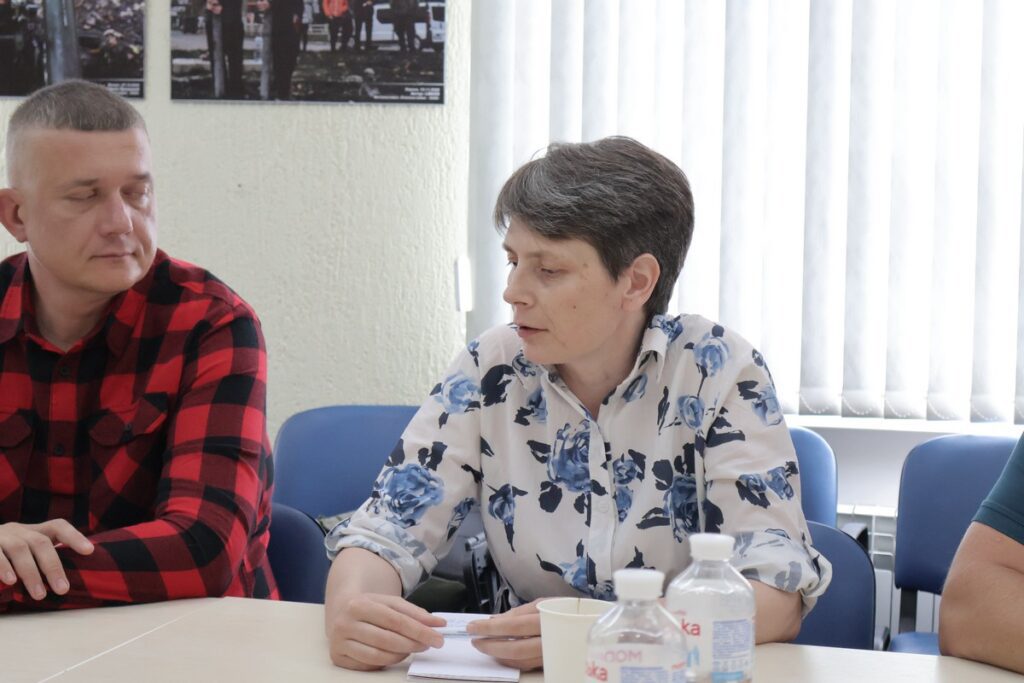
She told her story during a meeting at the National Union of Journalists of Ukraine with the president of the German Federation of Journalists (DJV), Mika Beuster, the coordinator of the Mediadialog project, Dr Wolfgang Ressmann, and the president of CIVIL – Center for Freedom (North Macedonia), Xhabir Deralla. The partners listened and took notes. What they wanted to understand, they said afterwards, was how completely the machinery of occupation reaches into a newsroom — and how much support a journalist needs long after the evacuation is over.
Three weeks in a basement two metres by three
Nashe Slovo had been published in Volnovakha since 1932. Before the full-scale invasion it had a readership of its own and a print run of two to two-and-a-half thousand copies. On 24 February 2022, Lidiia still went in to work. The paper was printed in Mariupol and its driver was due to bring the fresh issue that had been laid out the day before. Then he called to say the post office was shut and everything was closed.
The pre-war issue stayed in Mariupol and was never delivered. That day Lidiia sent the staff home, took the newsroom’s seal and its statutory documents, locked a few things in the safe (just in case) and hoped she would be back soon. The seal and a folder of documents are all that survived of the newsroom’s property. Everything else the occupiers took or destroyed.
On the first day Lidiia moved her children from an apartment block to her parents’ house, which had a basement and a well. The family spent the active fighting underground, from 24 February to 12 March, in a damp cellar roughly two metres by three. They warmed themselves with hot tea and hot soup, lay under blankets, keeping each other warm.
“It was hell — explosions were everywhere,” she recalls. “They attacked us with Grad rockets, tanks and mortars.” Mobile connection and the internet disappeared almost at once, so people in Volnovakha could not tell what was happening or decide whether to run or wait. One night a shell hit the house opposite; another landed in a neighbouring cellar. In the town a single shop still worked, where the owners baked their own bread. People stood in a long queue for it, and while they waited, a plane flew over Volnovakha and dropped a bomb.
Only when the shelling eased did Lidiia decide to leave. There were no shops to buy food, no electricity, no water — nothing to live on.
The men with automatic rifles
Volnovakha lies about sixty kilometres from Mariupol. When the enemy took the town, the family’s route out of occupation led first through the so-called “DNR”, to Donetsk, where Lidiia stayed for a time with relatives. She did not intend to linger. The occupation authorities had been trying for a while to “restart” the newspaper, and they came looking for her.
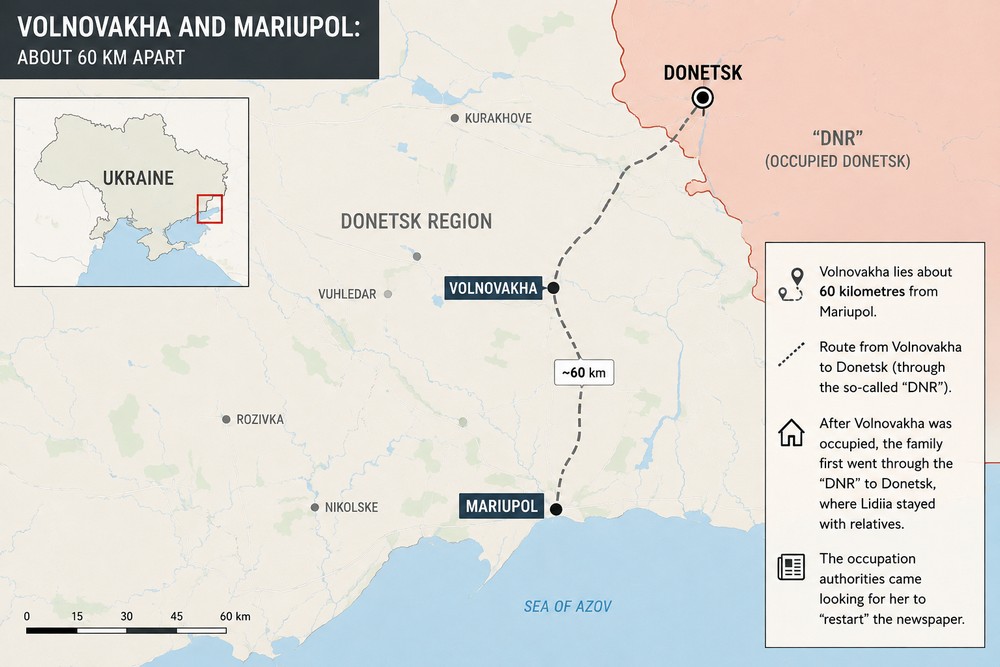
A former colleague passed her number to a woman described as a representative of the “DNR administration”, who offered “cooperation” — resume publishing Nashe Slovo, this time under Russian control. Lidiia refused. The calls continued. When they got no agreement, the pressure sharpened.
“Either you agree, or you have no way out. You must agree,” the journalist remembers being told. “And even if you don’t agree — it’ll either be Russia here, or an atomic war.”
Then five armed men in military uniform came to her parents’ house while she was already hiding with her children in Donetsk. She happened not to be there. “They told me people with automatic rifles had come to my home, Russian soldiers,” she says. “I understood I was in danger and had to leave quickly, and keep going.”
For a journalist on occupied territory, refusing to cooperate is more than a professional decision. It is a decision bound up with one’s own safety and the safety of one’s family. What the occupiers wanted was not only another newspaper for their propaganda. They wanted to take from a person the very sense that a choice existed — to frighten, isolate, and convince her that resistance was pointless.
When they could not force her, they stole the name
The Russians could not force Lidiia to work for them, so they took the paper’s identity instead. On 15 and 22 July 2022, two issues of a propaganda “newspaper” called Nashe Slovo appeared in occupied Volnovakha. The real newsroom had nothing to do with them.
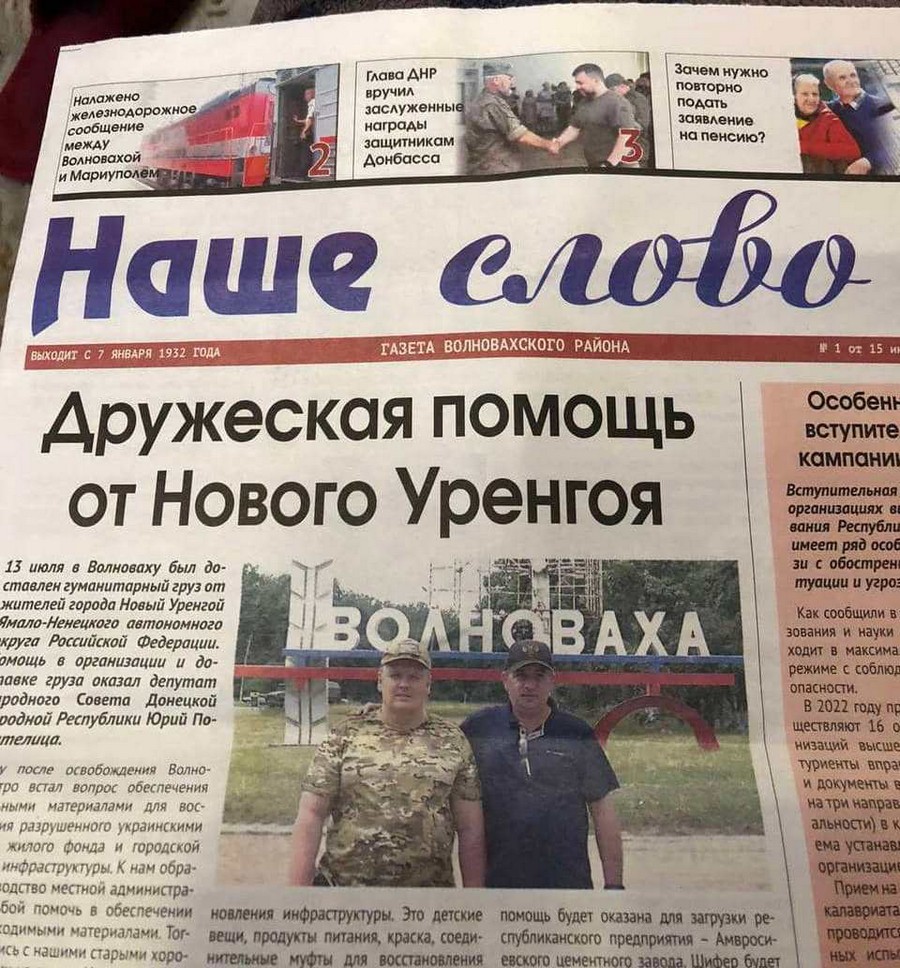
“The occupation authorities appropriated not only the name Nashe Slovo, but the fonts of the title, the layout of the front page, and even the blue colour of the name that we used on our website and on the paper’s Facebook page,” Lidiia wrote to the NUJU leadership. “We note that no member of our staff has any connection to the publication of this newspaper.” By then all of the real newsroom’s staff had left the occupied territory, except one, who was killed.
The forgery was run by a state enterprise of the “DNR”, the “Republican Media Holding”, based in Donetsk and headed by Roman Karpenko; besides the fake Nashe Slovo, it put out two other imitation local papers on occupied Donetsk territory. The real newsroom’s premises were handed over to a so-called “pension fund of the Volnovakha district”.
It is the same pattern seen with the theft of the Mariupol paper Pryazovskyi Robochyi: seize a recognisable brand, its fonts, its front page and the trust it earned among readers over decades, and pour Russian narratives into that familiar shape. For residents of occupied territory, it means the loss of any way to receive independent information — Ukrainian journalists leave or are forced to stop, Ukrainian media are blocked, and publications that imitate the local press take their place.
Arriving in Kyiv with nothing
The way out was long and difficult. Lidiia and her children eventually crossed to Ukrainian-controlled territory, passing through occupied areas, filtration, Russia and several European countries before reaching Kyiv, where her older son was already studying. She arrived almost without resources for a new life.
“The first organisation I turned to was the National Union of Journalists of Ukraine,” she says. During the escape, its moral support mattered to her enormously. The Union stayed in contact throughout. The First Secretary of NUJU, Lina Kushch, became, in Lidiia’s words, her real guardian angel, and the financial help provided allowed the family to survive.
“I won’t stop thanking NUJU for helping us while we were under occupation. That was three months,” Lidiia says. “After they had already come to my home, I felt these might be my last days of freedom. I wrote about it, and after that I was constantly in touch with Lina Kushch. It was continuous moral support, and it was thanks to her that we held out through that time — three months of fear that I could end up behind bars and never see my children, or freedom, or anything again.”
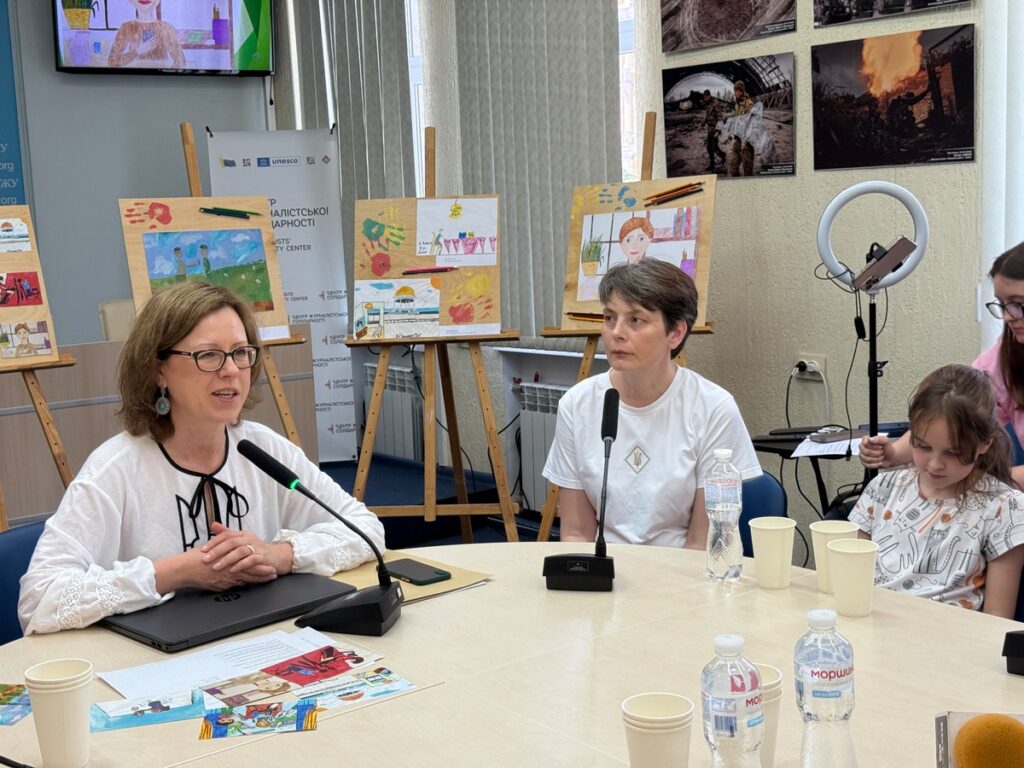
Through NUJU, she was later able to travel with her children to a retreat in Poland, meet colleagues, and begin to return to professional life.
From editor to human rights advocate
At one of the meetings at NUJU, Lidiia met representatives of the Media Initiative for Human Rights (MIHR), an organisation that documents human rights violations and war crimes. In November 2022 she was invited to a meeting with released civilians, where Tetiana Katrychenko, the head of the organisation, offered her a job. She has worked there ever since.
Lidiia’s professional path changed, but the substance of the work is the same as journalism: to gather testimony, to speak with people, to record facts, and to keep what they lived through from vanishing without trace. Now she works with people who have survived occupation, captivity, violence and other traumatic events of the war — and the journalist knows from her own life how hard it can be to speak about what one has endured.
“Having lived through such things ourselves, we work with people who also carry traumatic experiences,” she says. “We interview them, talk with them, then transcribe the recordings, read them again, and write about all these terrible things.” It is a double burden. She lives in the war herself (hears the sirens, thinks about her children’s safety, lives through the shelling) and then goes to work and immerses herself in other people’s testimonies, which are another form of the war. “We are in constant, unbroken stress,” Lidiia says. “And so, of course, we need help to recover.”
“I know that around thirty journalists are behind bars right now,” she adds. “And again, I’m grateful that I’m not in captivity, that no one has to fight for my freedom any more.”
What the story asks of Ukraine’s partners
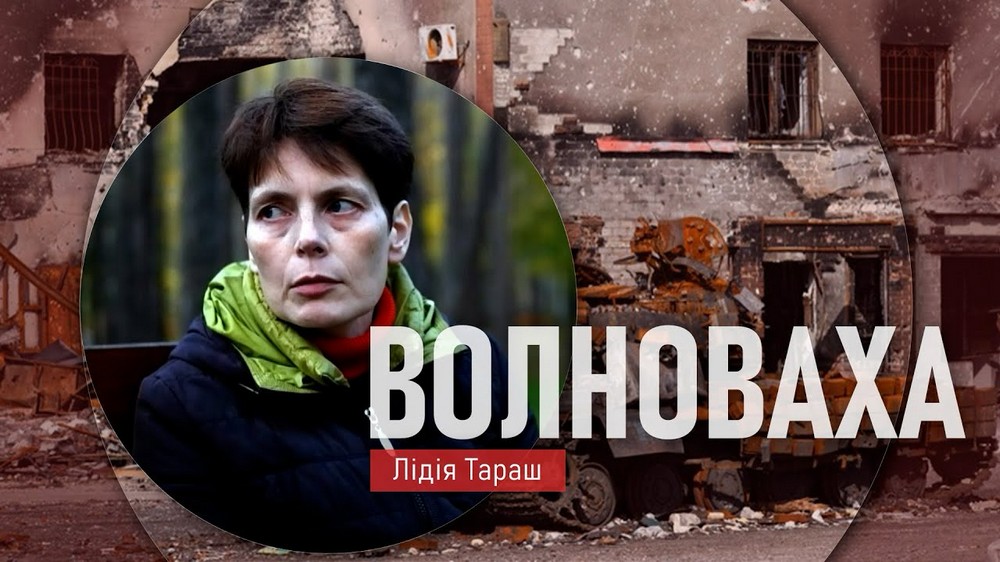
Volnovakha shows that the occupation of the information space is part of the occupation of territory, and that supporting a journalist after evacuation is an investment in preserving the Ukrainian information space. Many editors keep trying to reach their audiences through online platforms even after they have lost everything else.
Lidiia’s case also reflects a wider issue. Research conducted by NUJU in 2023 found that women journalists during the full-scale invasion take on responsibility for the relatives who depend on them — and that this often keeps them in occupation or in dangerous conditions near the front line, exposing themselves to risk while continuing to work.
From that point of view, Lidiia is convinced that journalists from dangerous regions need systemic support — financial, psychological and professional — and that it is needed not only at the moment of evacuation. Her own experience shows that the hardest stage often begins after the rescue: rebuilding a life, finding work, returning to the profession, settling the children, and working through what has been lived.
NUJU Information Service





Discussion about this post