

 THE NATIONAL UNION OF
JOURNALISTS OF UKRAINE
THE NATIONAL UNION OF
JOURNALISTS OF UKRAINE
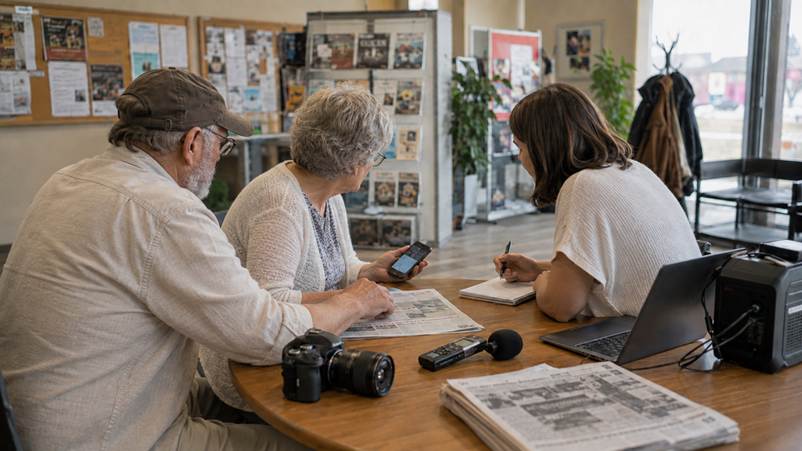
A regional TV and radio company in the Carpathian region, a Lviv-based website run by two mobilised editors, a three-person newsroom in Sumy region just a few kilometres from the frontline, the only radio station in frontline Nikopol, and a newspaper with 35 years of history. These and other media outlets participating in the “Your Audience Is Your Strength” project came together for the second experience-sharing webinar, organised by the National Union of Journalists of Ukraine (NUJU) with the support of the Ukrainian Media Fund Nordic.
“There is critically little resource support”
Opening the meeting, NUJU President Serhii Tomilenko recalled the context in which Ukrainian media are operating today.
“Unfortunately, we are seeing our international partners becoming tired and exhausted, while resource support for Ukrainian media is critically limited. There are not that many players supporting Ukrainian media, and their resources are not that substantial”.
The NUJU President noted that the Union continues to advocate for government support programmes for independent regional media and to engage with the Ministry of Culture. However, government policy is still focused primarily on the United News telethon and commitments to the public broadcaster, while the independent media sector remains critically underfunded.
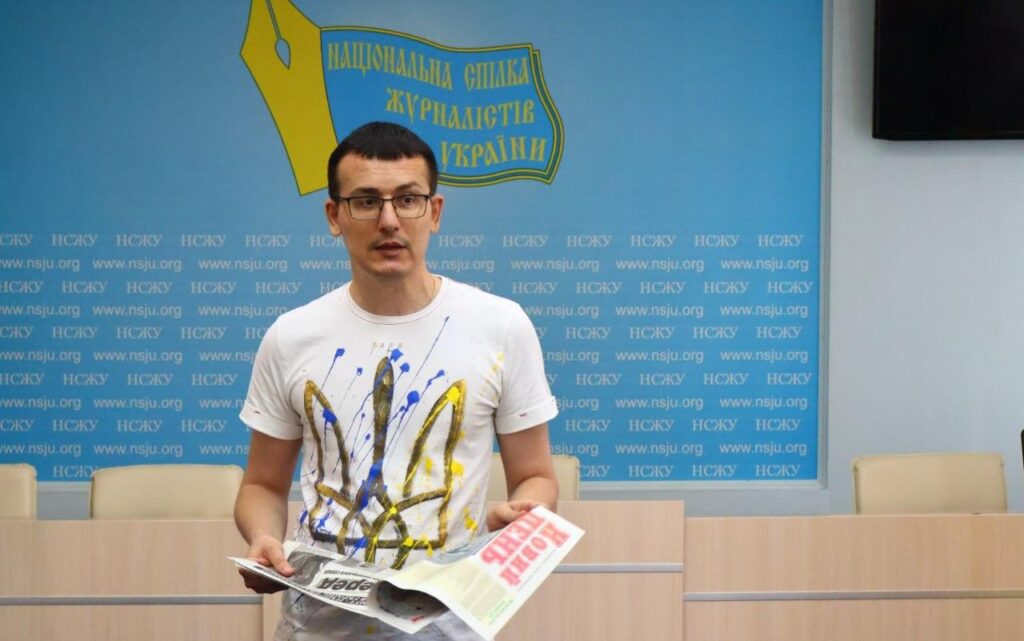
Sergiy Tomilenko
At the same time, Sergiy Tomilenko stressed, partner support is also coming in very concrete forms. Following a recent visit, Slovak journalists paid for drone detectors for five Ukrainian war correspondents. Meanwhile, Mika Boyster, President of the German Journalists’ Association, who recently visited NUJU, is preparing a fundraising campaign to provide equipment for Ukrainian newsrooms.
“With the initiatives we implement, we try to make sure they genuinely strengthen regional media rather than being formal projects or something done just for the sake of ticking a box”, the NUJU President emphasized.
Webinar moderator Vitaliy Holubiev, NUJU Secretary and mentor of the project, encouraged participants in “Your Audience Is Your Strength” to look beyond which colleague’s case was stronger when watching the presentations and instead focus on the practical experience: what a newsroom is doing right now, why it is doing it that way, and what others can take away from that experience.
One programme, several digital lives
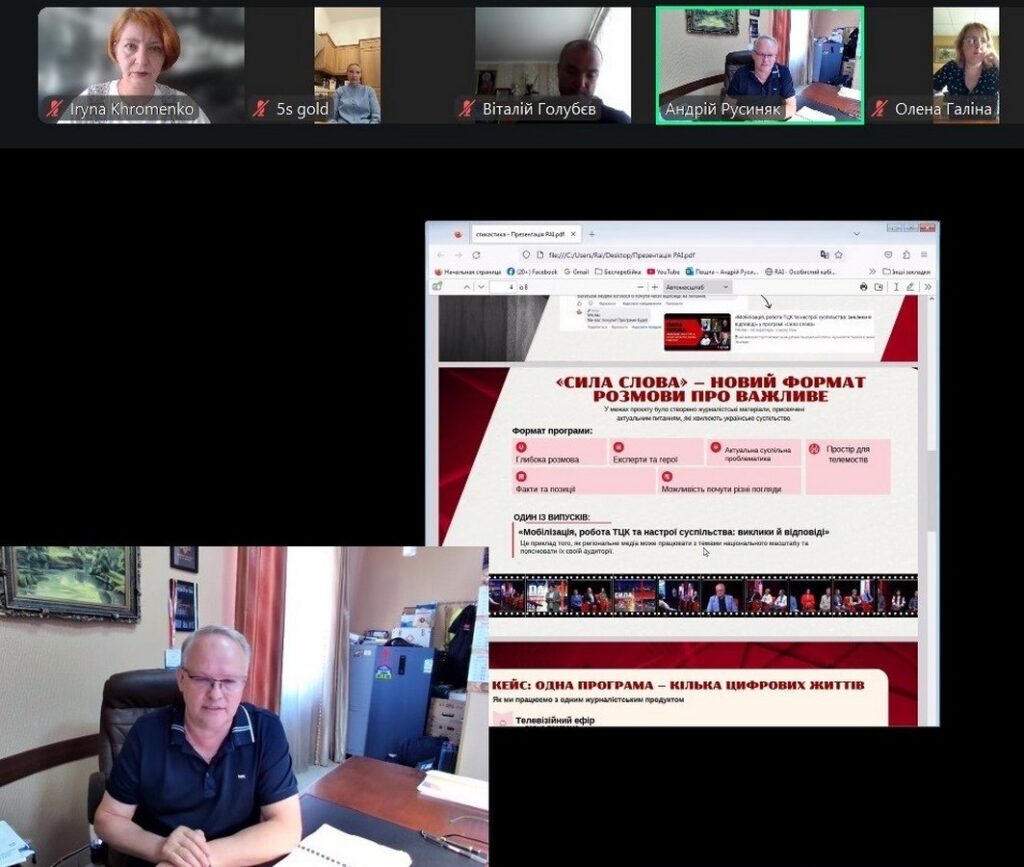
The first speaker was Andriy Rusyniak, head of the Ivano-Frankivsk-based TV and radio company RAI. His key message was simple: don’t produce twice as much content just because there are twice as many platforms. Instead, give one high-quality journalistic product several digital lives.
According to RAI’s head, the company has deliberately built a multi-platform operation. Studios in Kolomyia, Kalush and Burshtyn mean guests do not have to travel to Ivano-Frankivsk, while the newsroom is already technologically equipped to host live cross-studio broadcasts between the locations. Five television cameras have been installed in the radio studio, allowing radio projects to appear in the television schedule. An agreement with the MEGOGO platform has also given the radio station a video component: during morning live broadcasts, listeners can watch the studio feed.
The most illustrative example is The Power of Words, a project implemented with NUJU support. Each programme is a conversation lasting around an hour and a half, with up to six guests in the studio, and topics that Andrii Rusyniak describes as a fine line. One episode focused on the work of Ukraine’s Territorial Recruitment and Social Support Centres (TCCs and SPs), bringing together civil society representatives, academics, TCC representatives and members of the military administration.

Andriy Rusyniak
“In addition to our million-strong television audience, we reached a huge number of people who watched this content on social media,” says the head of RAI. “Individual speakers’ contributions received 250,000 views, and in some cases even reached one million”.
The full programme lives on television and YouTube, while the website serves as an archive. On Facebook and TikTok, the newsroom publishes short clips highlighting the key points.
“Regional media today are not just television channels. They are platforms for dialogue, sources of verified information, and spaces where people can hear different perspectives”, Andriy Rusyniak concluded.
Independence that translates into advertising revenue
Lviv-based online publication Leopolis.news was represented by its editor, Andriy Bolkun. He serves in the Armed Forces of Ukraine, as does his deputy, while the website continues to operate seven days a week, from 8 a.m. to 10 p.m.
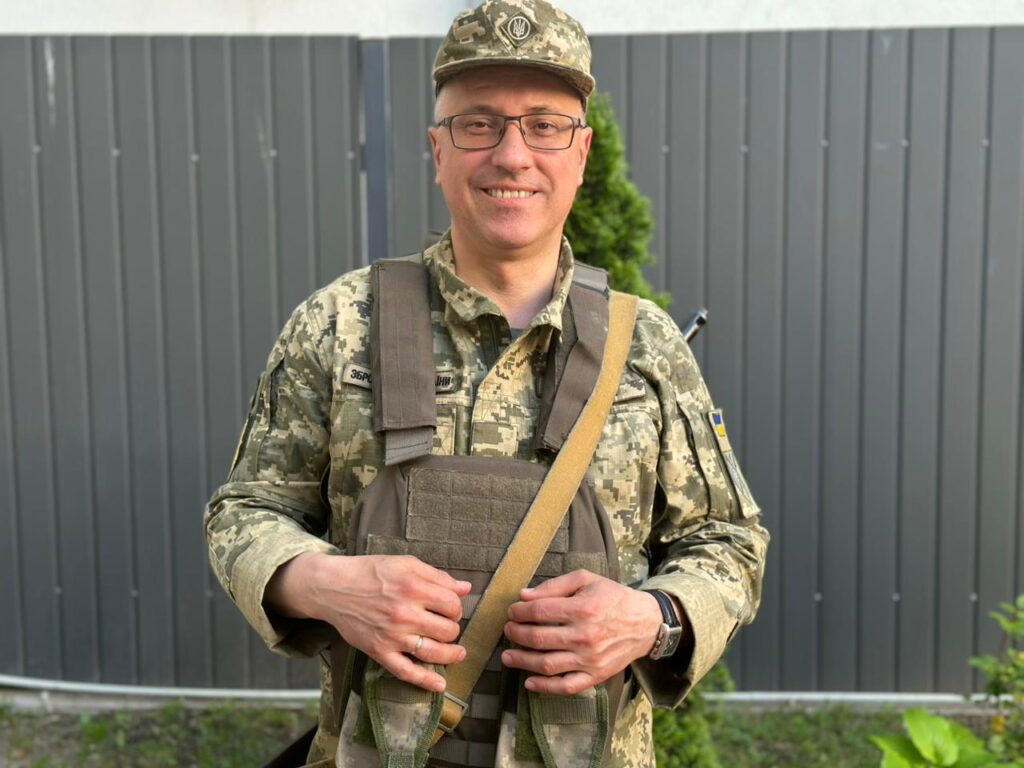
Andriy Bolkun
The website marks its tenth anniversary this year. Over that time, the editor says, it has experienced both periods of growth and crises and even attempts to simply sell the outlet.
“We have no owners other than ourselves, no sponsors and no political backing”, says Andriy Bolkun. “The formula is simple: good content, lots of readers, and therefore advertising. On the one hand, it’s very simple; on the other, it’s extremely difficult, because independence comes with many risks. And those risks are very tangible: conflicts with local authorities, lawsuits, and, at one point, even threats. At the same time, in June alone, the newsroom received around 25 commissions for sponsored content, while political orders are practically nonexistent”.
Investigations and hard-hitting stories attract the most views – on city council officials salaries, environmental pollution and construction projects. A story about a missing bomb shelter in Lviv that the authorities have failed to return to the community was prompted by readers, as have been many other stories.
The newsroom’s main communication channel is Facebook and its Messenger service. Readers send in their stories and leave their phone numbers; journalists arrange meetings and travel to the scene.
“When we went to a landfill outside Lviv, people were lining up to talk to the journalists. Unfortunately, many people have lost faith in public authorities, and journalists have become almost the last resort”, the editor recalls.
Staffing, Bolkun says, is the number one challenge. In particular, the managing editor moved abroad because she could not stay under shelling with a young child. But there is also good news: a student who joined the team has grown into a strong journalist, learning within a year and a half to produce high-quality stories.
The newsroom has had no physical office since the COVID-19 pandemic and the beginning of the full-scale war. Everyone works from wherever they are and when the power goes out, whoever still has electricity publishes the news. The newsroom received EcoFlow power stations through one of its grants.
“We are observers, not scriptwriters”
Mariia Kapustina from the Hlukhiv.City newsroom in northern Sumy region spoke about what it means to report the news when you are living inside the news yourself.
The outlet was launched from scratch during the full-scale war. Today, its Telegram channel has more than 27,000 subscribers, up from just 200 at the start. The team consists of three people.

Mariia Kapustina
The most difficult part of the job is covering funerals and commemorations of those killed in the war.
“If we don’t come to a funeral now, people may take offence. They have become used to seeing us there”, Mariia explains.
Together with her colleague Anastasiia Lutchenko, the newsroom has developed its own rules for working at such ceremonies: not disrupting the proceedings for a better shot; working remotely via Zoom when possible; not approaching the coffin or filming shocking images; not attending memorial services without the family’s request; and respecting people’s decision not to appear on camera – particularly when the fallen person’s fellow soldiers travel for hours to attend the farewell ceremony.
“This isn’t a story about beautiful photographs. It’s a story about paying tribute. That’s why we are observers, not scriptwriters”, the journalist says.
She also addressed an accusation she sometimes hears from colleagues – that journalists are “hype-chasing” at funerals.
“These reports haven’t generated views or brought us new subscribers for more than a year,” Mariia explains. “Unfortunately, there are so many of them that people are actually distancing themselves from the topic. But we understand that this is the least we can do for the families.”
The second part of the job involves travelling to the sites of attacks. Here, too, the newsroom has its own rules: approach people who are standing alone, take as many photos and videos as possible, collect their contact details so the newsroom can later tell how they have adapted to what happened, and pay attention to the details.
That is how the newsroom produced a story about Volodymyr Koltunov, a displaced person from Crimea who was painting an Easter landscape when guided aerial bombs struck. And then there was the most difficult story about seven-year-old Nikita, who wrote a letter to St Nicholas shortly before his death, asking for a toy train and sweets. His fellow villagers brought those gifts to his farewell ceremony.
In roughly 80% of cases, people themselves want to share what they have experienced. On 27 July, when Hlukhiv was attacked by five guided aerial bombs and the newsroom could only travel to the scene in the afternoon, people were asking in local groups why Hlukhiv.City had still not arrived.
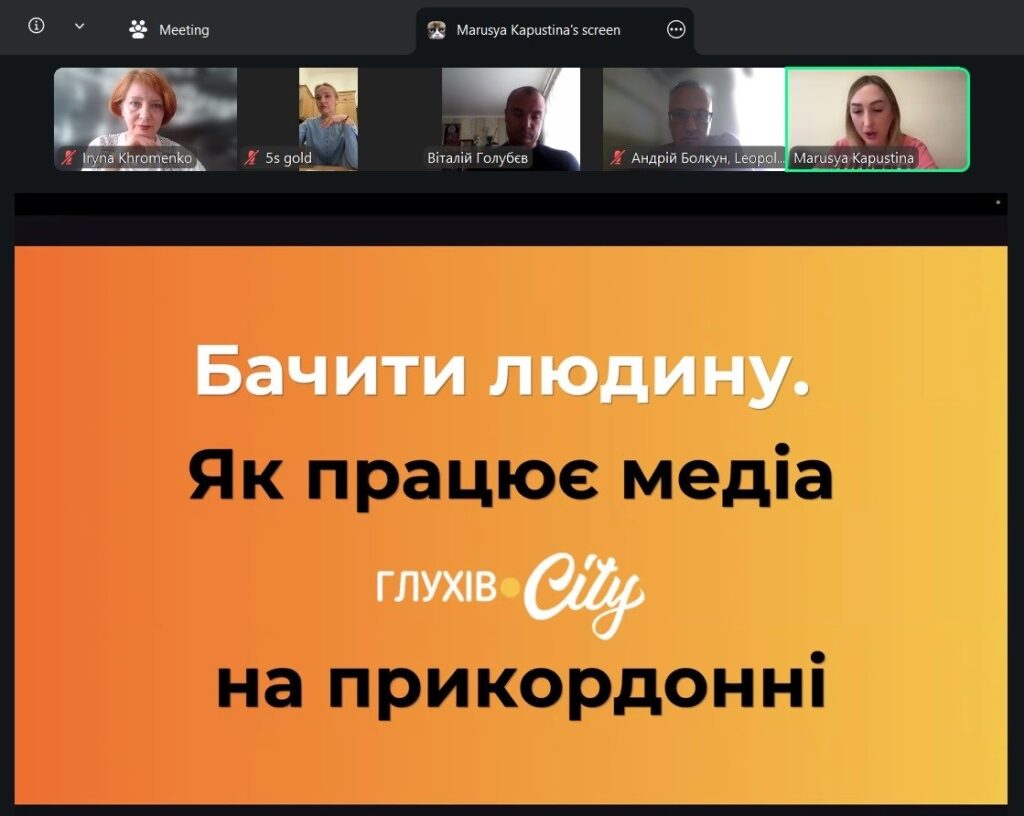
Recently, the newsroom has changed its approach: it pays closer attention to the audience’s mood and avoids publishing light-hearted stories on difficult days. Because of power outages, it has shifted to shorter formats and social media instead of its favourite long-form pieces. And when journalists receive threats, the newsroom responds by blocking the accounts.
“Every story is written by someone who has just experienced the shelling themselves. We live here too”, Mariia stresses.
Despite everything, the newsroom continues to look for positive stories. The most recent one is about 14-year-old Veronika, who has consciously chosen to remain in Hlukhiv with her mother and care for stray animals.
A measure of resilience: will we be on air tomorrow?
Olena Halina represented Nostalzhi Radio from frontline Nikopol – the only radio station currently operating in the area. It broadcasts around the clock and is listened to in Marhanets, Tomakivka and Pokrov, as well as in the occupied parts of Zaporizhzhia region. The newsroom once had 12 employees; today, only two female presenters remain, working online.

Olena Galina
The administrative building was hit twice, and the radio studio itself was also damaged. Everything was restored. After one of the attacks, when utility poles were knocked down and the electricity went out, the newsroom stayed on air for another four hours using power stations. Then the radio went silent.
“And as soon as it went silent, people started calling us – employees of the Pokrov and Marhanets city councils, as well as ordinary residents,” Olena Halina recalls. “Everyone was asking: Why can’t we hear you? What happened? Are you all right? When we returned to the air, that was when we realised that our radio was more than just a broadcast”.
According to Olena Halina, taking part in the “Your Audience Is Your Strength” project taught the team one essential lesson: it is not enough to talk to your listeners – you also have to learn to listen to them.
Residents now suggest topics for programmes themselves: evacuation and those who refuse to leave; anti-drone nets installed over roads; the work of municipal services after attacks; and entrepreneurs who bring bread and food into the city through fields and open terrain.
The newsroom is currently preparing a programme about publicly accessible Wi-Fi zones. The mayor suggested that local businesses open up their networks in shops so that people can check what is approaching from the sky and decide whether it is safe to go outside. Residents who have the internet at home have also started opening up their own Wi-Fi access points.
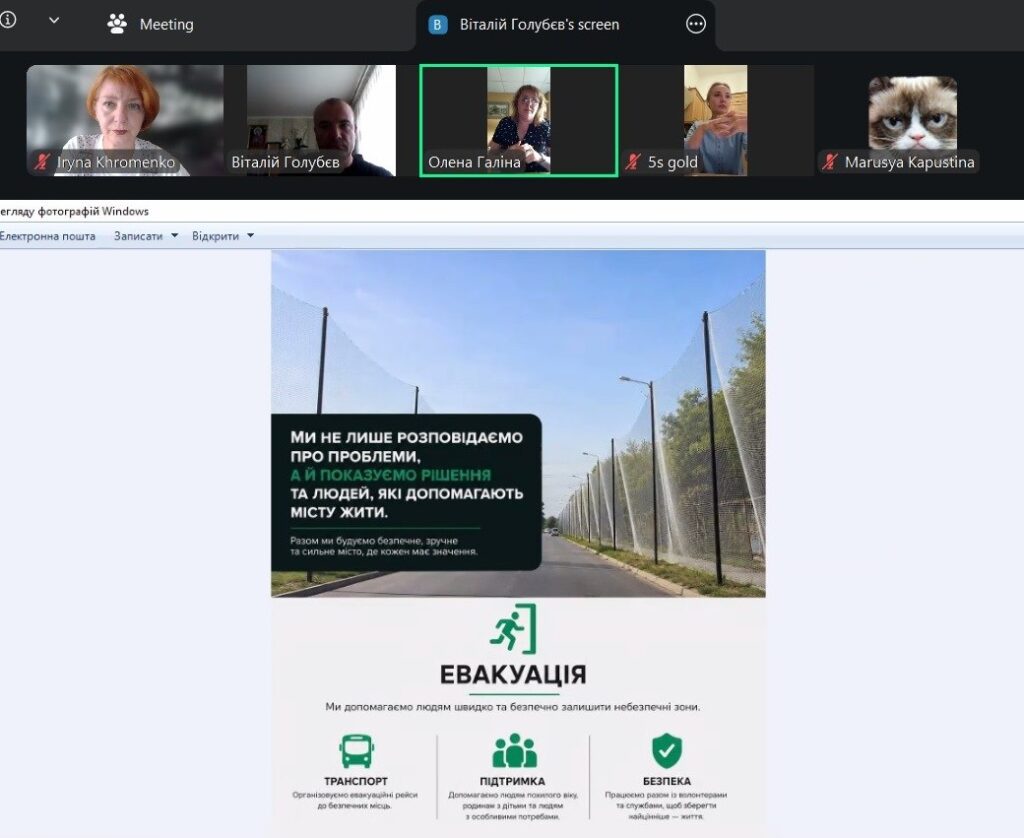
NUJU Projects Coordinator Iryna Khromenko reminded the participants of another story involving Olena – how she once spent an hour hiding among fir trees in the city centre while a drone was hunting her.
“We never put the profits in our own pockets”
The meeting was wrapped up by Nataliya Baliuk of Vysokyi Zamok. The Lviv-based newspaper is 35 years old, making it the same age as Ukraine’s independence and, quite possibly, the oldest Ukrainian newspaper still maintaining a print edition.

Nataliya Baliuk
It is part of a publishing house: alongside its flagship newspaper, the company publishes Dobryi Hospodar and Dobre Zdorovia, as well as the magazines Dobra Kukhnia and Incredible Life Stories. It also operates its own printing house, which produces commercial print materials as well.
“We have always viewed media as a business and have always relied solely on ourselves”, says Nataliya Baliuk.
Their critical stance towards the authorities also shaped another business decision: paying salaries off the books was never an option, because the newspaper could not afford to make itself vulnerable.
“As owners – me and Stepan Kurpil, my husband and the newspaper’s first editor – we have never taken dividends in our lives. We always reinvested: in the printing house, in our own premises so we wouldn’t have to pay rent, and then we built another office building next door, which we now lease out”, she says.
It is precisely these investments that are keeping the publication afloat today. The formula that moderator Vitaliy Holubiev called the webinar’s key quote was summed up by Nataliia Baliuk this way: we thought we were doing it for growth, but it turned out we were doing it for survival.
The print edition of Vysokyi Zamok is currently loss-making and is subsidised by other sources of income. Its circulation is around 30,000 copies, roughly half of which are subscriptions — something the editor says the newspaper has to fight to maintain. Meanwhile, Ukrposhta has banned subscriptions to bundles of publications for 2027. If the newsroom wants to continue offering them, it will have to package and distribute them itself.
The publishing house treats its website as a separate media outlet, and it is profitable. Social media are not yet monetised, but the team is working towards it. Here, Nataliia Baliuk offered colleagues some practical advice, explaining how she accidentally discovered two months ago that her own Facebook account was eligible for monetisation and activated the feature.
“It can bring in around $100–200 a month – not much, but it opens up possibilities,” she says. “I recommend that all my colleagues do it”.
Not 15 success stories, but 15 answers to shared challenges
Wrapping up the discussion, Vitaliy Holubiev noted that the success of a local newsroom cannot be measured today by a universal set of indicators. For some, the key achievement is that one journalistic product has found several digital lives. For others, it is a reputation built over decades that has become a source of resilience. For some, it is the trust of their community – a trust that sometimes means turning down the opportunity to maximise views. And for others, it is simply the fact that a radio station has managed to get back on air.
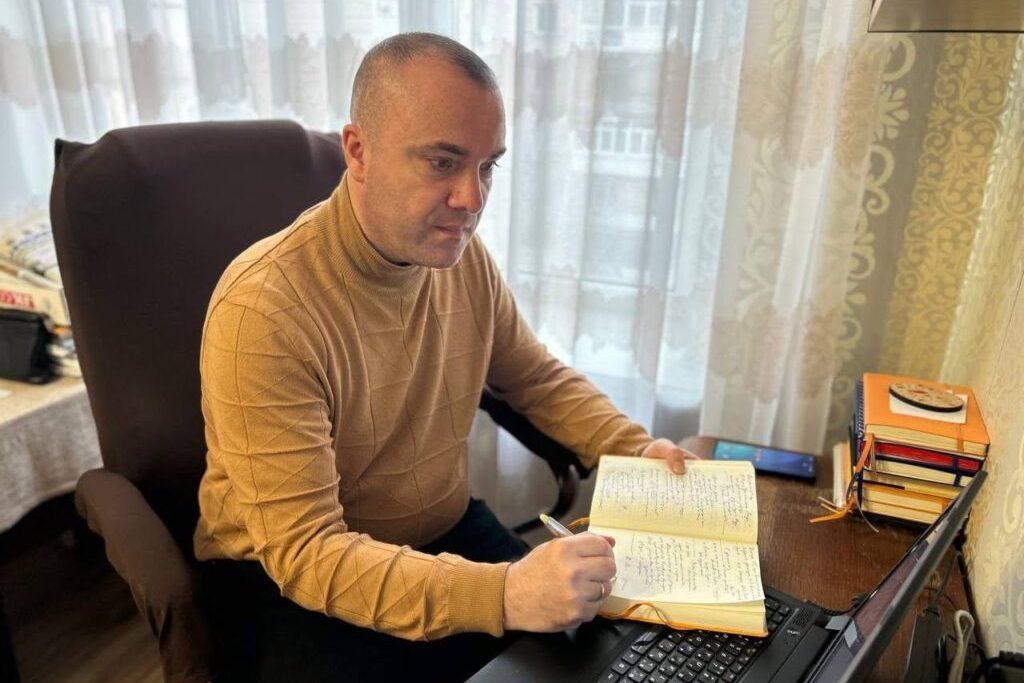
Vitaliy Holubiev
“We are not collecting 15 separate success stories, but looking at how 15 newsrooms respond to the shared challenges of wartime”, he said.
Iryna Khromenko added that what the project participants have in common above all is a high level of adaptability.
“Every media outlet is trying to survive, making use of its own resources and engaging its audience. Next time, the presentations will be prepared by newsrooms that took part in Ukrainian Media Fund Nordic projects a long time ago or have joined for the first time”, said the NUJU Projects Coordinator.
***
“Your Audience Is Your Strength” is a project of the National Union of Journalists of Ukraine aimed at supporting local and regional media and strengthening their ties with their communities. NUJU implements the project in partnership with Ukrainian Media Fund Nordic. The initiative aims to help newsrooms better understand the information needs of their readers, listeners and viewers, establish an ongoing two-way dialogue, and gradually turn audiences from passive content consumers into active communities around their media outlets.
The programme’s practical phase began in December 2025. It brought together online outlets, newspapers, radio stations and television companies from 11 regions of Ukraine, including media operating in frontline areas. Newsrooms received microgrants and mentoring support to test new ways of engaging with their audiences, including surveys, readers’ clubs, chatbots and Telegram channels, interactive features, live broadcasts, short videos and meetings with community residents.
An interim monitoring report showed that newsrooms had managed to revitalise communication with their readers despite staff shortages, shelling and power outages. Initiatives included an automated moderation bot for Poltava.to Telegram channels, the youth newsroom at Horodok.City, the relaunch of the Odesa-based More People media outlet’s Telegram channel, community media patrols, and formats in which readers’ questions and concerns directly became topics for journalistic coverage.
By the end of the programme, all 15 newsrooms had demonstrated growth in audience size, reach and the number of reader enquiries. In particular, the Sumy-based media outlets Na Mezhi and Hlukhiv.City significantly increased their number of followers across different platforms; Ivano-Frankivsk-based RAI increased its Facebook page reach by 50%; and Horodok.City’s TikTok channel gained almost 1,000 new followers in two months. The final results are presented in the “Local Newsrooms Are Learning to Engage Their Audiences” publication. The participants’ experience also formed the basis of an NUJU analytical report on trust in local media, the role of newsroom and personal brands, and turning audiences into co-creators of editorial content.
NUJU Information Service















Discussion about this post