
 THE NATIONAL UNION OF
JOURNALISTS OF UKRAINE
THE NATIONAL UNION OF
JOURNALISTS OF UKRAINE
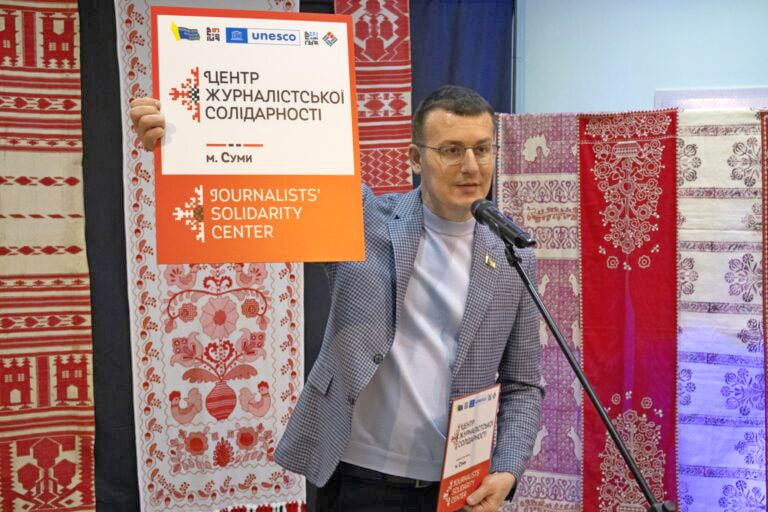
Over 9,000 Ukrainian and international journalists have received support through the network of Journalist Solidarity Centres since the start of the full-scale invasion, yet this infrastructure is now at risk due to the loss of stable funding. The resolution “On support to Journalists’ Solidarity Centers in Ukraine,” tabled by the Swedish Union of Journalists and the National Union of Journalists of Ukraine, was adopted at the European Federation of Journalists (EFJ) Annual Meeting on 18-19 June 2026 in Ankara.
The resolution instructs the EFJ Steering Committee to advocate for long-term institutional support for the Solidarity Centres network before European institutions and governments, to facilitate the establishment of sustainable funding mechanisms, and to promote international recognition of the Centres as an effective model for protecting journalists during armed conflict.
Full text of the resolution
On support to Journalist Solidarity Centers in Ukraine
Tabled by the Swedish Union of Journalists (Sweden) and the National Union of Journalists of Ukraine (Ukraine)
The European Federation of Journalists (EFJ) Annual Meeting on 18–19 June 2026 in Ankara,
Recognising the extraordinary challenges faced by Ukrainian journalists following Russia’s war against Ukraine;
Noting that for more than four years Ukrainian journalists have continued to work under conditions of constant shelling, destruction of infrastructure, forced displacement and severe psychological pressure, often while risking their lives;
Observing further that local and frontline media in many regions of Ukraine have lost offices, equipment, sources of income and the ability to operate safely, while continuing to inform communities despite daily security threats and extremely limited resources;
Acknowledging the role of the network of Journalist Solidarity Centres, established by the National Union of Journalists of Ukraine with the support of the European Federation of Journalists (EFJ), International Federation of Journalists (IFJ), and UNESCO, as one of the key mechanisms for providing practical assistance to journalists during wartime;
Aware that since the beginning of the full-scale invasion, the Journalist Solidarity Centres have supported more than 9,000 Ukrainian and international journalists and media workers, becoming a vital professional and humanitarian support infrastructure for the media sector;
Noting that the Journalist Solidarity Centres provide practical support through safe workspaces, access to electricity and internet during blackouts, protective equipment, emergency assistance following shelling and displacement, legal and psychological support, and professional networking opportunities;
Affirming that the Journalist Solidarity Centres have proven effective in maintaining the continuity of independent media operations during wartime, strengthening democratic resilience, combating disinformation, and safeguarding the public’s right to reliable information;
Alarmed that since March 2025 the network has lacked stable funding following the suspension of U.S. government assistance and reductions in UNESCO project funding, despite continued support mobilised through solidarity efforts by EFJ affiliates and European journalists’ organisations;
Concerned that without sustainable international support, essential services provided by the Journalist Solidarity Centres — particularly in frontline regions – risk being reduced or discontinued despite the continuing urgent needs of journalists and media workers;
The EFJ Annual Meeting expresses solidarity with Ukrainian journalists and instructs the EFJ Steering Committee to:
Recognise the importance of supporting independent Ukrainian journalism and the infrastructure protecting journalists as a strategic contribution to freedom of expression, democracy, and media resilience across Europe in the context of Russia’s war against Ukraine;
Advocate before European institutions, European governments, and international donors for long-term institutional support for Journalist Solidarity Centres, particularly in frontline regions of Ukraine;
Support the establishment of sustainable funding mechanisms for the network of Journalist Solidarity Centres in Ukraine as a vital infrastructure safeguarding journalists and ensuring the continuity of independent media operations;
Strengthen cooperation between EFJ affiliates and Journalist Solidarity Centres, including through partnerships, fundraising initiatives, equipment assistance, and professional exchange programmes;
Support programmes providing emergency assistance, psychological support, safety training, and energy-independent infrastructure for Ukrainian journalists working under wartime conditions;
Promote international recognition of Journalist Solidarity Centres as an effective model for protecting journalists and supporting independent media in armed conflict and humanitarian crises;
Monitor the evolving needs and sustainability of Journalist Solidarity Centres and report to EFJ affiliates on opportunities for continued solidarity and support.
NUJU Information Service
















Discussion about this post