 THE NATIONAL UNION OF
JOURNALISTS OF UKRAINE
THE NATIONAL UNION OF
JOURNALISTS OF UKRAINE
The full-scale war has changed not only what Ukrainian journalists report on, but also the conditions in which they have to work. FPV drones have pushed the danger zone far beyond the front line, independent frontline outlets survive only thanks to international support, and dozens of Ukrainian media workers remain in Russian captivity while their families wait years for any news.
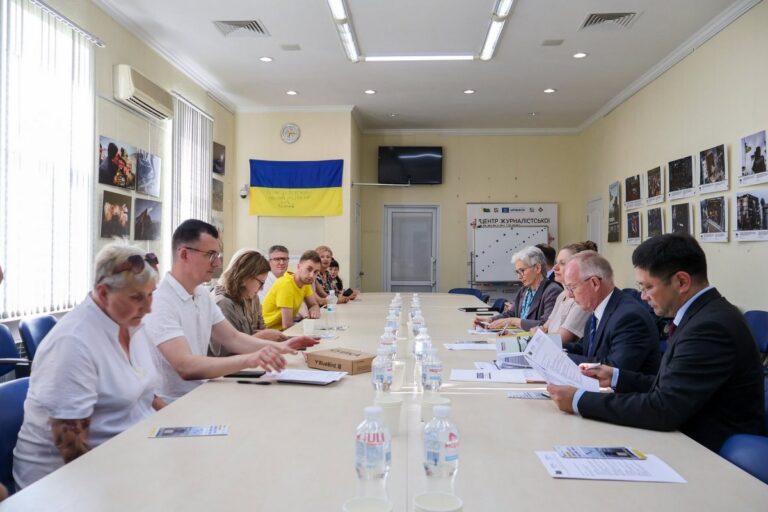
Jan Braathu, the OSCE Representative on Freedom of the Media, visited the central office of the National Union of Journalists of Ukraine (NUJU) in Kyiv to discuss these challenges and outline further steps for international cooperation on protecting media freedom.
Since the start of the full-scale war, the Representative’s Office has systematically supported Ukrainian journalists: organizing safety training, raising the issue of protecting media workers at the international level, addressing online harassment of media workers, developing practical support programmes, and paying attention to crimes committed against journalists working under wartime conditions. In his view, today’s reality for journalists at war demands a new approach to protection. “This is truly a crazy situation: you’re being hunted by a drone operator sitting 20, 30, even 40 kilometres away who is essentially playing a video game with live people. And there’s nothing you can really do to protect yourself,” Jan Braathu said.
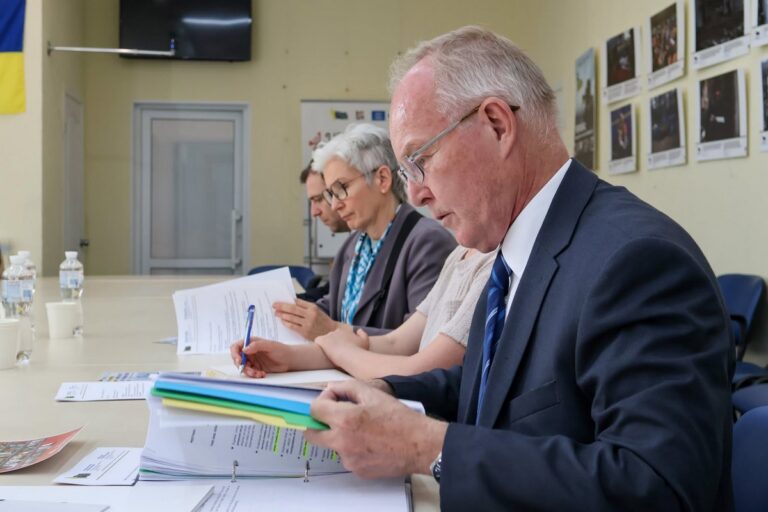
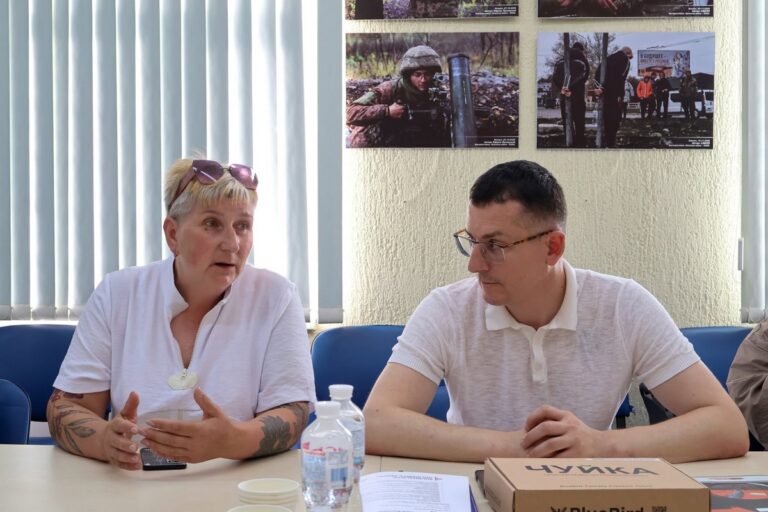
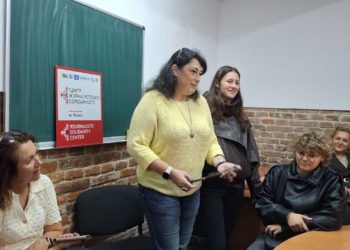
A separate part of the conversation focused on the story of journalist Iryna Levchenko, whom Russia is holding captive, as told by her sister, Olena Rudenko. Jan Braathu promised to continue raising the issue of imprisoned Ukrainian journalists and to personally follow Iryna’s case.
“She was moved to Krasnodar”: Iryna Levchenko’s sister on what is known about the case
Iryna Levchenko has been held in Russian captivity for more than three years. The 64-year-old journalist, a NUJU member, was abducted by Russian occupying forces on 6 May 2023 together with her husband Oleksandr from their home in occupied Melitopol.
Oleksandr was released after one year and four months, but he still remains in the occupied territory. Iryna, meanwhile, has been moved between places of detention in occupied territories for several years now: Donetsk, Mariupol, Melitopol, and occupied Crimea. According to Olena Rudenko, the family managed to establish contact with her sister only after some time, through volunteers, and since then letters from Iryna have been arriving roughly once every one to two weeks.
In June 2026, Iryna was transferred overnight from occupied Crimea to Krasnodar, Russia, in an overcrowded vehicle without ventilation, together with other detainees from the Simferopol pre-trial detention centre (SIZO). According to the latest information received by NUJU, the journalist is now being prepared for further transfer to Rostov.
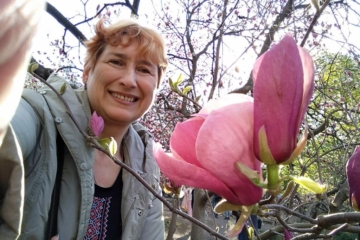
In Simferopol, according to Olena, the family had expected a trial to finally begin, but hearings were repeatedly postponed, and the case never moved forward. The family does not know what is happening to Iryna now, at the new location – they are waiting for information from her lawyer, who is expected to make contact with her in Krasnodar.
Iryna’s case is closed and there is no access to the case materials, so it is also unknown exactly what charges have been brought against her. According to the journalist’s sister, it could be anything: terrorism, espionage, treason. Iryna Levchenko’s relatives have had to gather documents ever since the first publications about her detention, in order to prove, at one of the most recent court hearings, the simple fact that after three years Iryna still has not received any verdict.
The situation is further complicated by the fact that the Melitopol and Crimea area currently has no electricity or internet access, which makes it impossible to maintain stable contact with the journalist’s husband, Oleksandr. He is visited late at night on a regular basis, and his phone and contacts are checked; during one of the most recent such visits, his documents were confiscated, including the Ukrainian passport. Oleksandr now has no identity document of any kind.
The “kill zone” has expanded to 30 kilometres
The zone where a drone can strike a target is no longer a narrow strip along the front line – it now extends 20, and in some places 30, kilometres inland from it. “The so-called kill zone keeps getting wider, and it has become the main danger for journalists covering the situation not only at the front line, but also in villages and towns, where it concerns the lives of the civilian population,” Lina Kushch, NUJU First Secretary and Coordinator of the Network of Journalists’ Solidarity Centres (JSC), told the OSCE Representative. The danger has long since spread beyond front-line positions. This new baseline now shapes the Union’s safety policy for media workers.
“Drones are attacking civilians in the same way – I’ve seen on Norwegian television how FPV drones are being used to hunt civilians even 30 kilometres from the conflict zone. This is truly a major problem,” Jan Braathu added.
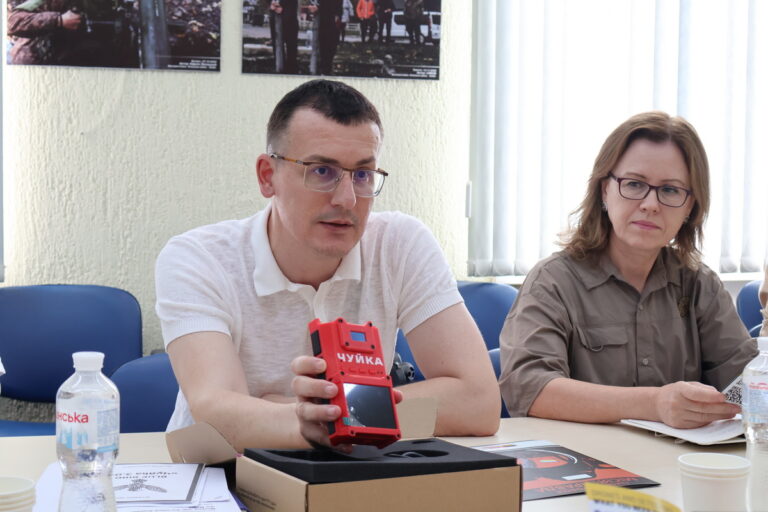
NUJU was the first Ukrainian organization to start providing journalists with drone detectors, and it is the Network of Journalists’ Solidarity Centres that is responsible for distributing the equipment and training people to use it. Last year, the network’s own team completed this training as well.
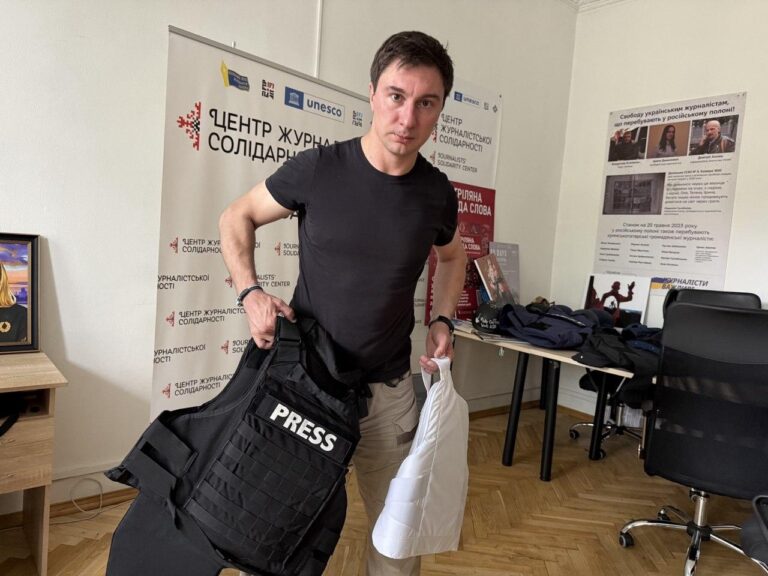
That said, detectors are only a support tool, not a guarantee: the device does not detect fibre-optic drones, which Russia is using increasingly often precisely because they are undetectable by such systems, and at best it gives only a few minutes to seek shelter or change route. NUJU openly considers the classic “PRESS” markings and heavy body armour, designed for earlier stages of the war, to be outdated: in the age of FPV drones, any moving object can become a target, and markings only make a journalist and those accompanying them more visible.
“We discussed this back in Vienna: we’ve just removed the ‘PRESS’ lettering. We now use neutral black and blue colours with no lettering at all, because Russia is deliberately targeting media workers,” said NUJU President Sergiy Tomilenko.
Funding for the protection system remains a painful challenge. “After the freezing of US funds, all media projects in Ukraine financed by UNESCO were halted, including the Network of Journalists’ Solidarity Centres. The number of requests from journalists is growing, while funding is shrinking,” Lina Kushch said. According to her, the network provides media workers with more than ten types of support, so the funding cuts put its continued work at risk.
NUJU is asking that this imbalance be reflected in the OSCE’s final report to participating states.
The drone war: can journalists defend themselves with weapons?
Another question increasingly raised by journalists working near the front is whether they have the right to defend themselves against FPV drones. This concerns not only electronic-warfare countermeasures or anti-drone nets, but also the possible use of weapons.
The answer for now is unambiguous: journalists who take up a weapon automatically lose their status as civilians, and with it, the protection guaranteed by international humanitarian law. Jan Braathu said that during a meeting with the Suspilne team, he was told that in some crews, journalists are accompanied by a guard carrying a shotgun, considered the most effective countermeasure against drones. According to him, a similar model (an armed guard as part of the film crew) is also used in Switzerland.
The OSCE Representative added that during a previous visit, his wife, who is a journalist and accompanied him and interviewed a number of Ukrainian colleagues, heard the same thing: media workers cannot defend themselves, because doing so would make them combatants the moment they pick up a weapon or any other means of protection, and they would lose their status as journalists.
The approach to equipment is also being reconsidered. Heavy body armour received by the Union back in 2022 from UNESCO headquarters – 125 sets, designed for work on the front line – is something journalists are increasingly refusing to wear because of its weight. Instead, NUJU is looking for lighter body armour that protects against shrapnel, which is the predominant threat in many regions today. At the same time, needs vary depending on where journalists are working: for example, shrapnel is the main risk in Kharkiv, while the security situation in Kherson has its own specific features.
NUJU confirms that among fixers and producers working with foreign crews, there are increasingly more voices in favour of using weapons against dronesь but the Union stresses that the issue is complex and requires a separate discussion involving human rights experts.
Independent press near the front line survives almost exclusively thanks to donor support
A telling example is the Kramatorsk newspaper Tekhnopolis, now more than 30 years old: it emerged right after the collapse of the USSR as the city’s first independent publication. According to the paper’s editor, Oleh Kubar, before the full-scale invasion Kramatorsk had three newspapers running at once, and Tekhnopolis was a self-sustaining business living off subscription sales. The full-scale war changed that: today the paper survives only thanks to international support, and the number of subscribers is falling because they are afraid to subscribe for six months or a year ahead without knowing whether they’ll still be in the city next week.
Tekhnopolis is one of 25 independent local and frontline outlets taking part in the Frontline Press project, a joint initiative of NUJU and the Swedish media business association TU, launched in late 2025. The project combines financial support for editorial offices with mentoring and consultations on developing local media. Without this support, some editorial offices in the Zaporizhzhia, Donetsk, and Sumy regions would be forced to shut down.
An additional challenge for frontline media is the effective disappearance of the local advertising market: in Kherson, for instance, business owners often ask journalists not to mention their business in publications, fearing that this could draw the attention of Russian forces and lead to a strike on their shop or warehouse.
Legal protection and documentation for future trials
NUJU’s legal advocacy work is grounded in the European Convention on Human Rights and the Universal Declaration of Human Rights: assisting journalists and editorial offices in accessing information, protecting their rights in cases of violations, and participating in the drafting of legislation related to journalistic work. This was briefly presented by NUJU’s Chief Legal Officer, Mykhailo Kocherov.
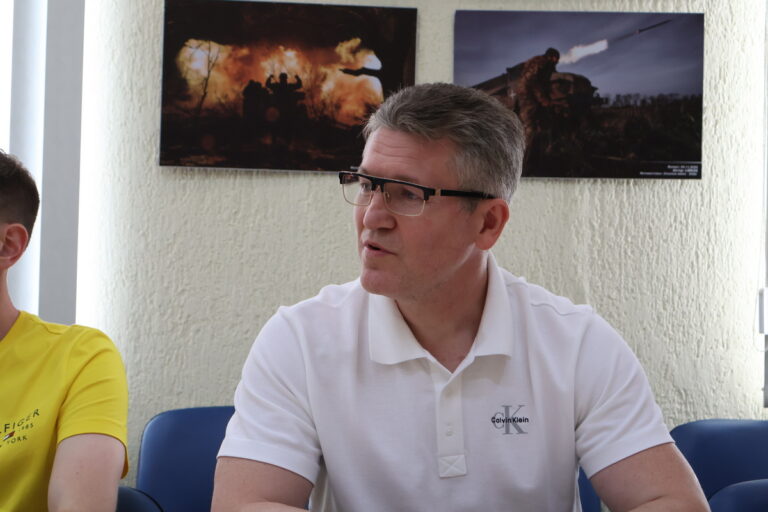
Jan Braathu recalled the document that the OSCE considers foundational in this area — the 2018 OSCE Ministerial Council Decision on the Safety of Journalists, adopted by consensus of all 57 participating states. At his initiative, the document was recently translated into Ukrainian. The network of national focal points on journalist safety, established by one of his predecessors, now systematically collects information on the state of implementation of these recommendations in various countries, so that the Representative can use this data in his work with governments.
Documenting crimes against journalists must become the foundation for future justice
While in Kyiv, Jan Braathu met with members of parliament, including Yevheniia Kravchuk, chair of the Verkhovna Rada’s Temporary Investigative Commission on Crimes Committed by Russian Armed Formations against Journalists and Other Media Workers. He is now awaiting the commission’s report on attacks against journalists. “These are exactly the kinds of things that are important to document, to show the world what is actually happening. So, I think we simply have to keep going,” the OSCE Representative on Freedom of the Media added.
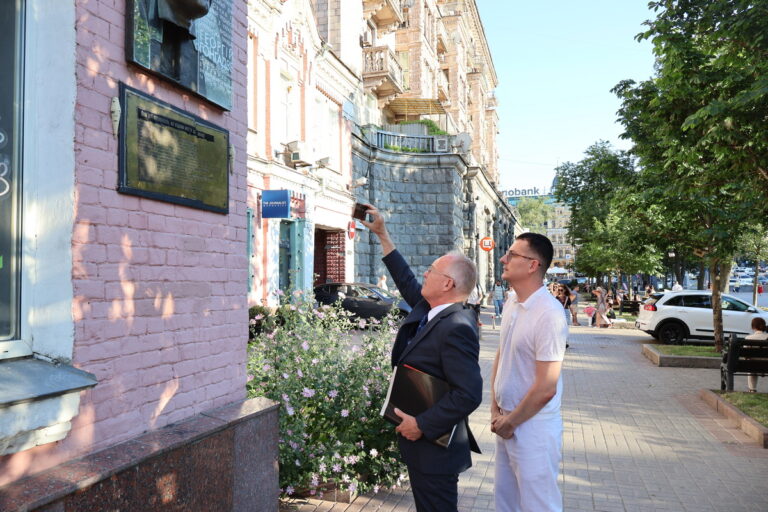
Over the course of a several-hour discussion, participants focused on the safety of journalists amid the drone war, protecting media workers’ civilian status, supporting frontline editorial offices, the work of the Journalists’ Solidarity Centres, the unlawful imprisonment of Ukrainian journalists by Russia, and international mechanisms for protecting media freedom and documenting crimes against journalists for the sake of future justice.
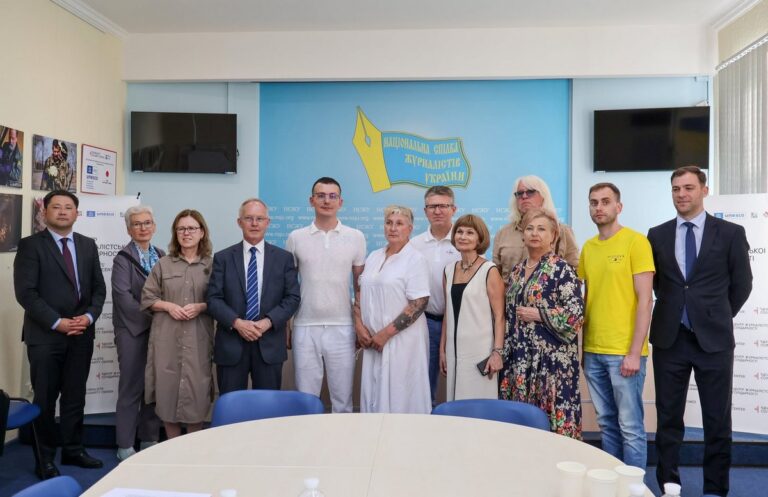
The expert discussion hosted by NUJU brought together the National Union of Journalists of Ukraine’s team, the OSCE Representative on Freedom of the Media Jan Braathu, and journalists and Union staff directly confronting the wartime challenges facing the media:
- Sergiy Tomilenko — President, National Union of Journalists of Ukraine (NUJU); Member of the Steering Committee, European Federation of Journalists (EFJ);
- Lina Kushch — First Secretary, National Union of Journalists of Ukraine (NUJU); Member of the Steering Committee, Global Forum for Media Development (GFMD);
- Oleksandr Kharchenko — Head of the Communications Department, National Union of Journalists of Ukraine (NUJU);
- Mykhailo Kocherov — Chief Legal Officer, National Union of Journalists of Ukraine (NUJU); Doctor of Juridical Sciences, Managing Partner, IBC Legal Services;
- Mykyta Holovchenko — International Affairs Adviser to the President of the National Union of Journalists of Ukraine;
- Anton Perepelytsia — Programme Assistant, Kyiv Journalists’ Solidarity Centre;
- Yevhen Cherevko — Documentary Filmmaker and Videographer; author of three documentaries about Ukraine’s frontline newspapers;
- Oleh Kubar — Editor-in-Chief, Technopolis frontline newspaper, Kramatorsk, Donetsk Region;
- Olena Rudenko — Sister of imprisoned Ukrainian journalist Iryna Levchenko, detained by Russian occupation authorities in Melitopol since May 2023.
Valeriia Muskharina
NUJU Information Service









Discussion about this post