
 THE NATIONAL UNION OF
JOURNALISTS OF UKRAINE
THE NATIONAL UNION OF
JOURNALISTS OF UKRAINE
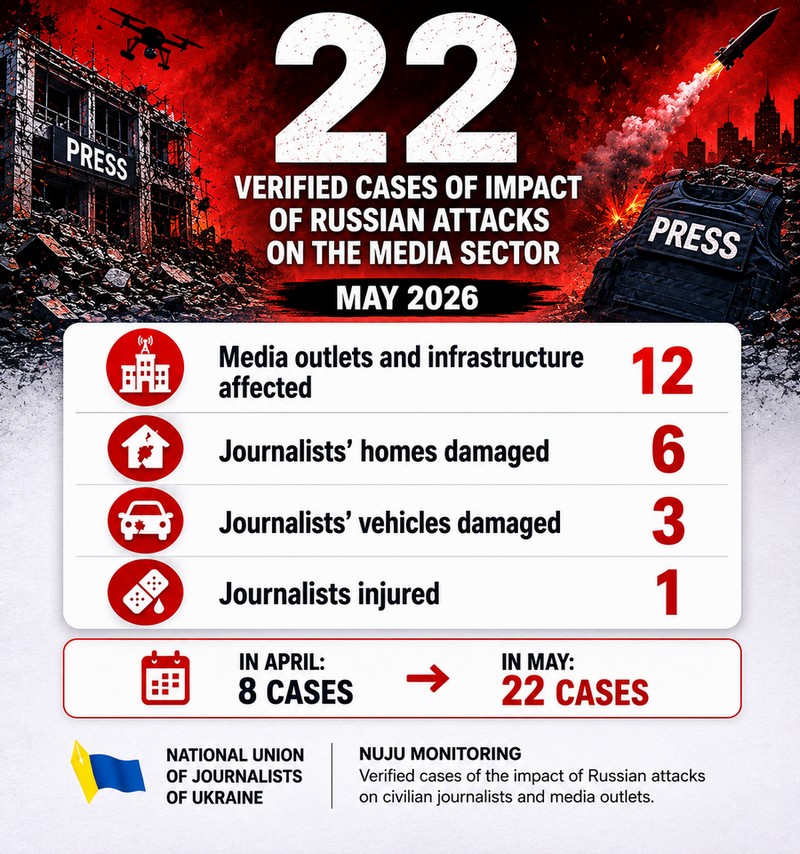
In May 2026, the National Union of Journalists of Ukraine (NUJU) documented 22 verified cases of the impact of Russian attacks on civilian journalists, media outlets and media infrastructure. This is nearly three times higher than in April, when 8 cases were recorded, and represents the highest monthly figure since the beginning of the year.
The NUJU monitoring covers only verified cases involving the physical impact of Russian aggression on civilian journalists and media, including injuries to journalists, damage to media outlets, journalists’ homes, and journalists’ property.
For comparison, NUJU recorded 2 cases in January, 10 in February, 18 in March and 8 in April. In total, 60 verified cases have been documented during the first five months of 2026.
“Behind each of the 22 cases documented in May are real human stories. These are journalists who run to shelters in the middle of the night, lose their homes, newsrooms or equipment, yet continue their work. Russia’s missile and drone terror has a direct impact on Ukraine’s media sector. Our task is to document these consequences, bring them to the attention of international partners, and support colleagues who need urgent assistance after attacks,” said NUJU President Sergiy Tomilenko.
Main factor behind the increase
The sharp rise in May was primarily driven by a massive combined missile and drone attack on Kyiv during the night of 24 May.
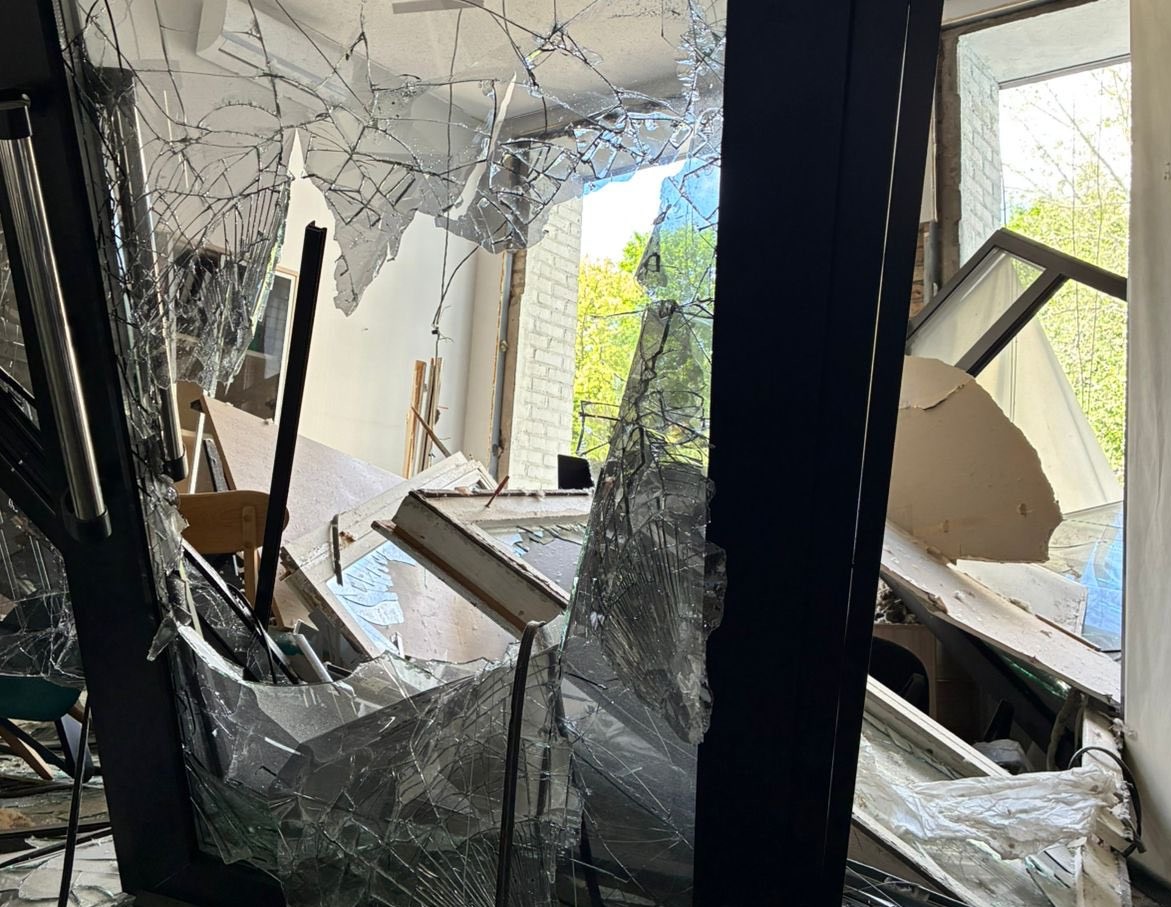
In a single night, at least ten media-related facilities in the capital were affected, including newsrooms, a news agency, foreign broadcasters’ studios, the office of a regional NUJU organisation, and journalists’ homes.
Even without this single incident, May would still have recorded 12 verified cases — exceeding April’s total.
Breakdown of May cases
Media outlets and infrastructure affected — 12 cases
This was the largest category recorded in May.
Affected media facilities included the offices of newspapers 20 Khvylyn and RIA Plus in Ternopil, Maiak newspaper in Bohodukhiv, the Suspilne Zaporizhzhia regional branch, and Promin newspaper in Snovsk.
Following the 24 May attack on Kyiv, damage was also recorded at the newsrooms of Graty, Realna Hazeta, Shelter, the UNIAN news agency, and the studios of German broadcasters ARD and Deutsche Welle.
In addition, the premises of the Zoria publishing house in Dnipro and the office of the Kyiv Regional Organisation of NUJU were affected.
Journalists’ homes damaged — 6 cases
Among those affected were the apartments of Suspilne Dnipro cameraman Yurii Tynnyk, D1 television cameraman Oleh Rodionov, and Hromadske Radio correspondent Andrii Hryn in Kramatorsk.
Following the 24 May attack on Kyiv, homes belonging to television presenter Olha Freimut, Taras Shevchenko National University journalism lecturer Artem Zakharchenko, and media professionals Ihor Martynenko and Viktoriia Zabiyan were damaged or destroyed.
“The most frightening thing is the feeling that this is not the end, that something else may happen at any moment,” said Viktoriia Zabiyan, whose apartment was damaged during the Russian attack on Kyiv.
Journalists’ vehicles damaged — 3 cases
Russian attacks damaged the vehicles of akzent.zp.ua journalist Yana Mozul in Zaporizhzhia, Channel 5 correspondent Valentyna Pestushko in Kherson, and television presenter Ihor Martynenko in Kyiv.
Journalists injured — 1 case
On 13 May, Oksana Rudyk, an editing director at Suspilne Ivano-Frankivsk, suffered a shrapnel injury to her leg while moving from her office to a shelter during a drone attack.
She was hospitalised.
Geography
While Dnipropetrovsk region recorded the highest number of cases in April, Kyiv became the epicentre in May.
Ten of the twenty-two documented cases were linked to the capital and the consequences of the large-scale attack on 24 May.
Other cases were recorded in Dnipro, Zaporizhzhia, Kharkiv region, Chernihiv region, Donetsk region, Kherson, Ternopil and Ivano-Frankivsk.
Note on journalists serving in Ukraine’s Defence Forces
NUJU’s monitoring does not include journalists and media professionals who were killed or injured while serving in Ukraine’s Defence Forces.
However, in May it became known that former cameraman and editing director Oleksandr Klymenko, who went missing during a combat mission in July 2024, had been killed.
Methodology
The monitoring of Russian attacks on Ukraine’s media sector is conducted by the National Union of Journalists of Ukraine.
Only verified cases involving the physical impact of Russian aggression on civilian journalists and media are included. These include injuries to journalists, damage to media outlets, journalists’ homes, and journalists’ property.
Verification is based on official reports from media outlets and media organisations, direct appeals from journalists and their families, information published in open sources, as well as NUJU’s own monitoring and reports provided by regional coordinators of the Journalists’ Solidarity Centres network.
The data are regularly shared with international partners, including the International Federation of Journalists (IFJ), the European Federation of Journalists (EFJ), the Committee to Protect Journalists (CPJ), and other organisations documenting Russia’s crimes against journalists and media.
















Discussion about this post