 THE NATIONAL UNION OF
JOURNALISTS OF UKRAINE
THE NATIONAL UNION OF
JOURNALISTS OF UKRAINE
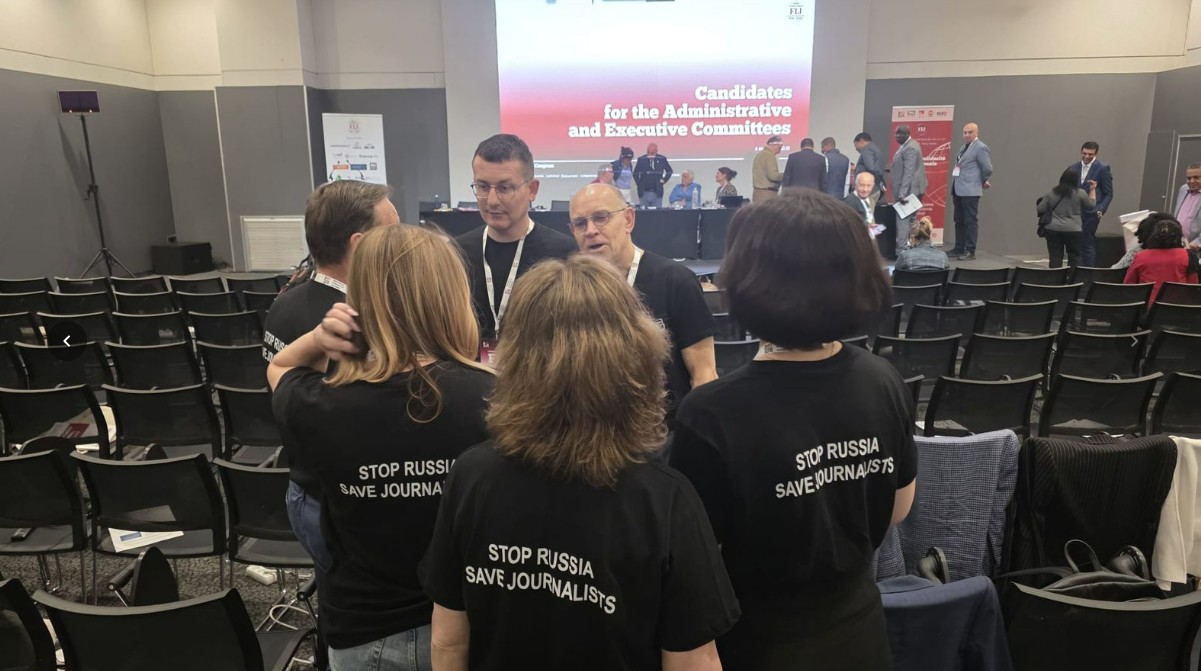
The Russian Union of Journalists has been expelled from the International Federation of Journalists by decision of the IFJ Congress, which endorsed the recommendation of the Appeals Commission – the body that examines disputed matters in accordance with the federation’s statutes.
The decision was adopted at the 32nd IFJ Congress, taking place in Paris from 4 to 7 May 2026 and dedicated to the federation’s centenary. Among the participants is a delegation of the National Union of Journalists of Ukraine. This decision marks the final stage of a process that has been ongoing since the early months of Russia’s full-scale war against Ukraine.
The IFJ Congress decision concluded a years-long process: the Russian organisation lost its membership following the failure of its appeal, against a backdrop of accusations of cooperation with the state and activity on the occupied territories of Ukraine.
The expulsion procedure, as explained in a comment to NUJU by long-serving former IFJ President and Honorary Treasurer Jim Boumelha, was formal but nonetheless significant. Until this moment, the Russian organisation’s membership had remained suspended – effectively “frozen” following the IFJ Executive Committee’s decision in 2023.
“The Appeals Commission recommended expulsion; the Congress endorsed that decision. The Russian Union of Journalists is no longer a member of the IFJ,” – Boumelha stated. He emphasised that the Russian side did not avail itself of the prescribed appeals procedure: despite having the opportunity to be present and demonstrate their position, representatives of the RUJ did not attend the Congress and did not submit a properly formatted appeal. A letter sent on the eve of the Congress contained general explanations but did not constitute a substantive appeal. “The Commission had no other choice,” he added, stressing that the decision was taken strictly within the framework of the statutory rules.
In Sweden, the expulsion of the RUJ was seen as a matter of principle for upholding the federation’s standards. President of the Swedish Union of Journalists Ulrika Hyllert stated that the IFJ cannot include organisations that are in close alignment with the state. “We cannot have organisations so close to the state in the IFJ,” she said, emphasising that the Congress decision provoked no debate. According to her, this will allow the federation to focus on its key priorities – defending freedom of expression, professional ethics, and supporting journalists, including in conditions of war. “It was the right decision and I am truly proud of it,” Hyllert added.
NUJU described the decision as “the only possible one and long overdue,” stressing that the campaign for the expulsion of the RUJ had begun on 28 February 2022 – immediately after the start of the full-scale invasion. At that time, Ukrainian journalists publicly called on the international community to distance itself from Russian propaganda structures.
In October 2022, NUJU, together with the Independent Media Trade Union of Ukraine, submitted an official protest to the IFJ’s governing bodies. The key argument was the RUJ’s establishment of its own branches on the temporarily occupied Ukrainian territories – in Donetsk, Luhansk, Kherson, and Zaporizhzhia regions. The Ukrainian side characterised this as a violation of international law and interference in the work of legitimate journalistic organisations.
“While we are rescuing journalists who are forced to flee from occupied territories and frontline zones, the Russian Union of Journalists is effectively an instrument of war and occupation,” NUJU President Sergiy Tomilenko had stated previously.
NUJU emphasises that since the suspension of the RUJ’s membership in February 2023, no changes have occurred that could serve as grounds for reconsidering the decision: Russia has not halted its aggression, has not condemned war crimes, and has not distanced itself from participation in occupation media structures. During this period, according to NUJU data, at least 149 Ukrainian and foreign media workers have been killed, 28 journalists remain in Russian captivity, and hundreds of media outlets have been destroyed or seized in the occupied territories — precisely the environment in which the RUJ was building its structures.
NUJU underlines that the Congress decision flows from the federation’s foundational principles. “Solidarity is only possible with those who respect human life, professional ethics, and freedom of expression,” the union states. “What in Russia is called journalism is an industry of hatred that serves the war.”
NUJU Information Service













Discussion about this post