

 THE NATIONAL UNION OF
JOURNALISTS OF UKRAINE
THE NATIONAL UNION OF
JOURNALISTS OF UKRAINE
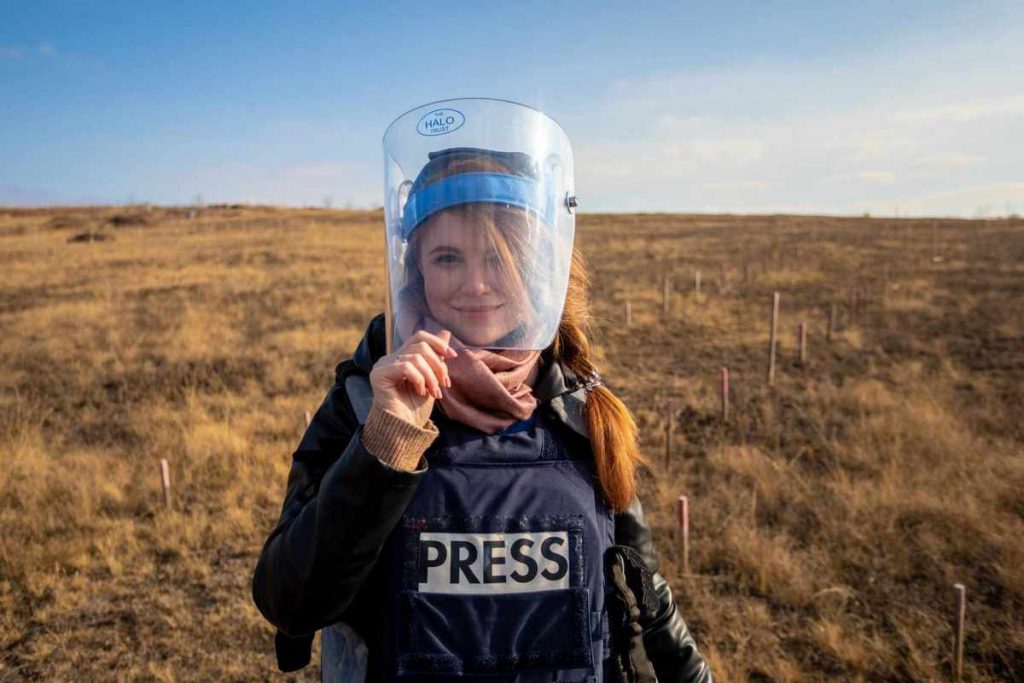
Yuliya Surkova, a war journalist who cooperates with AFP and UNICEF/project mentor of the National Union of Journalists of Ukraine (NUJU), talks about the important role of local media and local journalists in the conditions of the russian-Ukrainian war.
The day before yesterday, I worked in Marhanets, on the outskirts of Nikopol. This is a city on the Dnieper River. And on the opposite bank, there is Enerhodar, occupied by the russians, and the Zaporizhzhia nuclear power plant, whose silhouette constantly reminds of the danger of detonation.
The front line is less than five kilometers away. That means a short distance for constant artillery fire and drone attacks. There is no stable water supply and communication in the city. And now, with the arrival of cold weather, the anticipation of blackouts and a hard winter is threatening the city.
So, there, you want to finish the work as soon as possible and have time to go to the next shelling. And as a journalist working for international publications, I have the privilege of going from a small front-line town to a safer Kyiv.
But when international and national journalists leave, our colleagues from the local mass media stay in place. Under drone attacks, in broken newsrooms, dividing time between survival and work. And often, they are driven not just by a desire to stay at home but by a real journalistic responsibility.
After all, let’s be honest: most residents of Nikopol hardly read AFP or the BBC. At least because they don’t always have internet, they are one hundred percent more waiting not for my report but for the report of, for example, Ms. Inna Shvydka from the Pivdenna Zoria newspaper who works in a newsroom affected by shelling, during alarms and without even having a bulletproof vest and a helmet.
With this introduction, I want to say that the work of small front-line newsrooms is almost invisible on a global scale but critically important to their communities. But often very dangerous.
For the past six months, I have been a content mentor in the project of the NUJU and UNESCO, which supported newsrooms from the de-occupied and front-line territories. And after talking with dozens of such mass media representatives, I saw their problems and their potential.
The most acute problem is, of course, security. You have all heard the sad figure of 75 killed journalists since the beginning of russia’s war against Ukraine. But, unfortunately, the number is higher.
After all, sometimes local journalists who were killed in their cities under shelling are counted as civilian victims. But does a journalist cease to be a journalist if they are killed not while collecting information?
Are there, for example, calculated numbers of broken schools and hospitals in Ukraine? But what is the number of destroyed newsrooms?
Many local journalists working in the five-kilometer front-line zone often do not even have bulletproof vests and helmets. And here, the problem of security intersects with the problem of lack of money. Advertisers have been lost, subscribers have become refugees, and printing houses have found themselves somewhere behind the front line.
And where printing can be restored, the problem of distribution appears, as there are no postal services, or they are very expensive.
For instance, today, the only printed district newspaper published in the Kherson Region is Visti from Novovorontsovka District. The only journalist working in this newspaper is Iryna Kosharska. She survived the occupation by burying her journalist ID in a glass jar in the garden. She unearthed it after the liberation of the village and now publishes a newspaper with the help of the journalists’ union without even receiving a salary. Her community was flooded after the russians blew up the Kakhovka HEPP. So, she distributed 600 copies of this newspaper herself, sometimes delivering them by boat to flooded villages. And there, readers did wait for the newspaper, as it was the only source of information for them, for those left without light and communication.
Similarly, in the border towns of the Sumy Region, during active hostilities, journalist Oleksii Pasiuha had to hand out the Vorskla newspaper to people himself. And the pensioners receiving it embraced the copies with joy. All because for the front-line territories, local newspapers are not some random pieces of paper with some news. They are a sign that Ukraine has not gone here, and there is hope for a return to normal life.
I am sure that the important local role of small media can be scaled to the global context. After all, these journalists are insiders of stories of heroism or witnesses of war crimes. And global media can get news from them to create great investigations or powerful human stories.
So, I advise international colleagues to get to know local colleagues, support them, and involve them in educational projects. And then, the next time you go to Kherson, Izium, or Kostiantynivka, you, like me, will have reliable sources and caring friends there.
Yuliya Surkova














Discussion about this post