 THE NATIONAL UNION OF
JOURNALISTS OF UKRAINE
THE NATIONAL UNION OF
JOURNALISTS OF UKRAINE
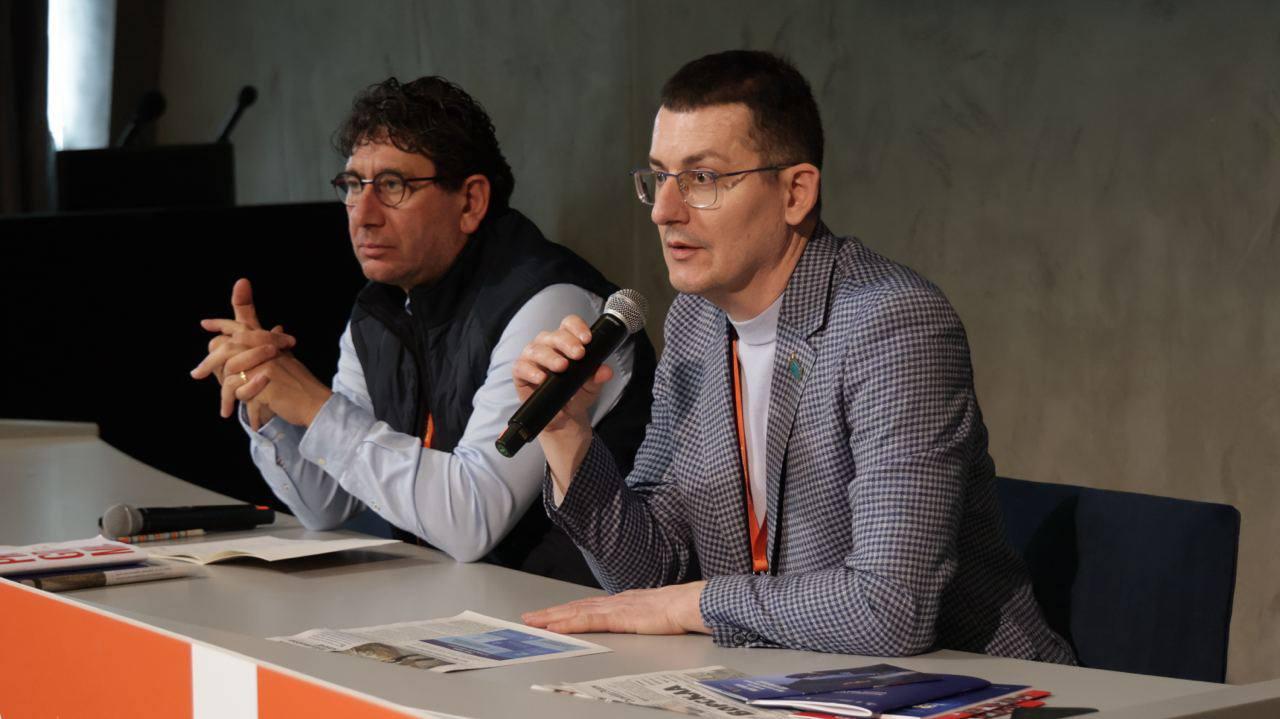
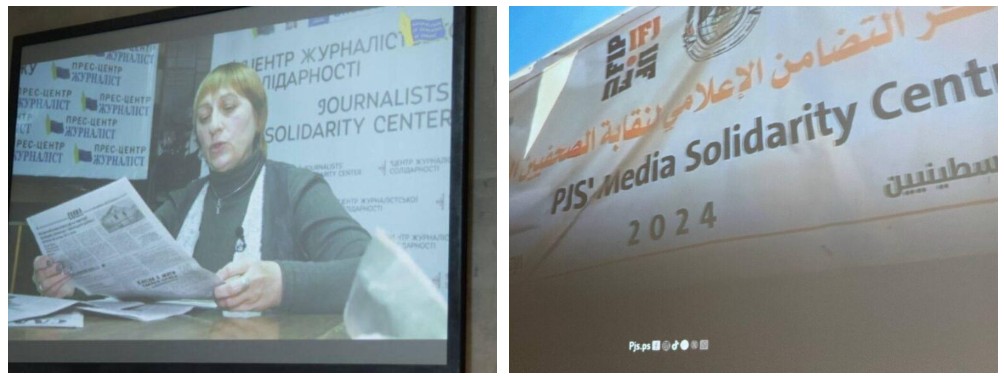
The Network of Journalists’ Solidarity Centers (JSC), created by the NUJU in response to the full-scale russian invasion, has become a model that is being adopted today by colleagues from the Palestinian Journalists Syndicate (PJS). Three such hubs are already operating in the Gaza Strip – in tents, under constant threat of strikes, but according to Ukrainian patterns.
Unique experience: keeping journalists of a warring country in the profession
In February 2022, the NUJU met a full-scale invasion, having one bulletproof vest at its disposal – in the Kyiv office. For hundreds of journalists across the country.
It was this dramatic start that forced the NUJU to build what is now called a network of JSCs in a matter of weeks. At first, these were points for issuing helmets and bulletproof vests, then full-fledged hubs with generators, Starlinks, legal and psychological consultations, premises for working during power outages, hot meals, and first aid courses under shelling.
Over almost four years of war, this network has turned into a unique experience: how to keep journalists in the profession of a country at war when newsrooms go bankrupt, employees are mobilized, and regional media survive under occupation or kilometers from the front line.
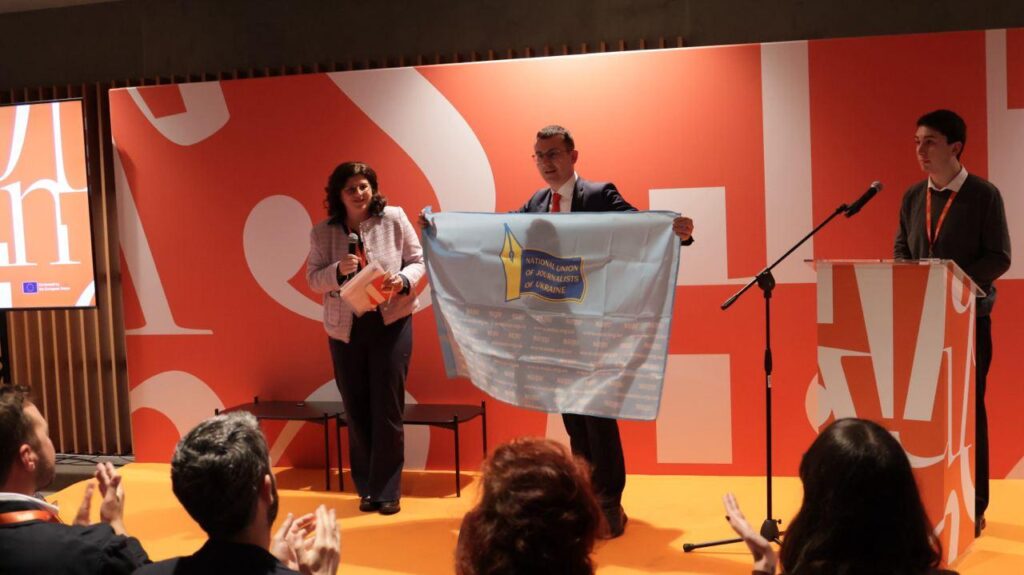
In March 2026, at the third festival Voices – European Festival of Journalism and Media Freedom in Florence, the NUJU received the grand prix – the Media Freedom Award for this network. But another event was no less important – at the festival grounds, NUJU President Sergiy Tomilenko met with Yousef Habash, a representative of the European branch of the Palestinian Journalists Syndicate (PJS). The conversation was about how the Ukrainian model of JSCs was transferred to the reality of the Gaza Strip, where the infrastructure is so destroyed that there is no question of stationary offices at all.
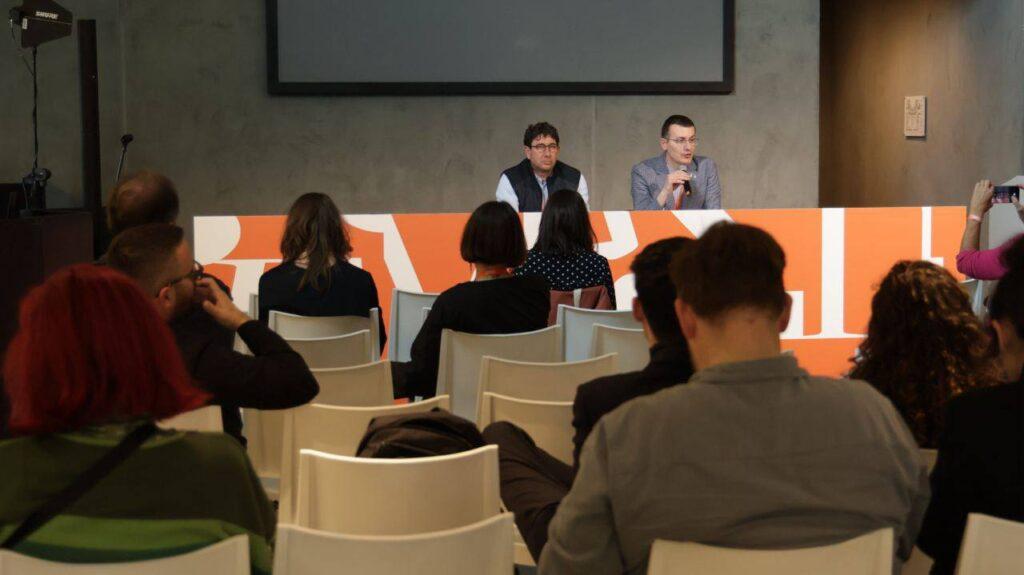
The result of this cooperation is already visible “on the ground” today.
“In Gaza, we have installed three such hubs – according to the same model as in Ukraine,” says Yousef Habash.
The Palestinian centers are deployed in tents. Journalists come there to charge their cameras, phones and laptops, get access to satellite internet, coordinate with each other, and transmit materials to the newsroom outside Gaza. Often this is the only technical opportunity to stay on the air.
“Sometimes we are afraid that these centers may be directly attacked,” says Habash. “In two years, we have lost about 260 journalists.”
“Journalists are brave, but this is not enough”
Cooperation between the NUJU and PJS is not a political declaration or a formal memorandum. It is the transfer of a specific methodology tested in Ukrainian conditions. In the conversation between Tomilenko and Habash, at least four practical principles are visible that make the model work outside of Ukraine.
The first principle: The Center is a function, not a building. If it is impossible to rent an office in Gaza, a tent performs the function. When a building in a frontline city in Ukraine cannot withstand another shelling, the Center can move to a basement, a library, or the premises of the local administration. The main thing is that the generator, communications, first-aid kit, and a coordinator trusted by colleagues’ work.
The second principle: the hub serves the profession, not a separate media outlet. Journalists from state and private media, freelancers, photojournalists, and regional video bloggers come to the Centers. The only criterion is membership in the workshop. It is this universal approach that allowed the model to be scaled up in a country with a completely different media market.
The third principle: psychological support. In both Ukraine and Gaza, journalists work in a mode of chronic mental trauma, often without the opportunity to take a break. Without systematic work on mental health, the network loses people faster than it has time to find and train them.
The fourth principle: international solidarity as the fuel of the system. The centers do not work on self-sufficiency. Both the Ukrainian and Palestinian networks rely on the support of the European and International Federations of Journalists (EFJ-IFJ), national partner unions, and private donors. Without this external contour, any internal enthusiasm will run out in a few months.
This is where the key shift lies. During the first two years of the full-scale war, the Ukrainian journalistic community got used to the role of the receiving party: bulletproof vests, helmets, humanitarian grants, equipment, security courses, relocation programs. This was a necessary and natural stage.
The Gaza case captures a new status: the Ukrainian community has transformed from a recipient of international support to a donor of methodology. The experience cultivated in Kyiv, Zaporizhzhia, Dnipro, and Kharkiv is today reshaping journalistic work in a completely different conflict – thousands of kilometers away, with a different language, a different religion, a different geopolitical framework.
In a conversation with Yousef Habash, Sergiy Tomilenko from formulated a thesis that could become the motto of the entire initiative: “Journalists are brave, but that’s not enough.”
Behind this phrase is a sober understanding that Western audiences sometimes lack: the individual courage of a reporter in a bulletproof vest is the last line of defense of the profession, not the first. In order for this reporter to really be able to work, a system is needed: logistics, equipment, legal protection, evacuation, insurance, psychologists, lawyers, colleagues nearby. All this is what the network of JSCs is building – first in Ukraine, and now in Gaza.
“We don’t know what challenges tomorrow will bring,” says the President of the NUJU. “But we do know that journalists should not feel alone. That is exactly what the Centers are for.”
NUJU’s JSCs Won the Voices – European Festival of Journalism and Media Freedom in Florence
Podcast as a Record of Experience
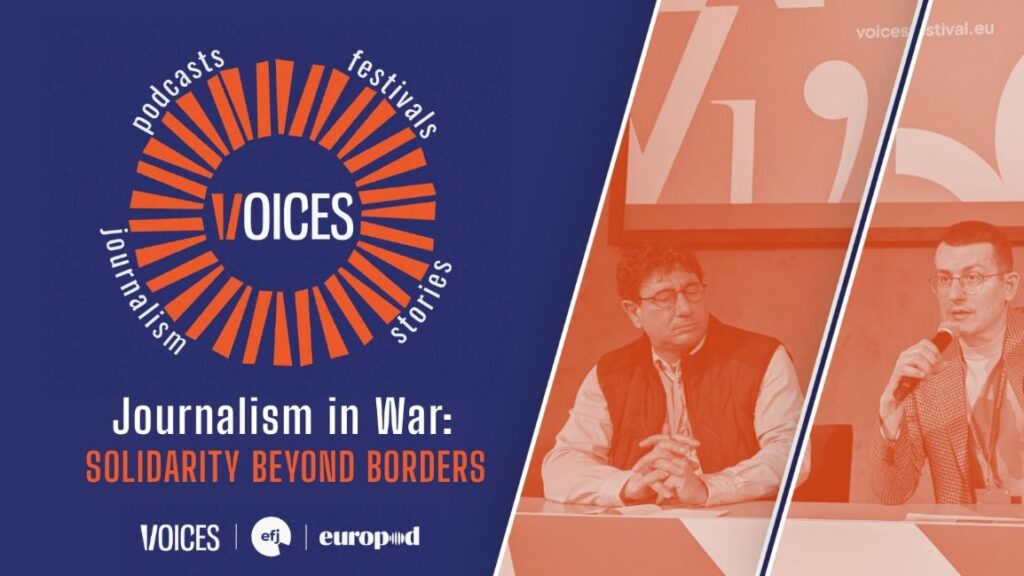
The public summary of the Ukrainian-Palestinian conversation in Florence was the first episode of the Voices podcast – “Journalism in War: Solidarity Beyond Borders”, which the EFJ together with the Europod studio released on April 21, 2026. In it, Sergiy Tomilenko and Yousef Habash tell in detail how the JSCs work in both countries and what exactly is transferred from the Ukrainian experience to the Palestinian one.
The EFJ plans to continue the communication campaign around this material until World Press Freedom Day on May 3 – precisely to keep the attention of donors and the international community on the fact that JSCs need continued funding, both in Ukraine and in Gaza.
NUJU Information Service









Discussion about this post