

 THE NATIONAL UNION OF
JOURNALISTS OF UKRAINE
THE NATIONAL UNION OF
JOURNALISTS OF UKRAINE
In the modern world, and especially in times of war, a journalist must not only be a master of words but also be a fact-checker, an analyst of the reliability of information. In today’s multidimensional communicative space, he must be both a communicator and a psychologist, able to understand the mechanisms by which information influences people and their specific nuances for different audiences.
This is especially true of manipulative and unreliable information, which is the basis of the information war launched by russia against Ukraine.
And these are not just loud words. Today, russia ranks first in the world in terms of systematic investments in propaganda. In 2024 alone, its budget for this exceeded USD 2 billion. The most powerful weapon against this propaganda is critical thinking. At the same time, as the professor stated in her research, only about 20% of the population has a sufficient level of critical thinking.
That is why the topic of fakes, manipulations, and disinformation, and most importantly, ways to recognize and counteract them, became central at the second mentoring session of the media expert of the Academy of Ukrainian Press, business trainer, professor, and head of the Department of Social Communications of Mariupol State University, Tetiana Ivanova.
The course participants were editors-in-chief and journalists of front-line media – participants of the NUJU project called Strengthening the Resilience of Frontline Media as a Tool for Combating Disinformation.
Should journalists always react to fakes?
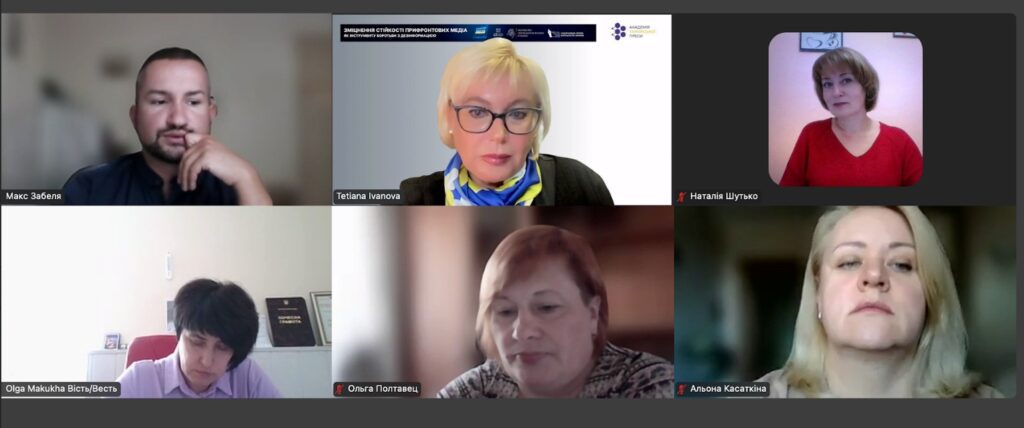
Working with real examples of fake messages, the participants learned how to react correctly to unreliable information. Using specific cases, they developed a model of reliable news. They identified the key messages that should be included.
This is important because, as Tetiana Kaushan, the editor of the Putyvlski Vidomosti newspaper, said, in their region, many people spread rumors, such as: “tomorrow they will seize a piece of territory, blow up bridges, and we will remain near russia.” Such messages sow fear and anxiety, and people quickly begin to believe them if they see them on some resources.
Another question was is journalists always need to react to misinformation in the information space.
Together, we concluded that the media must definitely react, especially if it is not an isolated case, but a widespread spread of untruth.
According to Tetiana Ivanova, it is essential to present verified, official information to the audience immediately and even indicate this in the headline. Yes, fact-checking takes time, but the advantage of a journalist is always on the side of reliability.
Counter-propaganda as a journalist’s mission
“During war, journalists cannot be propagandists, but they must be counter-propagandists,” emphasizes Tetiana Ivanova. After all, not opposing or spreading fake news is a small but dangerous victory for the enemy on the information front, and we cannot allow him to do so.”
The expert highlighted several key principles for journalists who refute fake news:
- Use facts, not slogans. Propaganda often relies on emotional slogans, whereas journalists should work with facts, documents, and verified testimonies.
- Show complexity. The truth is often ambiguous, and you should not hide “gray areas.” Honesty builds trust.
- Allow the reader to draw their own conclusions. Do not impose your opinion, but offer information that stimulates critical thinking.
- Do not become like the enemy. Avoid hate speech and dehumanization, even in materials about the war.
- Tell personal stories — without idealization. The power of truth lies precisely in its imperfection.
So, writing the truth is not only a challenge, but also a responsibility — this was the main conclusion of the participants.
Why do people believe fakes?
The next stage of the training involved identifying the psychological mechanisms that lead people to trust lies.
In the format of a brainstorming session on the Canva platform, participants analyzed the reasons for trusting disinformation. They concluded that journalists should explain these reasons to their audience. This enhances the informational and psychological appeal to readers.
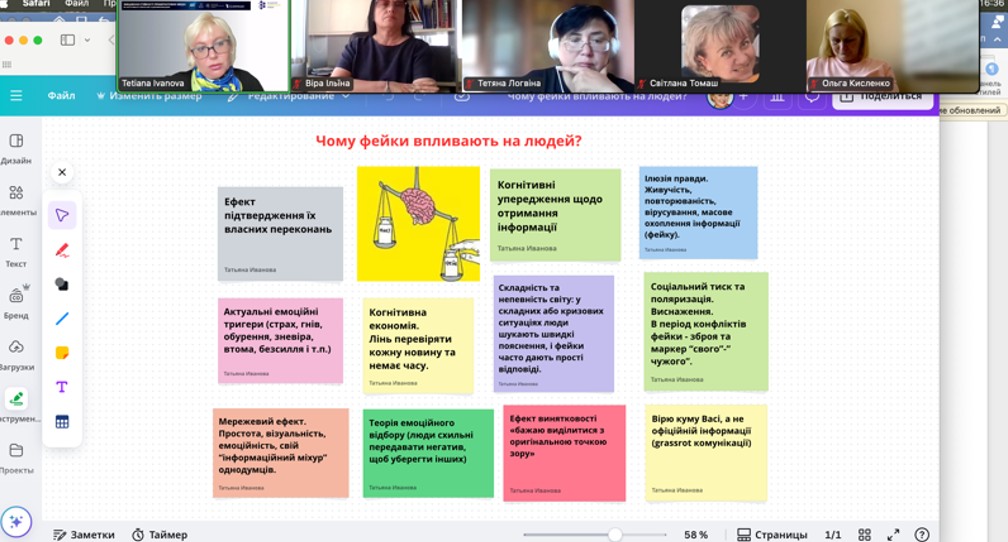
“A person who lives in a state of war, psychological confusion, is often unable to think critically. He is more likely to believe in what gives him the illusion of survival. To create a fake, it is enough to influence two areas: emotions and cognitive biases,” explained Tetiana Ivanova.
Technologies for creating fakes
A separate module was the study of technologies used to spread fakes. The participants analyzed:
- photo fakes and deepfakes,
- staging of events,
- embedding lies into authentic content,
- Goebbels’ “pie of lies,”
- methods of neurolinguistic programming,
- technology of “information waves”, etc.
Using examples from their regions (Zaporizhzhia, Nikopol, Sumy, Chernihiv, etc.), journalists saw how russian propagandists use these methods, and what threat they pose to society and the state.
Information verification tools
“Social networks remove only about 5% of fake content. The remaining 90% continues to live even after refutations,” noted Ivanova. That is why fact-checking is critically important.
Among the technologies, the participants became acquainted with OSINT (Open Source Intelligence Investigation) methods, which are based on open-source information: social networks, photo and video resources, maps, databases, and satellite images, among others.
We also examined fact-checking tools:
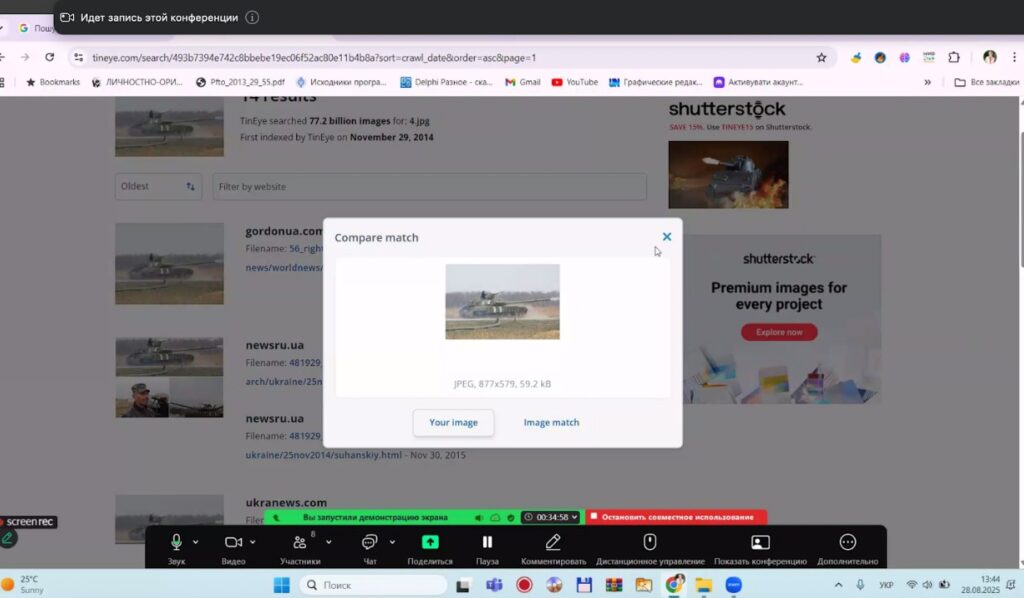
- Google Reverse Search — reverse image search;
- com — search for the source and chronology of the appearance of a photo;
- com — detection of editing through image analysis (ELA).
The participants were able to see how the same fake photo reveals its falsity through three different tools.
Practical “highlight”
Ultimately, the participants completed the “Fake” exercise, analyzing the “news” according to fact-checking criteria and determining its veracity.
“This was the real “highlight” of the training. After all, as Socrates said, the most valuable truth is the one that a person has reached on his own. This is how, through practice, discussions, inspiration, and mutual support, the resilience of Ukrainian front-line media is formed,” concluded Tetiana Ivanova.
The project is funded by the Embassy of the Republic of Lithuania in Ukraine within the framework of the Development Cooperation and Democracy Promotion Programme.








Discussion about this post