

 THE NATIONAL UNION OF
JOURNALISTS OF UKRAINE
THE NATIONAL UNION OF
JOURNALISTS OF UKRAINE

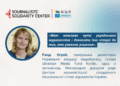
Details, reportage moments, facts, and expert comments, as well as respect for the hero of the story, even if they are negative, are the mandatory components of a successful feature. How to make a feature from your materials that is interesting to Western media, what to pay attention to and what mistakes to avoid, was discussed during the second mentoring session, which was held for participants in the National Union of Journalists of Ukraine’s (NUJU) course called Strengthening the Resilience of Frontline Media by Yuliya Surkova, a journalist with experience in covering war in international media.
Feature. Everything that is not news
In English-language journalism, almost everything that does not belong to the news genre is usually referred to as a feature. This article features a news-related component (although not necessarily about the latest events), reportage moments, and a few thoughts, with a focus on human history. In terms of volume, the material typically ranges from 700 to 1,000 words.
The feature should contain details that reveal the hero and the atmosphere, evoking empathy and creating the effect of presence.
In a feature, respect for the hero around whom the material is built is important.
“Even if the hero is negative, give them the opportunity to express their point of view. If they are positive, let themself reveal their ideas. Talk, but with respect for their feelings and experience,” Yuliya Surkova noted.
The mentor gave an example of a question that should not be asked of the hero: “What did you feel when a shell hit your house?”
Comments from experts, opponents, and relatives should support the hero’s story. Everyone who will help make the feature an honest picture of objective reality.
“The story will not leave the reader indifferent only if you yourself are not indifferent to it. Suppose a journalist wants to be the voice of their hero and their city, their country. In that case, his voice will definitely be heard,” the journalist added.
Elements of a successful feature:
- There must be an informational component;
- Several opinions must be presented;
- Expert points of view must be presented;
- Reportage moments (atmosphere, texture, emotions of the characters, details);
- Human history is the central meaning of the material;
- Remember that this is still journalistic material, so use fewer adjectives and adverbs. Don’t abuse evaluative judgments, reread the text, and leave only those constructions, adjectives, and adverbs without which the essence is lost.
- Break the text into subheadings.
To understand whether your text is easy to read, Yuliya Surkova advises reading it aloud. If you get tired after 2-3 paragraphs, it means that it is overloaded.
What might interest a Western audience
Global processes and events (elections, politics, environmental issues, competitions, contests).
Things that are close to everyone (children, animals, food, sports, holidays).
Stories of success and overcoming, as well as stories of rescue with a crazy ending.

Stories from our country that are connected with other countries.
“For example, when there was a meeting between Putin and Trump in Alaska, where they talked about Ukrainian territories, in particular, russia’s ambitions for the entire Donbas, local media could have done stories about people who came from the Donetsk Region, asked their opinion about it,” Yuliya Surkova gave an example. “Stories about animals are also good to read, in particular, those that become friends of our military.”
The journalist emphasized that it is important to remember the timing. If there is a siesta in Italy, then you should not offer difficult topics about death in the media. If there are elections to the Bundestag in Germany, they are unlikely to be about art.
“There are always anniversaries that are ‘working’ – the anniversary of the full-scale invasion, the anniversary of the Kakhovka tragedy, for which it is worth preparing materials,” added Yuliya Surkova.
How to make the material interesting for Western audience
During the session, using the materials that participants had prepared based on the results of the previous session, Yuliya Surkova provided recommendations on how to adapt the texts to meet the requirements of Western media.
Journalists talked about their work on children’s stories (a practical task from the previous session). Tetiana Velyka, the editor of the Holos Huliaipillia newspaper, shared her experience: her story about 16-year-old Sashko Bondarenko, who was injured after an attack on the village of Dolynka by enemy guided bomb. On the day she agreed to interview the teenager, he was just being discharged from the Zaporizhzhia Regional Children’s Hospital. The journalist said: she lets each such story “pass through her”, and this could not affect the material.
The material by Olena Kasatkina, the editor of the publication Panorama, is about a little Sumy resident, Illia Otroshenko, who was not even nine years old when the full-scale war began. Since then, two of his books have been published, and the boy became the record holder of the National Register of Records of Ukraine.
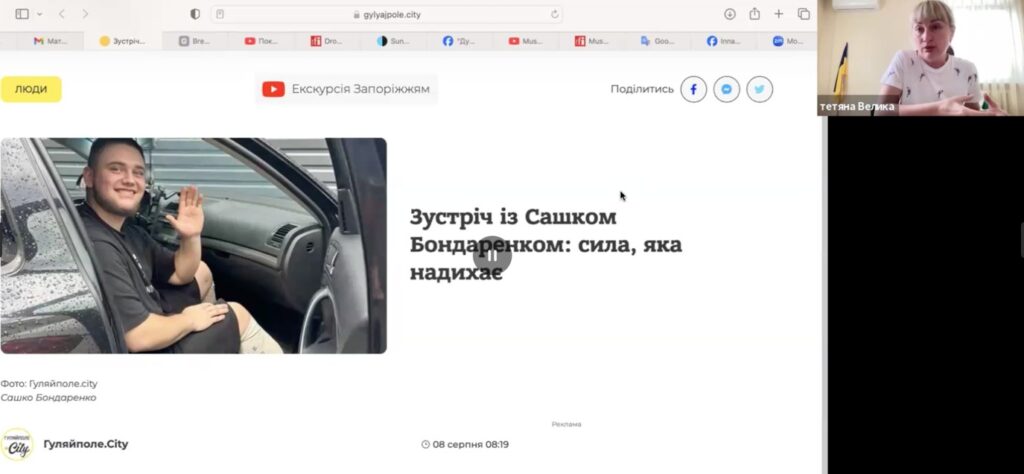
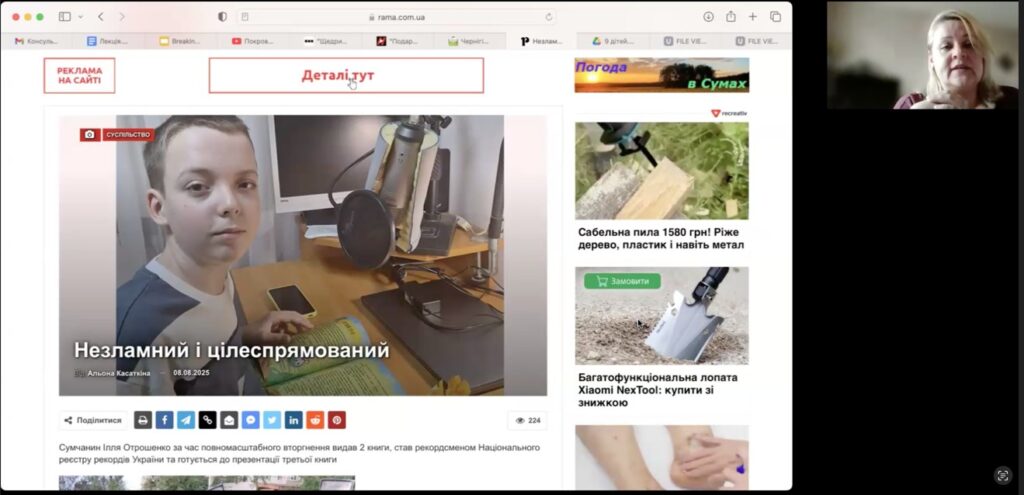
Discussing their materials with the participants, Yuliya Surkova drew attention to the following points:
- Do not forget about the information component, the so-called Five Ws principle (Who, What, When, Where, Why). It is advisable to present this information not too “far away,” for example, in the second paragraph, so that the audience understands the context.
- Provide additional information about the location of the event, specifically the distance from the front line and the number of full-scale wars already underway in the area (this is important for foreign media).
- Provide generalized data or statistics (if it concerns injuries – how many children were injured due to the war; if it concerns gifted children – how many of them went abroad or to other cities where they study, and so on).
- Pay attention to photos: Western media outlets that are too “bloody” usually do not take them. Instead, it is better to include reportage photos of the settlement, archival photos, and so on.
- Do not mix genres: often in journalistic materials, the format of a story (feature) turns into an interview. This is not worth doing.
The project is funded by the Embassy of the Republic of Lithuania in Ukraine within the framework of the Development Cooperation and Democracy Promotion Programme.










Discussion about this post