

 THE NATIONAL UNION OF
JOURNALISTS OF UKRAINE

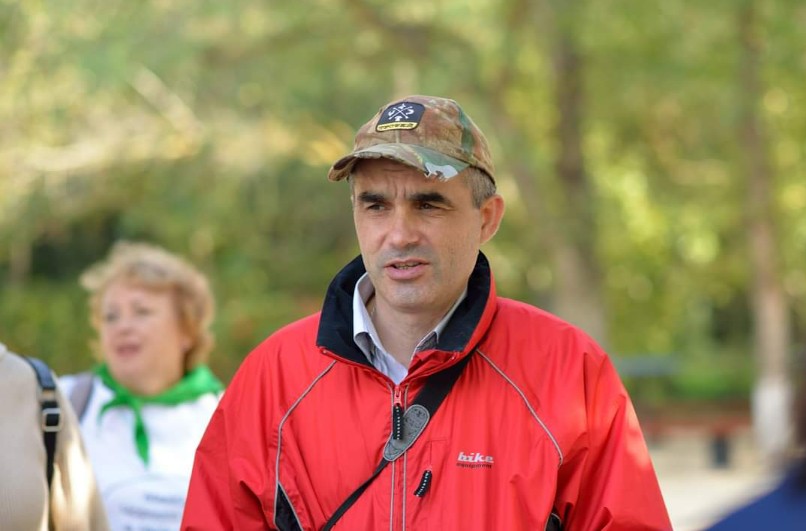
Oleksandr Mezinov is a Ukrainian biologist. For twenty years, he studied the migration of wild birds at a biosphere reserve and had nothing whatsoever to do with military affairs. But the Russians labeled the scientist and his colleagues “terrorists.” And the reserve itself is being destroyed and turned into a territory of fear for every living thing.
Askania-Nova lies in the part of the Kherson region that Russian troops occupied in the first days of the full-scale invasion, and what is happening there is followed by Novyi Den (“New Day”), which for decades was the region’s leading newspaper in circulation and influence. The editorial team itself had to leave at the start of the war and now works remotely, but its reporting is still centered on the Kherson region: on the city of Kherson and the right bank of the Dnipro, which come under daily fire from artillery, mortars, guided aerial bombs, and FPV drones, and on the occupied left bank, where people, animals, and the land itself have been cut off from the rest of Ukraine. Despite the danger, the newspaper continues to print an edition for residents of frontline communities.
Oleksandr Mezinov is a Ukrainian biologist. For twenty years, he studied the migration of wild birds at a biosphere reserve and had nothing whatsoever to do with military affairs. But the Russians labeled the scientist and his colleagues “terrorists.” And the reserve itself is being destroyed and turned into a territory of fear for every living thing.
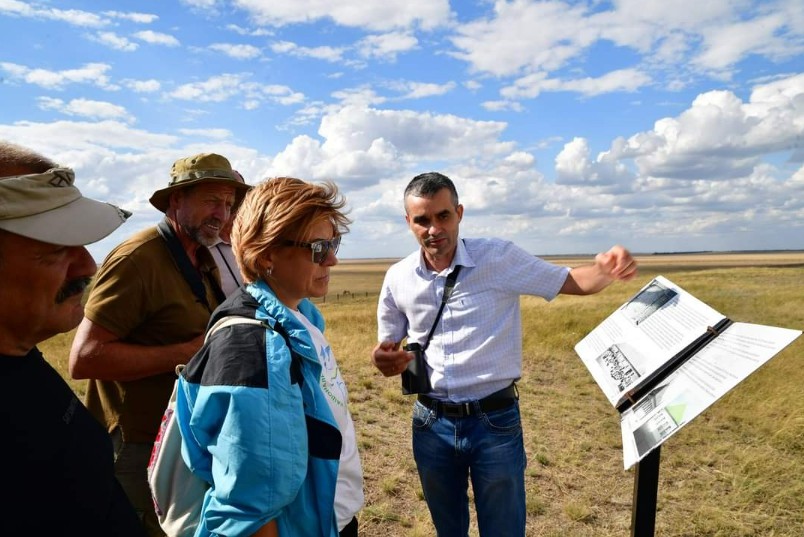
The Askania-Nova Biosphere Reserve is a true jewel of Ukraine—and not only of Ukraine, but of the entire continent. It is home to the largest area of virgin steppe in Europe: a natural landscape that has never been plowed and has survived in a nearly primeval state. Hundreds of species of steppe grasses and wildflowers grow here, alongside animals that have all but vanished from the wild across the rest of the continent.Przewalskiʼs horse, one of the last truly wild horse species on Earth, Père Davidʼs deer, Burchellʼs and Grévyʼs zebras, and common eland. And also: American bison, mouflon sheep, llamas, camels, saiga antelopes—nearly fifty species of hoofed animals and around a hundred species of birds. This unique biosphere was shaped over decades. Because contrary to a common misconception, the steppe is not “empty space”—it is a complex and fragile ecosystem in which life depends on the balance between grasses, insects, birds, and large ungulates.
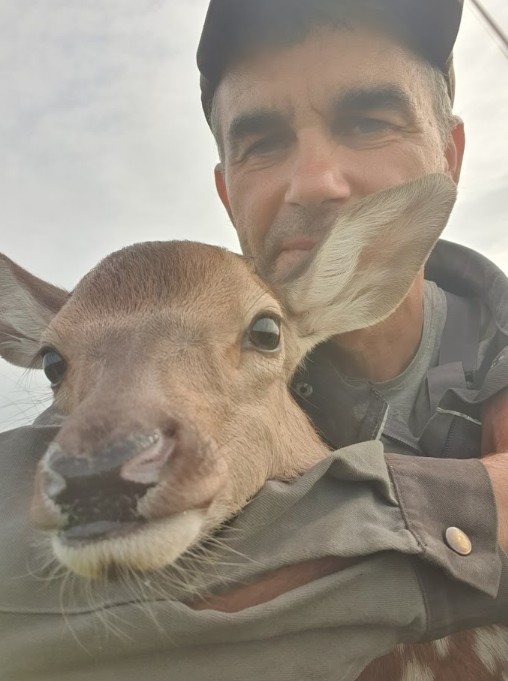
One of the people who helped build this wonder on the steppe was Oleksandr Mezinov, head of the laboratory for the conservation of wild animal diversity.
But everything changed on February 24, 2022, when Russia launched its full-scale invasion of Ukraine.
Grad Rockets and Tanks Against a Nature Reserve
“At five in the morning, I stepped onto the balcony of my apartment and saw the horizon catch fire—they hit our territory with Grads,” recalls Viktor Havrylenko, one of the reserveʼs senior researchers and its longtime director before the war. The BM-21 Grad is a Soviet-designed multiple rocket launcher capable of firing dozens of explosive rockets in rapid succession—one of the most widely used weapons in the Russian arsenal. “The earth shook, our 90-apartment building jolted. A tank column drove demonstratively onto the reserve grounds, tearing through the land as though with plows.”
The war threatened the very logic of the reserveʼs existence. Askania-Nova holds the status of a UNESCO Biosphere Reserve—meaning it is part of the global system of nature conservation. Russia’s occupation of Ukraineʼs Kherson region effectively cut the reserve off from Ukraine and from the international scientific community.
Combat operations destroy the steppe no less brutally than they destroy cities and villages. Tank tracks and armored vehicle treads strip away the topsoil. Explosions obliterate plant cover that took decades to form. For the steppe, this is critical: while a forest can regenerate, virgin steppe, once destroyed, often does not recover at all.
Animals die from stress, the noise of explosions, and lack of feed. Aircraft and helicopters traumatize the ungulates, causing panic in herds. Bird migration patterns are disrupted, and with them, years of scientific observation.
Today, according to scientists, a significant portion of the rare and valuable animals has been lost or removed. In their place, the Russian occupation administration has been bringing in low-value or unsuitable species—more for appearances than for conservation. A significant portion of the protected steppe has been scorched by fires.
A Person in a Great Catastrophe
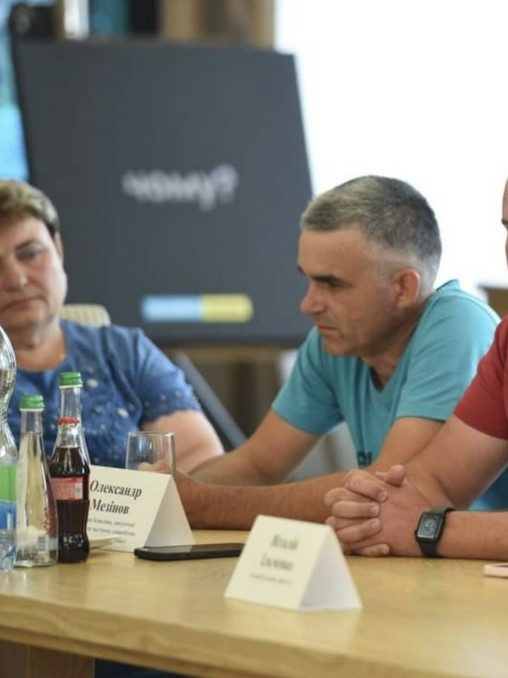
The catastrophe of Askania-Nova has not only a global dimension, but a deeply personal human one. Zoologist Oleksandr Mezinov spent 17 years heading the laboratory for the conservation of wild animal diversity at the Askania-Nova Institute of Animal Husbandry of the Steppe Regions.
When the occupation began, he did not leave. He stayed to work alongside some of his colleagues. The scientists desperately tried to keep the situation under some measure of control.
“The Ukrainian state flag flew over our reserve until March 21, 2023, and we tried to preserve what a large team had worked tirelessly to build over decades,” Oleksandr recalls.
The flag still flew, but the Ukrainian state treasury system no longer functioned in the occupied territory. It became impossible to purchase animal feed or veterinary supplies. So through social media, the scientists called on volunteers and fellow researchers around the world for help. And help came.
“Money came from the European Association of Zoos and Aquariums, from Polish, Czech, and German zoos, among others. Within two months, we managed to stockpile enough supplies and feed for more than a year and a half. We also purchased building materials for potential repairs to the animal enclosures—it was wartime, after all!” the scientist recounts.
However, within two months, Ukrainian intelligence warned Mezinov: there was information that Russia’s FSB—the Federal Security Service, Russiaʼs primary domestic intelligence agency and successor to the Soviet KGB—was preparing to arrest him. The reason? Russian propaganda had declared the scientist a “biological terrorist.” As evidence, they cited television news segments in which he had demonstrated maps showing bird migration routes—a scientific subject he had been studying for decades.
“To the word ‘laboratory’ in my job title—’head of the laboratory for the conservation of wild animal diversity’—the propagandists added the prefix ‘bio,’ and suddenly I was a terrorist! That’s what passes for ‘evidence’ with the Russians,” Mezinov comments with irony.
His departure to Ukrainian-controlled territory became an ordeal fraught with serious danger. Oleksandr had to pass through 53 Russian checkpoints. Meticulous document inspections at gunpoint. Searches. Only after reaching Ukrainian soil did he realize how close he had come to being caught. It would have been enough for any one of the Russians to run his name through the FSB database, and arrest and captivity would have been inevitable. Whether through negligence or because the occupiersʼ repressive system was not yet fully calibrated, he managed to pass through all fifty-three checkpoints.
Instead of Scientists—“Researchers” From the Security Services
What happened next? Oleksandr knows that after he disappeared, his own apartment in Askania-Nova was looted and turned into a barracks. He dreams of returning to his home and to his beloved steppe. He says with bitterness: “They turned our ‘pearl of the steppe’ into a cage—not only for rare animals, but for people.”
Today, the scientist continues his work in the Lviv region of western Ukraine. He is developing a deer farm in the Precarpathian area and helping animals that have been displaced from the Donetsk and Luhansk regions—the war-torn east of the country. He remains in contact with colleagues who, for various reasons, stayed at Askania-Nova. Their accounts are grim.
“Askania is dying. The ungulates and birds are suffering. There are fewer and fewer of them. Before the war, more than fifty peacocks alone would run along the zoo’s paths. Now you might see one or two in a frame of a propaganda video. While stealing the valuable species, the occupiers bring in a lot of ‘junk.’ Then they show off these low-value animals. As if to say: ‘At least we have something,’” Mezinov says.
Friends also tell him that reserve staff are quitting en masse: the occupiers have not paid salaries for five months. “The occupation management knows nothing about how the work here is done—they came only to steal,” Oleksandr says, relaying the words of his colleagues.
One telling detail: the occupiers appointed as “director of the reserve” one Dmytro Meshcheriakov, a former officer of Ukraine’s Security Service (SBU) who defected to the Russian side.
The story of Oleksandr Mezinov is not only about a truly life-threatening risk and his personal escape from danger. It is about the fragile line between civilization and barbarism—a line that was drawn across centuries-old virgin steppes by the heavy treads of occupation tanks. The steppe does not scream. It does not resist. It simply disappears. And with it, the people who knew how to protect it.
By Andrii Beinyk, Novyi Den newspaper, Kherson region, Ukraine. Translated and adapted for international audiences.
_______________________________________________________________
Novyi Den (meaning “New Day”) is an iconic media outlet of the Kherson region that for decades remained the region’s leading newspaper in terms of circulation and influence. The publicationʼs story during the full-scale war has become an example of extraordinary dedication to the profession: from the very start of Russia’s invasion, the editorial team was forced to relocate and now operates remotely—a decision that allowed it to preserve its staff and maintain uninterrupted coverage.
The security situation for the outlet remains critical. Although the team works remotely, its focus is on its home region, where the right bank of the Dnipro River—including the city of Kherson—is subjected to daily mass bombardment from artillery, mortars, and guided aerial bombs (known by their Russian acronym KABs, a type of precision munition dropped from aircraft). An additional threat comes from enemy FPV drones (first-person-view attack drones), which actively hunt civilian vehicles and people on the streets. Despite the fact that the editorial offices in Kherson are physically inaccessible or under fire, Novyi Den continues to publish a print edition that is delivered to residents of frontline communities.
As a participant in the Frontline Press program (implemented with the support of the National Union of Journalists of Ukraine and its international partners), the outlet has transformed into a powerful multimedia resource. Novyi Den today is the voice of the Kherson region—heard across borders, through shelling, and despite the distance.
Official website: newdayua.net.
Novyi Den is one of 25 local and regional media outlets participating in the Frontline Press support program, funded by the Swedish media business association Tidningsutgivarna. The program supports professional journalism about life in Ukraine’s frontline communities. The National Union of Journalists of Ukraine (NUJU) is happy to share these stories with international media for republication. To request permission to republish this or other materials produced through the Frontline Press program, please contact [email protected].














Discussion about this post