

 THE NATIONAL UNION OF
JOURNALISTS OF UKRAINE
THE NATIONAL UNION OF
JOURNALISTS OF UKRAINE
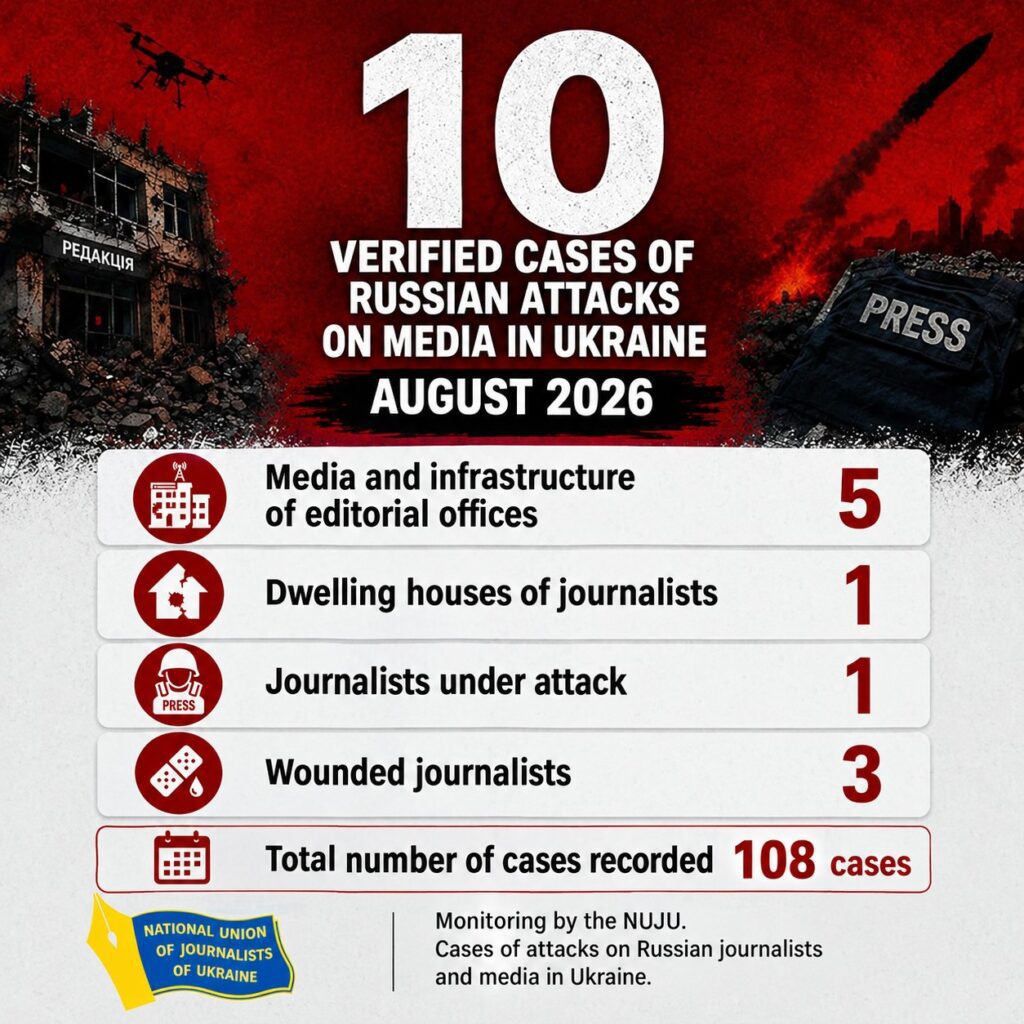
Throughout August 2026, the National Union of Journalists of Ukraine (NUJU) recorded 10 verified cases of Russian attacks physically affecting civilian journalists, newsrooms and media infrastructure. Since the beginning of the year, NUJU monitoring has documented 108 such cases.
The August attacks damaged the workplaces and newsrooms of five Ukrainian media outlets, ranging from regional publications to a national broadcaster, in Kyiv, Zaporizhzhia, Kharkiv region, Donetsk region and Kherson region. The lives and health of five media workers were put at risk while they were carrying out their professional duties or as civilians in Dnipropetrovsk region, Kharkiv and Kherson.
Breakdown of August cases
- Damage and destruction of newsrooms and media infrastructure facilities – 5 cases.
5 August. Visti Barvinkivshchyny newspaper, Barvinkove, Izium district, Kharkiv region.
A drone attack involving Geran-type unmanned aerial vehicles damaged the administrative building where the newsroom has been based for 20 years. Two UAVs struck near the building, while a third hit the roof. The newsroom’s doors were blown out, furniture was damaged, and the walls were hit by shrapnel. No one was injured.
11 August. Vision Radio “Na Dotyk”, Zaporizhzhia.
A missile struck a building approximately 100 metres from the media outlet’s office and studio. The blast wave shattered panoramic windows and damaged a wall and doors. Some of the equipment was also damaged. The incident occurred at night, so no one was injured. Since September, the team has moved to a new, safer location, while the damaged premises will be repaired.
14 August. Visti Novovorontsovshchyny newspaper, Novovorontsovka, Beryslav district, Kherson region.
A drone strike involving a Shahed-type UAV caused a blast wave that damaged the building where the newsroom of the only local newspaper still operating in Beryslav district was based. The office windows were blown out, the doors were torn off, and the roof was destroyed. The premises became unusable for the newspaper team. The staff managed to save the equipment by evacuating it within an hour of the strike. The newsroom was left looking for a new place to work.
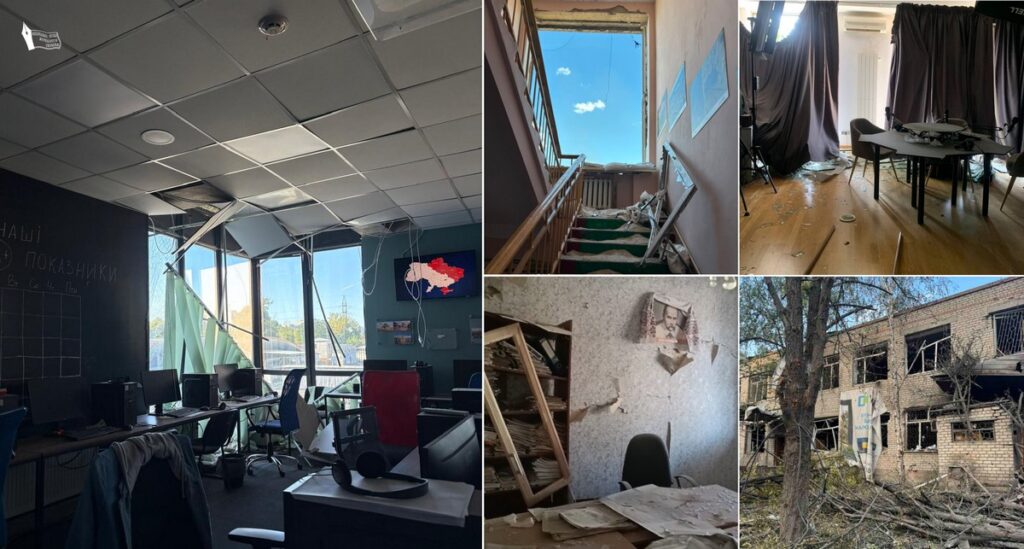
20 August. We Are Ukraine TV channel, Kyiv.
A massive attack on the capital damaged the entrances to the building, shattered windows and damaged parts of the structure. The studio and part of the channel’s filming and technical infrastructure were affected, while newsroom workspaces were badly damaged. Windows in the newsroom were blown out, part of the suspended ceiling was destroyed, and lighting, mounted television equipment, interior structures and work areas were damaged. Broadcasting continued without interruption, while some members of the team switched to remote work.
Unlike the other cases, this incident involved not only damage to the building itself but also to the media outlet’s production infrastructure.
26 August. Visti newspaper, Sloviansk, Donetsk region.
A FAB-guided aerial bomb strike on the city centre also damaged the building housing the newsroom of Donetsk region’s oldest newspaper, which will mark its 109th anniversary in September. Windows, bars and frames were blown out, while equipment and furniture inside the office were likely also damaged. The newsroom has relocated due to the security situation and no longer uses the premises in Sloviansk on a permanent basis. The team works remotely, while the newspaper is distributed free of charge in the city.
This was not the first time the Visti building had been damaged: in 2014, the media outlet’s office sustained similar damage amid the hostilities.
- Attacks on journalists while carrying out their professional duties – 1 case
6 August. STB TV channel (“Vikna-Novyny”) reporting crew.
Reporter Anastasiia Vilkhova and cameraman Oleksandr Dubyna came under attack by Russian FPV drones near Mezhova, in Dnipropetrovsk region. The journalists were travelling by car, accompanied by military personnel, to a position where they were due to report on the work of Ukraine’s Defence Forces.
According to Dubyna, five or six drones were involved in the attack. The first struck the part of the vehicle where a communications device was installed, while subsequent drones continued targeting the car. The journalists spent about an hour hiding in a field, without communications. They were eventually spotted by chance by military personnel returning from the position, who evacuated them. No one was injured.
The case illustrates a tactic increasingly used by Russian FPV drone operators hunting vehicles in frontline areas: first disabling communications equipment and then continuing to target and pursue the people inside.
Particular attention should be paid to cameraman Oleksandr Dubyna’s account that the crew deliberately works without PRESS markings because of the risk of targeted attacks on journalists. This is a systemic problem that media workers and NUJU have repeatedly highlighted: the protection afforded to journalists as civilians under international humanitarian law is, in practice, turning into an additional risk factor.
- Injuries to media workers as civilians – 3 cases
All three cases occurred in Kherson and reflect the deteriorating security situation in the city in recent months. Kherson has been under constant attacks involving guided aerial bombs and various types of UAVs. Neighbourhoods that were considered relatively calm just a few months ago are now coming under increasingly intense attacks by Russian forces, while drones relentlessly target people and vehicles.
10 August. Olena Hnitetska, a freelance journalist who contributes to the media outlets Misto Sontsia and Bilozerka.Info, came under a drone attack in her own apartment. An FPV drone struck the building between her apartment and that of her neighbours. At the hospital, Hnitetska was diagnosed with a closed traumatic brain injury and concussion.
16 August. Ivan Shestopalov, a freelance contributor to Kavun City, was injured when a Molniya UAV struck the Tavriia shopping centre in the central district of Kherson. He was several dozen metres from the site of the strike at the time. He showed signs of concussion.
Then, on 26 August, Shestopalov was hospitalised with a burn and shrapnel wound to his leg after an FPV drone struck a car in which he and several other people were travelling. The others were also injured.
- Damage to media workers’ property – 1 case
9 August. Vladyslav Yesypenko, a freelance correspondent for Shelter media outlet, Kharkiv.
During shelling of the city, a Russian Bandероль missile struck a ten-storey residential building, hitting an apartment next to the one where the journalist was staying during a work trip. Yesypenko was not injured, but his car, parked near the building, was severely damaged by shrapnel. After the strike, Yesypenko helped neighbours escape from a damaged apartment and assisted in putting out a fire on the top floor until rescuers arrived.
The case has a dual dimension: Yesypenko was in Kharkiv on a work assignment, so the incident affected a media worker while on professional travel and resulted in the loss of his work vehicle. Damage to the car directly impedes his professional activities — without it, the journalist cannot travel to report from frontline areas.
Conclusions
Not every case allows us to conclude that a particular media outlet was deliberately targeted. However, the overall impact of the attacks is clearly systemic: infrastructure essential to the operation of independent media and to communities’ access to verified information is being destroyed.
Local and regional media serving frontline communities remain the most vulnerable. For them, an attack on a newsroom means not only material losses but also the risk of shutting down the community’s only source of local information — as in the case of Visti Novovorontsovshchyny in Kherson region and Visti in Sloviansk, Donetsk region.
None of the affected media outlets suspended their operations. We Are Ukraine TV continued broadcasting without interruption; Vision Radio “Na Dotyk” quickly resumed broadcasts from its damaged studio; and Visti Novovorontsovshchyny, despite delays, is preparing a new issue of the newspaper for its community.
“This resilience should not obscure the real cost: today, the continuity of broadcasts and newspaper publication is often sustained by the newsrooms’ own internal resources,” says NUJU President Sergiy Tomilenko.
Separately: deaths of media workers
NUJU monitoring does not include journalists and other media workers who were killed or injured while serving in the Defence Forces of Ukraine.
At the same time, August brought news of the death of television professional Volodymyr Tyrtychnyi. In late August, Oleksandr Nazarenko – a serviceman, head of the Chernihiv regional organisation of NUJU and editor-in-chief of the Menа-based newspaper Nashe Slovo – died while serving in the Armed Forces of Ukraine.
liberation from Russian captivity
The month also brought some welcome news: on 19 August, serviceman and media professional Oleksandr Abramov, an editor for the Football TV channel, was released from Russian captivity. Abramov had been mobilised two years earlier, on 18 August. On that same date in 2026, his name was put forward for a prisoner exchange.
The plight of civilians held hostage by the Kremlin remains acute: 28 Ukrainian journalists have been held in Russian captivity for years.
Methodology
Monitoring of Russian attacks on the media sector is conducted by the National Union of Journalists of Ukraine (NUJU). The monitoring includes only verified cases of the physical impact of Russian aggression on civilian journalists and media outlets, including injuries to journalists and damage to newsrooms, homes and media workers’ property.
Verification is based on official statements from newsrooms and media organisations, reports from journalists and their families, publications in open sources, as well as NUJU’s own monitoring and information provided by regional coordinators of the NUJU Journalists’ Solidarity Centers network.
The data are regularly shared with international partners, including the International Federation of Journalists, the European Federation of Journalists, the Committee to Protect Journalists and other organisations documenting Russia’s crimes against journalists and media.
NUJU Information Service















Discussion about this post