

 THE NATIONAL UNION OF
JOURNALISTS OF UKRAINE
THE NATIONAL UNION OF
JOURNALISTS OF UKRAINE

Artificial intelligence is rapidly reshaping the media landscape. For large national media groups, adapting to new search algorithms is largely a matter of investment. For local newsrooms, however, it is increasingly a matter of survival. Almost every regional newsroom in Ukraine is already experimenting with AI. Yet 92% say they are dissatisfied with their visibility in search engines and AI-generated search results. Ahead of the NUJU webinar “Can You Make AI Cite the Media?”, the National Union of Journalists of Ukraine (NUJU) surveyed local media outlets across the country. The findings were presented by Iryna Khromenko, NUJU’s Project Coordinator and moderator of the webinar.
Who is embracing new technologies while working under Russian shelling? Why are journalists increasingly concerned about zero-click search? And what practical solutions are local newsrooms looking for? The survey offers valuable insights into how Ukraine’s regional media are adapting to the age of generative AI.
Digital realism: geography and cohesion
A total of 66 participants representing 58 media organisations from at least 20 regions of Ukraine registered for the webinar. The largest number came from the Kharkiv, Sumy, Zaporizhzhia, Dnipropetrovsk, and Chernihiv regions.
Notably, many local newsrooms registered entire teams rather than sending just one representative. Four journalists joined from the Mykolaiv-based outlet Gard.City, three from RIA Pivden in Zaporizhzhia, and two from TRK RAI in Ivano-Frankivsk. This suggests that the challenges posed by AI are no longer the concern of individual enthusiasts – they have become a strategic issue for entire editorial teams.
The particularly strong participation of media outlets from frontline and heavily affected regions illustrates what might be called digital realism. Editors working every day under the threat of missile and drone attacks understand that if their journalism disappears from Google search results or AI-generated answers, they risk losing their connection with readers and, ultimately, their ability to survive.
Everyone is using AI, but there is a catch
The survey found that no newsroom plans to abandon AI tools.
- 52% use AI tools on a regular basis.
- 45% are experimenting with AI and using it occasionally.
- 3% plan to start using AI in the near future.
In total, 97% of respondents already have hands-on experience with generative AI. The findings challenge the common assumption that small local media outlets with limited resources lag behind in technological innovation. On the contrary, Ukrainian regional newsrooms are adopting AI at a pace comparable to their colleagues in Kyiv.
The main concern: invisibility in search and the era of “zero-click”
Despite this high level of AI adoption, the survey revealed a serious structural problem.
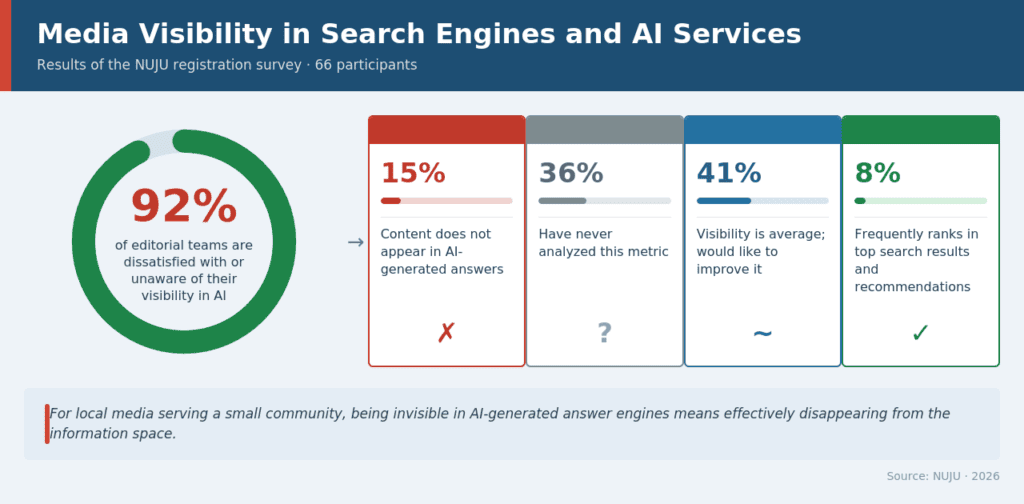
Ninety-two percent of respondents are either dissatisfied with or simply unsure about, their visibility in search engines and AI-powered search services.
Only 8% said they were confident that their content ranks well and appears prominently in search results.
Another:
- 41% described their visibility as “average”;
- 36% admitted they had never analysed it or did not know how to assess it;
- 15% said their content does not appear in AI-generated answers at all.
For a local newsroom serving a relatively small community, disappearing from AI-powered search effectively means disappearing from the public information space.
Journalists are also increasingly worried about the rise of zero-click search – a model in which AI systems summarise a newsroom’s reporting and present the answer directly to users, often without providing a meaningful link back to the original publisher. How can local media preserve audience traffic and advertising revenue if readers no longer visit their websites?
For many publishers, this has become one of the defining business challenges of the AI era.
Basic SEO: the missing superpower
Why do AI systems overlook local journalism? According to the survey, the answer often lies in technical content optimisation.
Nearly 78% of respondents acknowledged significant gaps in their SEO knowledge – skills that are becoming increasingly essential in the age of AI search. Only 23% said they consistently optimise headlines, leads, metadata and article structure for search engines. Meanwhile, 20% admitted they were approaching the topic as complete beginners.
What do journalists want to ask the experts?
An analysis of the questions submitted by participants ahead of the webinar revealed the key challenges facing Ukraine’s regional media today:
- “AI uses our work for free”
How can newsrooms protect their copyright and encourage AI systems to link directly to the original source instead of news aggregators that simply republish their stories? - The “we need it yesterday” technical checklist
What simple steps can a small newsroom take today to compete with major national media outlets? How should headlines and leads be written to increase the chances of appearing in Google Discover? - Ethics and visual content
How do search engines treat AI-generated images on a news website’s homepage, and how should such images be properly labelled? - Limited resources
Perhaps the shortest – and most painful – question came from the Visti newspaper in Chernihiv: “Where are we supposed to find the money for all this?” Most small local newsrooms simply cannot afford to hire a dedicated SEO specialist.
The profile of today’s editor and what the media community needs
Based on the NUJU survey, it is possible to draw a portrait of a typical regional newsroom leader: an editor or publisher working in a frontline region. They already use AI extensively in their daily work and understand the fundamentals of SEO, yet they acutely lack the practical skills needed to optimize content for the new generation of search algorithms. Above all, they fear losing contact with their audience.
The webinar organizers emphasized that media professionals no longer need abstract discussions about the benefits of artificial intelligence. What they need are practical tools, clear checklists, and actionable guidance – the kind of advice that answers the question: “What exactly should I do by Friday?”.
The challenge of AI visibility and copyright protection in the era of generative search will only become more pressing. During the webinar, speaker Andrii Yurychko – journalist, media trainer, and lecturer at the Educational and Scientific Institute of Journalism of Taras Shevchenko National University of Kyiv – shared practical recommendations on how to make news content more discoverable by large language models and more visible in search results. He also answered participants’ questions.
The webinar was organized as part of NUJU’s priority initiative, “Recovery Ukrainian Media”, with the support of the UkrAInian Media Fund Nordic.
NUJU Information Service
















Discussion about this post