

 THE NATIONAL UNION OF
JOURNALISTS OF UKRAINE
THE NATIONAL UNION OF
JOURNALISTS OF UKRAINE
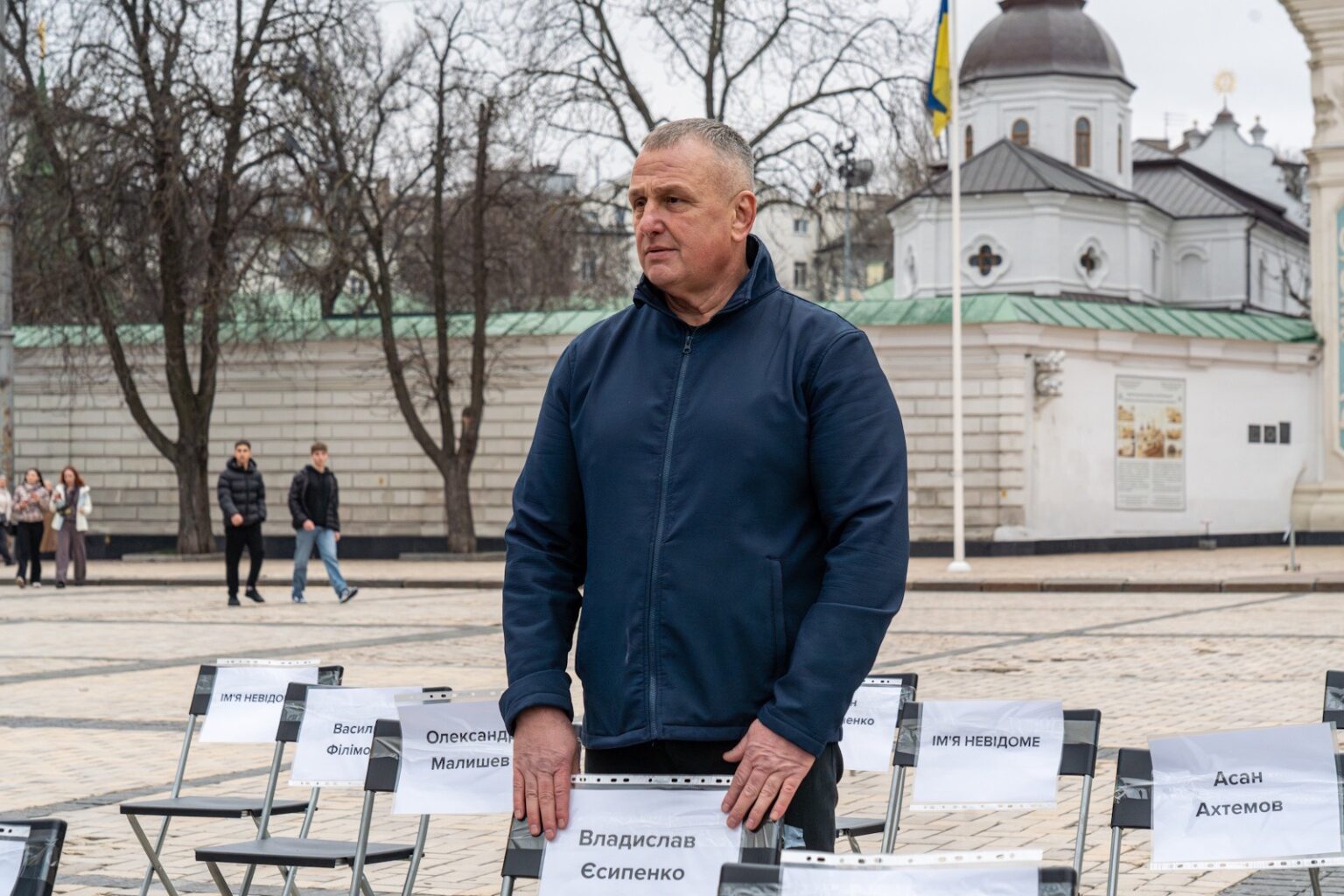
Freelance journalist Vladyslav Yesypenko, who was a prisoner of the Kerch colony for more than four years because of his journalistic activities, told Krym.Realii about the system of enslavement in the occupied Crimea.
Vladyslav Yesypenko, a freelancer for the Radio Free Europe/Radio Liberty project Krym.Realii, managed to work in Crimea for four years. He took on the most difficult and risky topics. And this despite the fact that he claims in an interview with the project’s journalists Anzhelika Rudenko and Viktoriya Veselova that until 2014 he had never thought of engaging in reporting activities. When Russia annexed Crimea in 2014, he could not come to terms with this reality, “he did not want his daughter to wear a St. George ribbon and listen to stories about some incomprehensible “russian spring”. In 2014, he began filming events in Crimea for himself – “for the sake of history”. And then he offered his services to Krym.Realii.
Vladyslav Yesypenko filmed the so-called ‘Putin’s cottage’ in Crimea, the grave of the son of ex-President of Ukraine Viktor Yanukovych in Sevastopol, when Lyudmila Yanukovych visited it, and other sites. There were no other journalists at the cemetery except Vladyslav Yesypenko. Despite the presence of guards, he managed to make a short video.
In March 2021, Vladyslav Yesypenko was detained by FSB officers at the Angara Pass in Crimea on charges of ‘espionage for Ukrainian special services’ and ‘storage of ammunition’. A grenade was ‘retrieved’ from his car. The journalist denied the charges and said that the confession was extracted from him under torture.
The russian-controlled Simferopol District Court sentenced him to six years in prison and a fine of RUB 110,000. Later, the russian courts, having considered an appeal, reduced Vladyslav Yesypenko’s sentence to five years in prison.
Human rights organizations and the Ukrainian authorities, as well as the management of Radio Free Europe/Radio Liberty, came to Vladyslav Yesypenko’s defense, calling his case political. He spent several months in the Simferopol remand prison. Then he was sent to the Kerch colony to serve his sentence.
“The biggest fear there is that there will be a riot in the colony. They warned: if you try to somehow establish your own rules of the game here, we will “work” you: you will not get out of the penal isolator and from the special high-security zone, which means, you will suffer all this time,” says Vladyslav Yesypenko.
According to him, many citizens of Ukraine from the territories occupied by russia are held in Simferopol Remand Prison 2. It was opened in the fall of 2022 in the territory of Colony 1 in Simferopol.
“FSB officers in Remand Prison 2 have the opportunity to torture people they suspect of something. I have talked to these people. I understand that Simferopol Remand Prison 2 is a branch of Donetsk-based ‘Izoliatsiya’, where a person is a so-called ghost. Until they bring them into the legal field, they can do whatever they want with them,” says Vladyslav Yesypenko.
“When Armed Forces of Ukraine (AFU) servicemen were brought in, most of us were immediately taken to other floors. They were guarded there separately by the FSB with dogs. There is a passage in the remand prison – it is called the “gut”, where people wait for their transfer for investigative actions or the colony. It is a dirty, smelly room with convicts. And there is another room, cleaner. Ukrainian prisoners of war were taken through this second “gut” and we heard them being beaten. They had no rights by definition. They were ‘mirages’ – people who are nowhere to be found according to documents,” says Vladyslav Yesypenko. In the remand prison of Simferopol and the Kerch colony, Vladyslav Yesypenko managed to meet many Crimean prisoners whose cases human rights activists call political.
He recalls meeting a Ukrainian named Kostiantyn Shyrinh, who was accused by the FSB of ‘espionage in favor of Ukraine’ in the territory of Crimea. Vladyslav Yesypenko says that ‘literally behind the wall’ next to him was 70-year-old Crimean Halyna Dovhopola, sentenced to 12 years in prison. According to him, she was held in the women’s block of the Simferopol remand prison, which is called a “monastery.” Women are sent there who want to be closed off from communication with the outside world or from reprisals due to conflicts with other prisoners.
In the Simferopol remand prison, Vladyslav Yesypenko crossed paths with ex-political prisoner Nariman Celal, the current ambassador of Ukraine to Turkey. “He came up to me when we were walking before the transfer. He said that he was Nariman Celal, he talked to my wife on the ‘Crimean Platform’. And for me it was like he was my brother, a kindred spirit. We later echoed each other in the cells,” he says.
NUJU Information Service














Discussion about this post