

 THE NATIONAL UNION OF
JOURNALISTS OF UKRAINE
THE NATIONAL UNION OF
JOURNALISTS OF UKRAINE

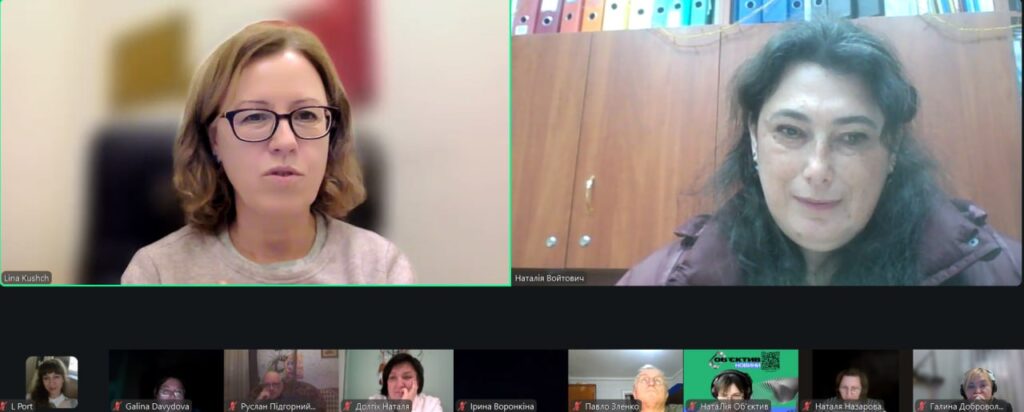
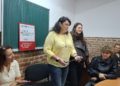
What are the typical mistakes that newsrooms make in grant applications? What is worth knowing in the conditions when competition is growing, and donor programs are tightening requirements? These and many other questions were answered during the online webinar ‘Why did your newsroom not win a grant and what could be improved’, organized by the National Union of Journalists of Ukraine (NUJU), by speakers Lina Kushch, the First Secretary of the NUJU and Nataliya Voitovych, the Coordinator of the Unified Western Ukrainian Journalists’ Solidarity Center (JSC).
But if the advice from the webinar was not written out in detail, this is the case when they say that it is better to see and hear once… However, it is worth rephrasing: it is best not to see or hear once, but to constantly participate in educational events held by the NUJU in order to gain knowledge that can later be converted into real grant funds or other donor support.
Lina Kushch announced that several more such events will be held next year. Nataliya Voitovych suggested that the webinar participants complete a homework assignment, for which, of course, no one will give grades, but an analysis will be made that will help to better understand the emphasis in the applications for donors. This is extremely important because the competition for grant funds for the media is tough, one might even say, wild. All projects related to the largest donor, USAID, have been frozen. And now dozens, if not hundreds, of applicants are competing for grants from other donors. Projects are often financed through government appropriations, that is, taxpayers’ funds of a particular country are used. Hence, the requirements for grantees are serious, and reporting is responsible.
Unfortunately, even a perfectly written application from the grantee’s point of view does not guarantee victory, because it may not correspond to the logic of donors’ thinking.
One of the main theses voiced by the speakers: a grant application is not a request for the salvation or survival of the media, but a form of professional communication and a proposal for partnership with specific ideas and a clear explanation of the ways of implementation and results. You need to understand the requirements of donors, know the areas of their work, and participate in information sessions where you can ask further questions. They can also be sent to the organizers in writing.
As for involving AI, before asking it to generate, say, 10 ideas for a grant, you need to provide it with two documents: detailed conditions of the grant application and complete information about the media. And only then can the proposed ideas be adapted to your realities.
Lina Kushch emphasizes that grant activities are not a one-time attempt to save the newsroom, but a long process of learning and improvement.
“This is not a short race, but a marathon, during which we all learn, make mistakes, and become stronger,” she notes, recalling her own experience of writing dozens of applications for international donors.
It is also necessary to understand that rejection is not a defeat, but part of a system where one often has to choose between several equally strong applications. The speaker gave an example when ten grants with a good budget were offered in an international competition, two of which were directed to support the media, and there were eight hundred (!) participants.
“Many donors are interested in what impact the grant funding will provide,” explains Lina Kushch. “It is about creating a logical matrix of the project and a specific definition of the impact. It is important to turn the idea in the application into a clear logic of the changes that the donor expects, with the formulation of the goal, and to indicate measurable indicators of results. Mostly, the donor provides funds so that there is a benefit for the community in which the media operates, for development. Grants are not humanitarian support for those who are weaker. On the contrary, grantmakers are ready to support newsrooms that demonstrate resilience. And their teams are successful and self-confident, able to represent the strengths of their audiences. The audience is the main resource that needs to be talked about as specifically as possible, on which donors focus their attention. It is also necessary to collect success stories to confirm the impact of your media. These can be screenshots, video content, etc.”
The webinar participants, together with the speaker, considered specific ideas for grants that would demonstrate the achievement of certain goals, the creation of measurable changes in society. They could include, for example, addressing the needs of IDPs, which is very relevant, talking about relocated newsrooms, exchanging experiences with grant applications, and generally having a lively discussion of issues.
The speaker recommended the GFMD MediaDev fundraising guide, which has been translated into Ukrainian, emphasizing that it describes in detail all the components of grant applications and provides a lot of useful information.
It is advisable to look at the text of your application through the eyes of a grantor, as Lina Kushch emphasizes. To do this, you can use a simple but effective tool – self-checking for typical errors.
10 typical errors in media grant applications
This list can serve as a kind of filter before applying. If you recognize your own wording in it, it is a signal that the text needs further revision.
- The language of survival, not the language of development
Applications built around the phrases “we are on the verge of closure” or “the grant is our only chance” do not work. Donors support development, overcoming the crisis, resilience during war, not hopelessness.
- Appeal to feelings
Describing difficult conditions without demonstrating strength, experience, and potential creates the impression of hopelessness, even if the real situation is different.
- Focus only on the needs of the editorial team
Financing salaries and equipment is important, but the donor needs to see the benefits for the community and society.
- Ignoring the donor’s priorities
An application written without taking into account the program’s goals is almost always doomed. The project should “speak” the language of the grantor.
- “Vague” formulation of the idea
Abstract formulation does not allow for understanding what exactly will change after the project is implemented.
- Lack of measurable results
Intentions without indicators are the weak point of many applications. Donors expect clear indicators.
- Impact that was not mentioned
Editorial departments often have real results, but do not know how to record them and present them as evidence, success stories.
- Underestimation of own resources
Audience trust, reputation, brand, and experience are also resources, and they are worth talking about.
- Weak description of the audience
Circulation or number of views is not all that needs to be indicated. It is important to show what kind of target audience you have, who your reader is, and why they trust you.
- Blind use of AI
Template texts are easily recognized. ChatGPT, for example, can help structure thoughts, but it is not a substitute for live experience and specifics that apply to each editorial department.
What increases the chances of success
In conclusion, Lina Kushch emphasizes that in a grant application, the media should present itself as a professional partner, not a requester. Grantors support newsrooms that understand their context, know their audience, and are able to offer solutions that are useful to the wider community. And this is what should be kept in mind when preparing each application.
Of course, such an approach does not guarantee instant success, but it significantly increases the chances of being heard, and in conditions of fierce competition, this is already half the battle.
The material about the experience and warnings from Nataliya Voitovych will be posted on the NUJU resources. Follow the publications.
Liudmyla Maznova










Discussion about this post