
 THE NATIONAL UNION OF
JOURNALISTS OF UKRAINE


In one of the many parodies of Lukashenko’s ‘creativity,’ the self-proclaimed president of Belarus ponders the dirty bomb that the Ukrainians allegedly plan to drop on him. He shouts to his subordinates: “Who knows what that bomb is contaminated with? Wash the rags in bleach and use them to wash the floor and everything else, just in case.”
For journalists not to wash rags in bleach when the territory is contaminated but to know well what to do in case of chemical or nuclear contamination of the territory, the Kyiv Journalists’ Solidarity Center of the National Union of Journalists of Ukraine (NUJU) organized a training.
In the framework of the meeting, its participants could meet with the author of the modular training program on responding to chemical threats, Maksym Dovhanovskyi.
It is worth mentioning that Maksym Dovhanovskyi is a rescuer who has devoted 18 years to the profession. Currently, he is an international expert on radiation and chemical protection issues, cooperates with many international organizations he told a lot of interesting things about during the training.
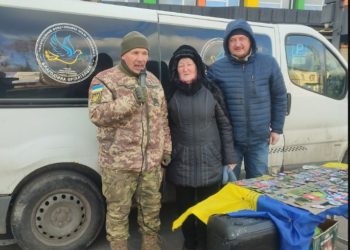
The fact that even experienced journalists were interested in the training was evidenced by the presence of well-known Ukrainian journalist Dmytro Chystiakov from Inter, Apostrof’s military correspondent Mykhailo Sharkov (he was the one to hand over to NUJU a state flag signed by Ukrainian soldiers from the front lines. Among other things, the flag reads: ‘Journalists are important!’). Halyna Dobrovolska–Rybalkina, the director of the On The Waves Of Korsun TV and radio company, also took time out of her busy schedule and came from Korsun-Shevchenkivskyi. The event was also visited by, so to speak, experienced participants, the journalists who had not missed a single training organized by the Journalists’ Solidarity Center.
And Maksym Dovhanovskyi and his colleague lived up to all expectations: the issue important not only in war conditions but also at all times was covered clearly, in informal communication with the participants.
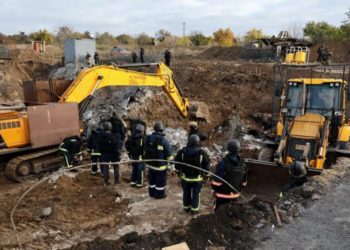
The main message is that emergency services cannot always immediately assess a real threat. It happens that emergency rescuers go, for example, to a fire and do not suspect that there is chemical or radioactive contamination. Journalists seeking to inform people come to the scene of an emergency quickly.
Unfortunately, they often have the illusion of security, the confidence that nothing dangerous is happening. They believe they can be in the hottest spots with a journalist’s license. Meanwhile, there may be several threats, and the consequences (secondary threats) may be more dangerous than the primary ones.
“Take care of your safety!” Maksym Dovhanovskyi insistently advises and tells how to recognize a threat, what should be done first in a zone of chemical or radioactive contamination, what personal protective equipment exists, and, most importantly, how to use it correctly.
“It’s not that important to be able to put a gas mask on. It is much more vital to know when to put it on, as it is not a joke but vital advice,” he adds.
We also got acquainted with the concept of ‘decontamination.’ In plain words, this means reducing (removing) contamination from clothing and body surfaces and preventing the spread of chemical, radiating, and biological agents from contaminated persons and objects. The complex of these measures is aimed at mechanical cleaning of the skin, mucous membranes, and open wounds in victims.
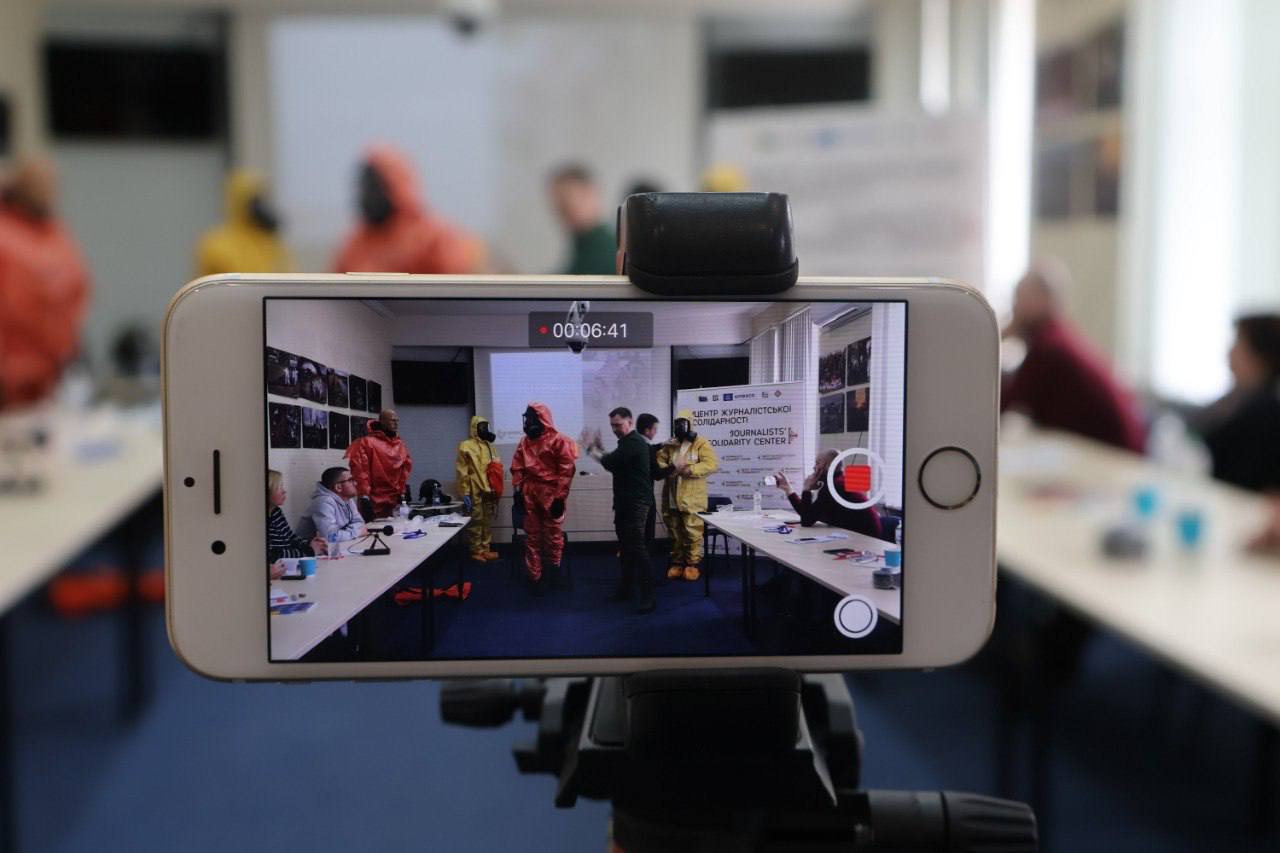
Decontamination is carried out regardless of whether the victim has symptoms characteristic of the clinical picture of the damage caused by chemical, radiation, and biological agents.
An essential piece of advice is that a journalist who goes to the place of a fire or an enemy missile hit should take a gas mask with up-to-date high-quality combined filters. After all, no one knows what is burning, what danger a rocket brought with it, even if it did not explode.
All the protective masks brought to the training could be tried on and studied by the participants. Some volunteers tried on protective suits according to all the rules: yellow – in case of chemical contamination, orange – radioactive ones. And it is worth mentioning that there are many subtleties in this process: protective gloves and sleeves, pants, and shoes must be insulated with tape, and the suit itself must not contain any air so that it does not turn into an inflatable ball that prevents a person from moving, providing assistance, etc.
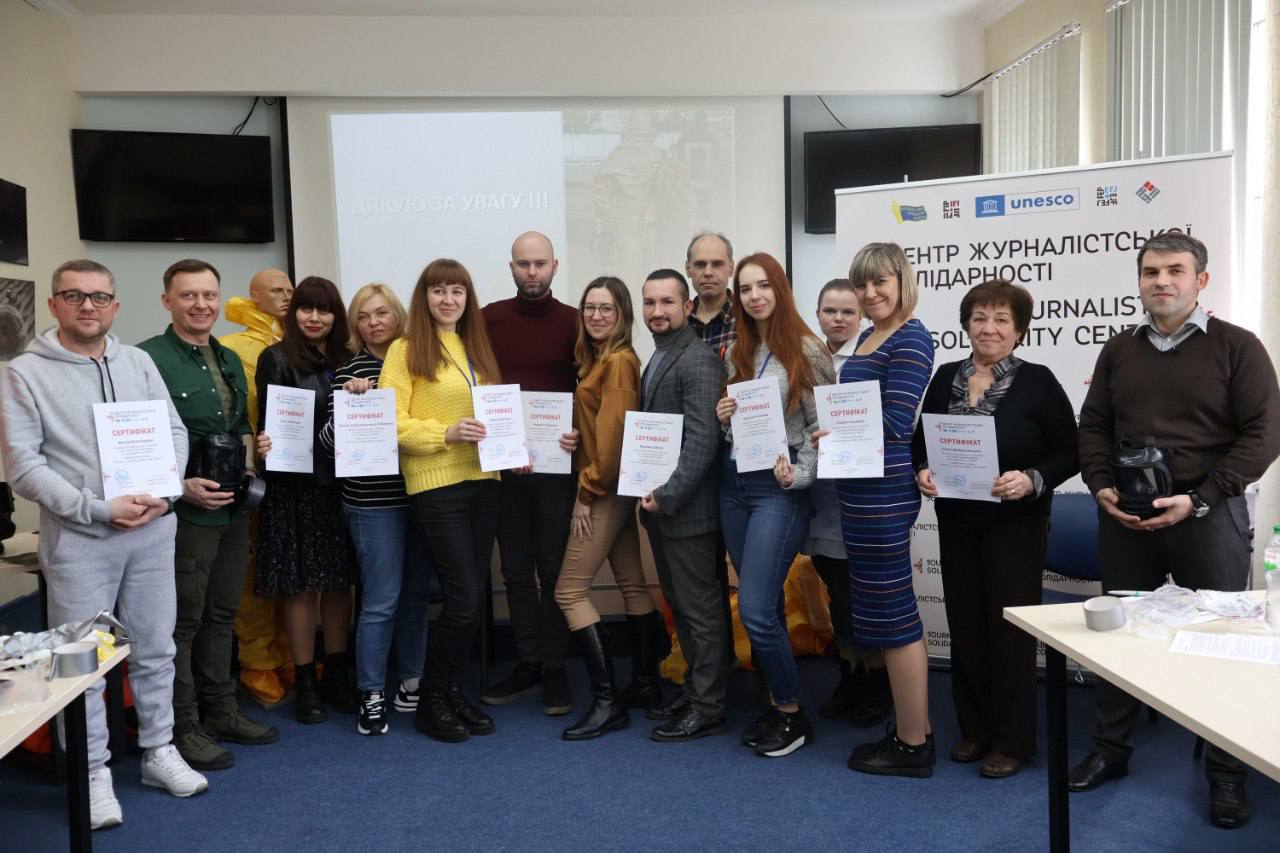
At the end of the training, all participants, according to the already established tradition, received a certificate confirming that its owner passed the basic safety course entitled Hazardous Attacks: Chemical and Nuclear Weapons: How To Act? for media representatives working in Ukraine.
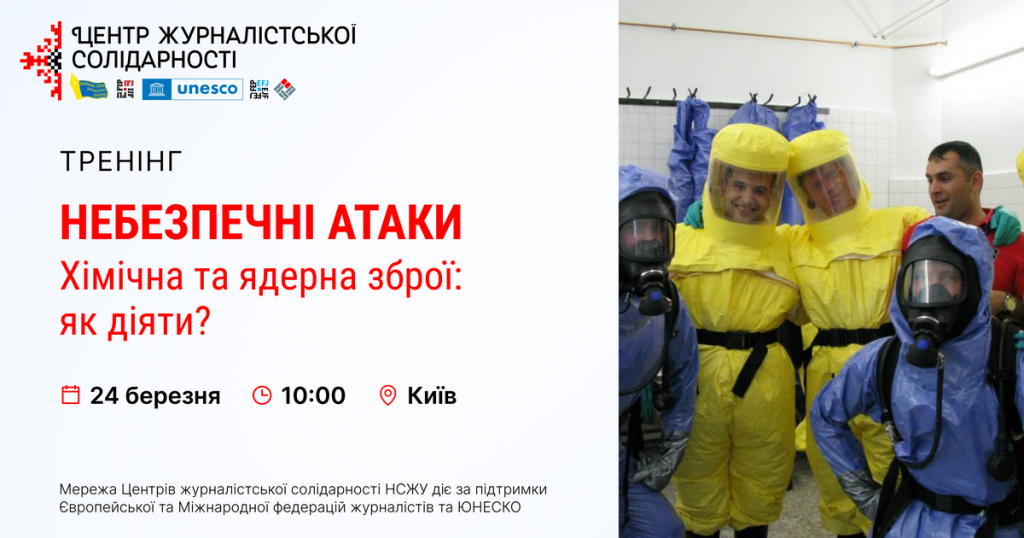
As earlier reported, the Journalists’ Solidarity Centers is an initiative of the NUJU implemented with the support of the International and European Federations of Journalists and UNESCO. The initiative is designated to help media representatives working in Ukraine during the war. The Centers operate in Kyiv, Lviv, Ivano-Frankivsk, Chernivtsi, Zaporizhzhia, and Dnipro and provide journalists with organizational, technical, legal, psychological, and other types of assistance.
UNESCO is the United Nations Educational, Scientific, and Cultural Organization. It contributes to peace and security by promoting international cooperation in education, sciences, culture, communication, and information. UNESCO promotes knowledge sharing and the free flow of ideas to accelerate mutual understanding. It is the coordinator of the UN Action Plan on the Safety of Journalists and the Issue of Impunity, which aims to create a free and safe environment for journalists and media workers, thus strengthening peace, democracy, and sustainable development worldwide. UNESCO is working closely with its partner organizations in Ukraine to provide support to journalists on the ground.
The designations employed and the presentation of material throughout this digest do not imply the expression of any opinion whatsoever on the part of UNESCO concerning the legal status of any country, territory, city, or area or its authorities or concerning the delimitation of its frontiers or boundaries.
The authors are responsible for the choice and the presentation of the facts contained in this digest and for the opinions expressed therein, which are not necessarily those of UNESCO and do not commit the Organization.
Olha Voitsekhivska, Journalist of Ukraine








Discussion about this post