

 THE NATIONAL UNION OF
JOURNALISTS OF UKRAINE

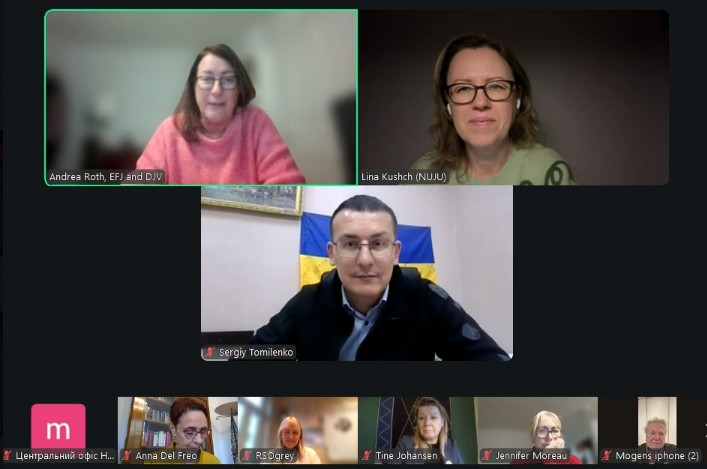
At a 2 November meeting, NUJU’s International Advisory Council discussed how to sustain the Solidarity Centers and frontline newsrooms as Russian attacks disrupt power and put reporters at greater risk.
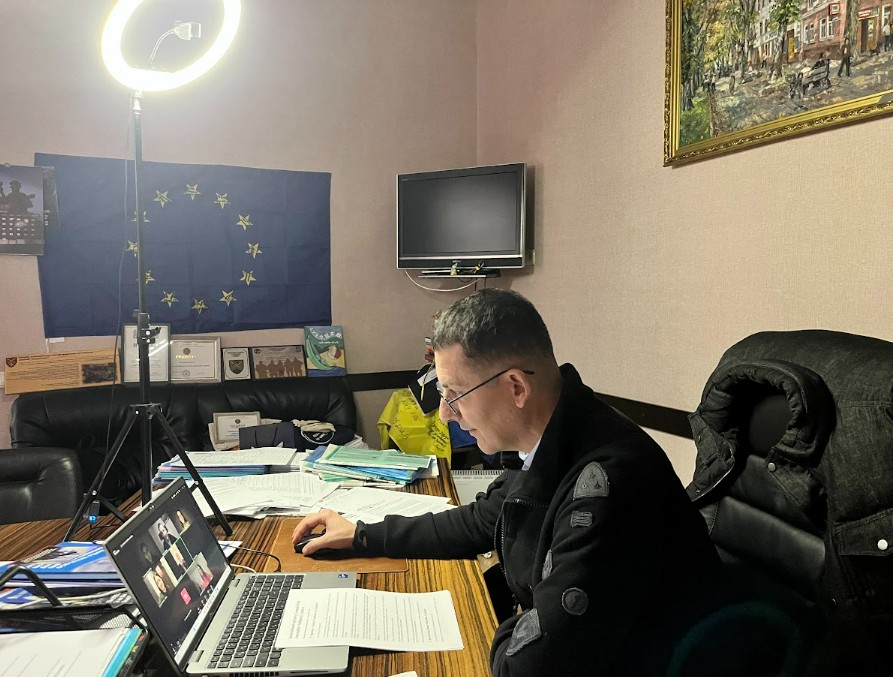
The lights were out in NUJU’s Kyiv office on 2 November. A portable power station and mobile internet kept the team connected to an international meeting about how to support Ukrainian journalists.
The blackout was a live reminder of the pressures on Ukraine’s media. The meeting focused on frontline safety, support for independent newsrooms and ways to make international assistance more flexible and predictable. Members discussed possible fundraising through unions, publishers, foundations and public events.
“It is right outside our window”
NUJU established its Journalists’ Solidarity Centers in 2022 with support from the International and European Federations of Journalists. The network now operates in seven locations across Ukraine, offering journalists protective equipment, emergency assistance, safety training, legal and psychological support, and places to work during power cuts.
Between 2022 and July 2026, the Centers recorded 10,573 requests for assistance. Through NUJU’s Frontline Press programme, supported by the Swedish publishers’ association Tidningsutgivarna (TU), 25 frontline newspapers received direct financial support to keep publishing.
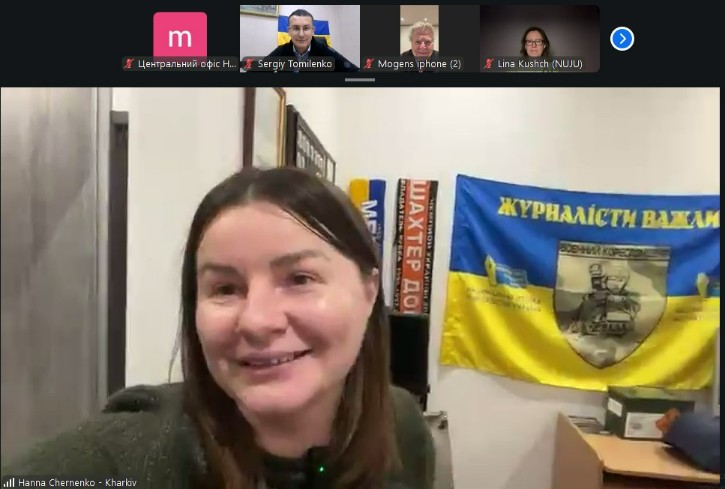
During the meeting, Hanna Chernenko, a war reporter and coordinator of the Kharkiv Center, showed Council members around its two-room apartment. Photographs by local correspondents line the walls. One is by Olha Kovalova, who was wounded while reporting in the Donbas region and is still in rehabilitation. Body armor and helmets are available for journalists to borrow, and a shattered window has been kept as a reminder of how close the war is.
“War is in your street, in your home, near your windows,” Chernenko said. “It is right outside our window.”
The Center’s equipment has come through several sources of support. The Ukrainian Media Fund Nordic provided a portable power station, UNESCO supplied a generator, and two new drone detectors were bought with funds raised by a friend in Scotland. A colleague has taken one of the detectors towards the Kupiansk area, where it picked up Russian drones.
The Center also transferred one of its generators to Vasyl Myroshnyk, editor of the Zoria newspaper in Zolochiv, Kharkiv region. Despite the threat from Russian drones, he has stayed in the area and continued publishing.
“We have to be prepared for anything”
Power cuts are affecting journalists well beyond the frontline. NUJU First Secretary Lina Kushch said that during the three working days before the Council meeting, the team in Kyiv had electricity for about an hour and a half a day.
“If it were just a matter of power outages, we’d survive this winter,” Kushch said. She added that the team could not predict what challenge might come next, so it had to be prepared for anything.
Requests for temporary relocation have roughly doubled, she said. Many come from small newsrooms, freelancers and journalists who have already fled occupied areas and now need to move again. Women caring for children or older relatives often face additional difficulties in finding housing, schools and medical care.
Some journalists are looking for a short break rather than a permanent move: a few days or a week away from the frontline or from air-raid alerts in a large city. Meeting those needs requires flexible support that can respond to emergencies as they arise.
NUJU President Sergiy Tomilenko told the Council that funding was in place for some activities over the coming months, but that the union was still considering how to secure further support. He asked members for advice on possible ways to organise fundraising, including whether a trusted international partner could help collect smaller donations abroad and transfer them to Ukraine efficiently.
“It’s not easy to receive many small donations directly in Ukraine,” Tomilenko told the Council. “We are looking for a partner in Europe who could collect them and transfer the money in one tranche.”
From ideas to practical support
Randi S. Øgrey, CEO of the Norwegian Media Businesses’ Association and chair of Ukrainian Media Fund Nordic, described her recent visit to the Lviv Center. She said she had met journalists with frontline experience and heard from journalism educators about the need to keep safety guidance up to date.
“Maybe a good piece of advice today could be killing you tomorrow,” she recalled one instructor saying.
Øgrey said the Ukrainian Media Fund Nordic was beginning to collect money in the Nordic countries for winter support. She also invited Council members to share ideas about how international partners could help.
Andrea Roth, Vice-President of the Bavarian Journalists’ Association and a member of the EFJ Steering Committee, proposed a coordinated effort among European journalists’ unions. She also offered to explore contacts with German foundations.
Anna Del Freo, Vice-President of the Association of Journalists of Lombardy and a former member of the EFJ Steering Committee, said she was exploring a possible public event in Italy with contacts at Rotary and the CGIL trade union confederation. She also offered to look into ways of raising the case of detained Ukrainian journalists through contacts in the Catholic Church.
Jennifer Moreau, Vice-President of the International Federation of Journalists and a representative of Unifor in Canada, suggested bringing Ukrainian journalists into direct conversation with colleagues abroad. She was exploring possible events with Canadian and North American partners, as well as shareable materials that unions could publish together.
Mogens Schmidt, a senior adviser on press freedom and media development and former Deputy Assistant Director-General of UNESCO, proposed approaching media employers and publishers as well as journalists’ unions. He said he would raise continued support for the Centers in an upcoming meeting with UNESCO leadership and explore a possible letter to WAN-IFRA, the global association of news publishers. Tine Johansen, principal of Brandbjerg Højskole and former president of the Danish Union of Journalists, offered to help with that outreach.
The discussion also highlighted the value of partners visiting Ukraine in person. Schmidt, who spent eight days in Kyiv for the Donbas Media Forum, described the strain of checking air-raid alerts repeatedly and said direct meetings with Ukrainian journalists help international colleagues understand the conditions they face.
Keeping Ukraine in view
Tomilenko raised the case of Iryna Levchenko, a 65-year-old journalist from Melitopol and NUJU member who was sentenced to 15 years in prison by a Russian-controlled court on “espionage” charges. NUJU has no direct way to ensure she receives medicine or independent legal assistance while she remains in Russian custody.
Council members discussed ways to bring Levchenko’s case to audiences beyond the journalism community. Johansen said sharing individual journalists’ stories can help keep attention on Ukraine. Del Freo said she would explore whether her contacts could help raise the case in Italy.
NUJU plans to share follow-up proposals with Council members, including a possible appeal inviting journalists’ organisations to consider solidarity initiatives in their own countries.
Organisations interested in supporting the Journalists’ Solidarity Centers can contact NUJU at [email protected].










Discussion about this post