

 THE NATIONAL UNION OF
JOURNALISTS OF UKRAINE
THE NATIONAL UNION OF
JOURNALISTS OF UKRAINE
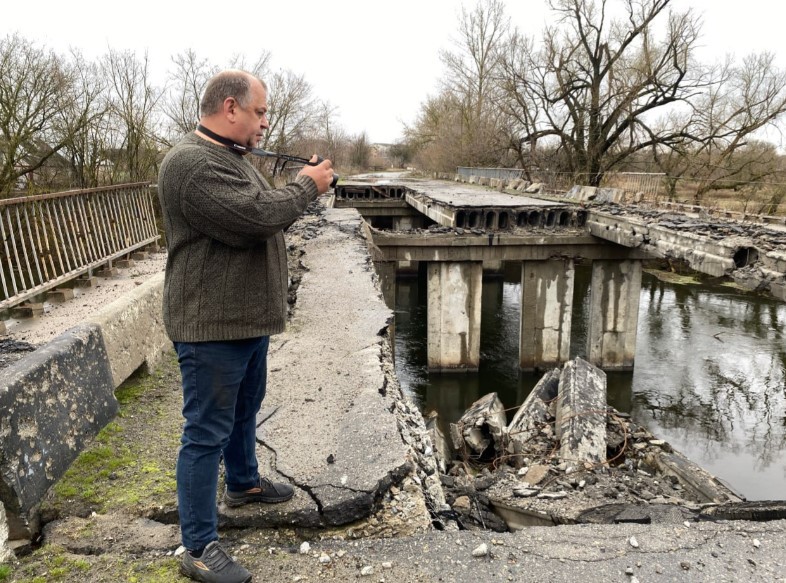
Despite the war, one of the main priorities for media outlets in Ukraine’s border regions of Sumy Oblast remains staying close to their communities. Despite relocation and constant challenges, Vorskla continues to publish, combining its traditional print edition with digital platforms. In an interview with the Lviv Journalism Solidarity Centre, Vorskla Editor-in-Chief Oleksii Pasiuha spoke about how the newsroom operates today, its digital transformation, financial challenges, and the role of local journalism during wartime.
– After the start of the full-scale invasion your newsroom was forced to relocate. Where are you working now, and under what conditions?
– In 2024, our newsroom building was destroyed by a Russian guided aerial bomb (KAB). Just a few days later, nearly 30 percent of the settlement of Velyka Pysarivka was devastated.
Despite everything, we kept working, even though we had no electricity, no internet access, and no opportunity to operate in anything resembling safe conditions. Writing a newspaper is one thing, but publishing it is another. To print an issue, you need reliable communication with the outside world.
We relocated, though not to a single location. Some members of our team found shelter in Kyrykivka, while others moved to Okhtyrka. Overall, it is fair to say that our newsroom is now based in Okhtyrka.
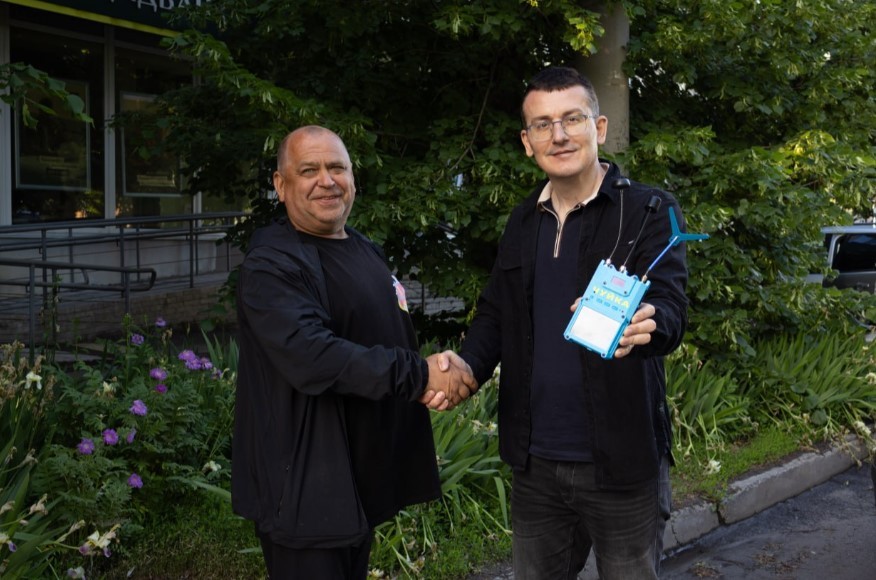
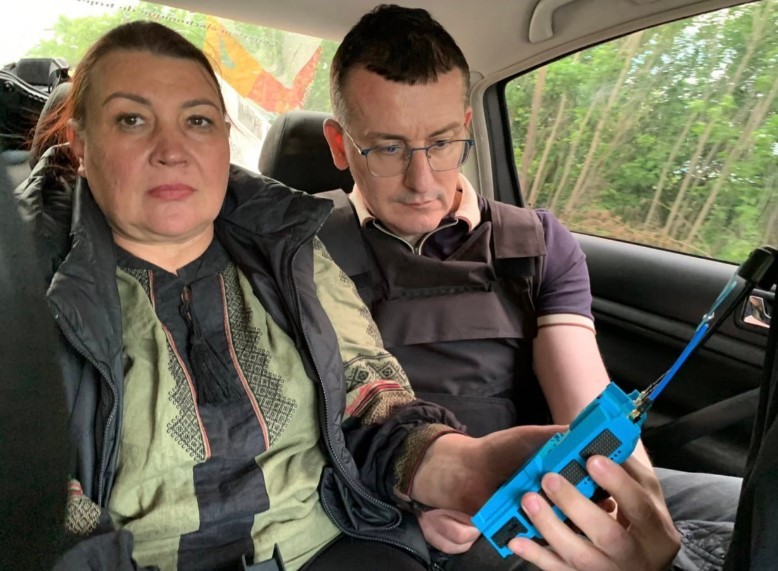
We no longer have our own office, it is simply beyond our financial means. Instead, we work from the premises of the relocated local council, the library, and sometimes from parks or cafés with internet access. At the same time, we spend most of our time on the road: looking for stories, meeting people, and reporting from the field.
An office is important mainly because people want to know where they can find us, share their stories, or simply visit the newsroom. When someone comes to Okhtyrka, we arrange a meeting, but in reality, our newsroom spends most of its time “in the field.”
– How has this way of working affected the newsroom and your ability to produce content?
– To write a strong story – especially one about a person – you need to meet them in person. Many readers look for familiar names, stories about relatives or neighbours. These stories become a connection to home and to life before the war.
Today, however, meeting people is not always possible, so much of our reporting now happens during field trips.
Relocation has also had a significant financial impact. When we had our own office, we could provide additional services such as photo printing and document printing, which generated extra income for the newsroom.
Of course, we would like to have an office again. But once you calculate the costs, you realise it is better to spend that money on a journalist’s salary than on rent. For us, the priority is ensuring that the newsroom continues to operate.
– At the beginning of the full-scale invasion, your biggest challenge was restoring the newsroom’s operations. What is your greatest challenge today?
– In reality, not much has changed. Restarting the newsroom was only the first step. The real challenge is continuing to work every single day.
Today, that means constantly searching for funding, not only to produce journalism, but also to pay the people who create it.
Another major challenge is staffing. It is extremely difficult to cover life in a border community when your entire team is working remotely.
Today, the Velyka Pysarivka community has become an active combat zone. Most settlements are virtually deserted. Yet even those who have evacuated still need information about their hometowns.
That is why, despite the enormous danger, we still travel there from time to time. It is risky, but staying connected with our community remains essential.
– How has the process of producing each issue of the newspaper changed over the years?
– The only thing that has remained unchanged is our weekly editorial meeting. We still plan our stories in advance, although some content now has to be produced immediately in response to events. We leave space in the newspaper for breaking news while also relying on our online platforms.
What has changed most is the pace of work.
Before the full-scale invasion, most work was done during regular office hours. Today, journalism is effectively a 24-hour job. If shelling or another major event occurs late at night, the information has to be published immediately, regardless of the time.
This has become a truly irregular working schedule, filled with late-night phone calls, urgent field assignments, and reporting at any hour of the day or night.
– How is newspaper distribution organised today? Are you still able to reach all the communities you would like to serve?
– In some ways, our work has become easier.
That said, we can no longer reach many of the villages we were still able to visit during the early months of the full-scale invasion. Velyka Pysarivka and the settlements beyond it are now considered high-risk areas, so we no longer travel there.
Over the years, we have developed our own distribution system. We deliver newspaper bundles to designated collection points, from where they are distributed across local communities.
One of our main hubs is Kyrykivka, where newspapers are further delivered throughout the Velyka Pysarivka and Kyrykivka communities.
We have also expanded distribution to other towns and villages where we have gained new readers. These include not only internally displaced people from the Velyka Pysarivka area but also local residents who discovered that Vorskla continues to be published.
– So you still organise distribution largely on your own?
– Yes. It is challenging, but it means we are largely independent of Ukrposhta.
At present, nearly 200 subscribers receive the newspaper through the national postal service, most of them living outside Okhtyrka District.
Since the second half of this year, we have also started selling the newspaper through Ukrposhta branches. This has become a separate distribution channel: around 250 copies are delivered across Sumy Oblast, allowing us to analyse where demand is strongest and adjust future distribution accordingly.
However, the bulk of our circulation – almost 1,000 copies – is still delivered by our own team.
This does not generate direct profit, but it helps us attract new readers and, with them, advertisers, classified notices, and greetings, all of which support the newsroom financially.
Most importantly, these delivery trips are not only about bringing newspapers to readers – they also allow us to meet people, hear new stories, and gather material for future editions.
– How does the newsroom manage to sustain its operations and continue publishing today?
– For more than a year, our circulation has remained at nearly 1,500 copies. Before the full-scale invasion, it was considerably higher, and we felt the sharpest decline during the first months of the war.
Eventually, we managed to rebuild our readership, and today 1,500 copies is the maximum circulation we can realistically sustain. We never try to persuade people to subscribe. If someone genuinely wants to read the newspaper, they subscribe. If not, they choose other sources of information.
That is precisely why we have invested heavily in developing our digital platforms. During this period, we launched channels on Telegram, YouTube, Instagram, TikTok, as well as our own website. These platforms also generate some revenue, although not yet enough to fully support the newsroom. Nevertheless, we continue to invest in their development.
– You mentioned that the newsroom has been actively developing its digital platforms. How difficult was it to adapt to these new formats?
– On 22 June, we learned that Vorskla had been included in the Recommended Media Map, compiled by Detector Media and the Institute of Mass Information (IMI). For us, this was a major achievement, because the list is dominated by online outlets, television, and radio, while our core product remains a printed newspaper.
What has changed the most is our attitude toward digital platforms. I used to think that our website and Facebook were competitors to the print edition, but experience has shown that this simply isn’t true.
The newspaper has its own readership – primarily older readers and fellow residents who read the PDF edition. Digital platforms, meanwhile, have enabled us to reach a much broader audience. While the print edition reaches around 1,500–2,000 readers, our social media platforms now reach tens and even hundreds of thousands of people.
This transformation required us to acquire entirely new skills. At first, it wasn’t easy. We were accustomed to working with long-form text, whereas digital platforms demand a completely different approach: video, short-form content, and rapid publishing.
We had to learn to rethink our workflows, and today we understand that digital platforms are no longer simply an addition to the newspaper – they have become an essential part of any media outlet’s future.
– What would you say is the newsroom’s greatest need today?
– In reality, we don’t need all that much. Above all, we need stable, predictable funding.
I want to know that if I hire someone today, I’ll be able to pay their salary tomorrow, next month, and a year from now. Everything else can be solved. We can purchase equipment and even acquire an armoured vehicle to work more safely in the border region. But without stable financial support, none of that is possible.
– Have Russia’s propaganda methods changed over the years of the full-scale war? If so, what narratives do you see today?
– They have changed dramatically. In the past, it was relatively easy to recognize the “hand of Moscow.” The messaging was openly pro-Russian, filled with disinformation and fake news.
Today, however, the methods are much more sophisticated. They often rely on bot networks or hacked accounts belonging to real people. As a result, false information appears to come from ordinary Ukrainian users.
Experienced journalists can usually identify pro-Russian narratives immediately, but many Ukrainians cannot. People read these posts and think, “Our own people are saying this, so it must be true.” Unfortunately, this is exactly how manipulation spreads among people who are exhausted by war and looking for simple explanations to complex problems. In my view, that is how propaganda works today—it tries to shift attention away from Russia’s actions and redirect public anger toward supposed “enemies” within Ukrainian society.
– Do you personally and does your team feel exhausted after years of full-scale war? If so, how do you cope with it?
– There is certainly fatigue, especially because people do not always understand the realities of journalistic work. We are often asked, “Why didn’t you report this?” In reality, there are situations where we simply cannot publish certain information, particularly for security reasons.
Unfortunately, not everyone understands that, and having to explain it repeatedly is exhausting. To be honest, our team is tired of the constant pressure, the risks, and the chronic lack of funding. Most people in our newsroom are true enthusiasts. They understand that if they stop doing this work, there will simply be no one to replace them.
– What are the most important lessons you have learned during the years of full-scale war? And what advice would you give journalists who want to report from border communities?
– The most important asset any journalist or media outlet has is its reputation. Don’t chase sensational stories or try to attract attention at any cost.
For an editor, it is incredibly important to value your team – especially those who stood by you through the hardest times. Thank them more often. Support them. Give them opportunities to rest. Show them that their work truly matters, even if financial resources are limited. And no matter what happens, always remain human.
Be sincere, kind, attentive to others, and willing to understand the people you write about. Try to see every situation through their eyes. Before judging someone or drawing conclusions, take the time to understand the context and their motivations. Perhaps that is the greatest lesson this war has taught us.
– If you had to describe Vorskla in just one sentence, what would you say??
– Simply love your own Vorskla. Everyone has their own Vorskla. It is not necessarily a newspaper, it is your homeland. Whether large or small, it is that special place where your childhood lives: where your parents are, your school, your memories. When you learn to cherish those small, deeply personal things, you also learn how to love your country as a whole.
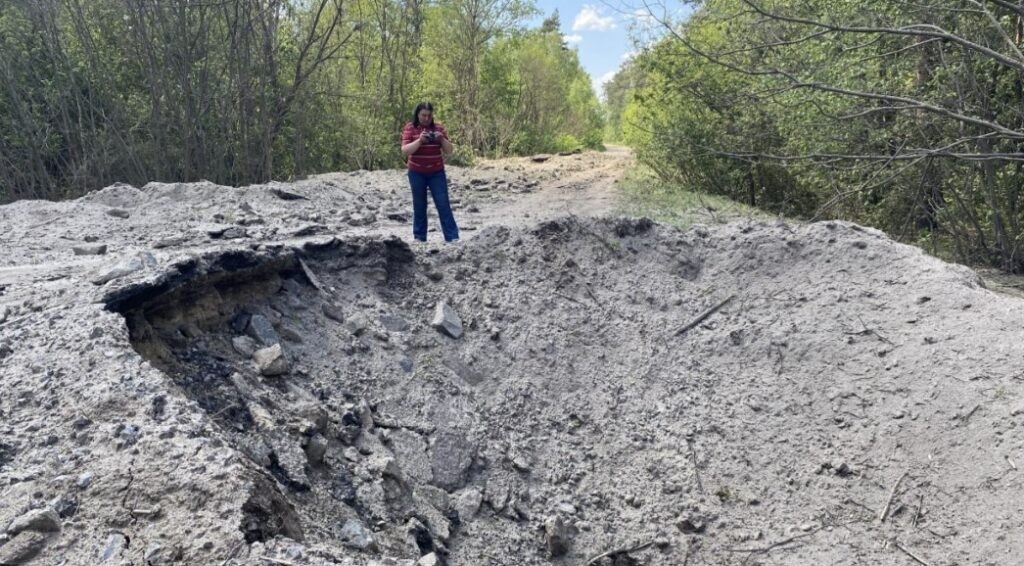
Valeriia Okopna, student-intern at Lviv JSC
The Journalists’ Solidarity Centers network is an initiative of the National Union of Journalists of Ukraine, implemented in cooperation with the International Federation of Journalists and the European Federation of Journalists. Our main goal is to support media workers working in Ukraine during the war. The Centers operate in Kyiv, Kharkiv, Zaporizhzhia, Dnipro, Lviv and Ivano-Frankivsk. The project is part of UNESCO’s broader efforts to support journalists’ safety and freedom of expression in Ukraine. The Network’s activities in the summer of 2026 are supported by the Ukrainian Media Fund Nordic.









Discussion about this post