 THE NATIONAL UNION OF
JOURNALISTS OF UKRAINE
THE NATIONAL UNION OF
JOURNALISTS OF UKRAINE
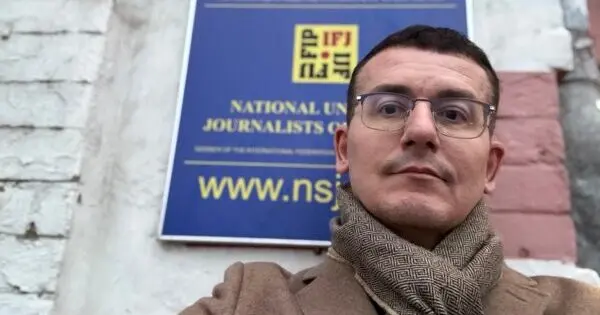
The President of the National Union of Journalists of Ukraine (NUJU), Sergiy Tomilenko, spoke about the network of Journalists’ Solidarity Centers (JSC), the desire to create relatively safe working conditions for journalists in the context of drone warfare, the challenges for independent journalism, and the social changes taking place in Ukraine against the backdrop of a full-scale invasion in an interview with the American publication The Good Men Project.
The conversation was led by Scott Douglas Jacobsen — a writer and editor with over 1,800 publications on the platform, a member of the Canadian Association of Journalists and PEN Canada.
Media Literacy and Disinformation
Social networks have long ceased to be a neutral channel for disseminating information — they form a framework through which the reader perceives even verified facts. High-quality journalism is increasingly reaching an audience that has already been “filtered” by social media narratives, and this significantly changes its impact.
This is precisely what russian propaganda is actively using, the interlocutors noted. It appeals not to reason, but to fear — and finds fertile ground where the level of media literacy remains low. The average news consumer, accustomed to receiving information from social networks, often simply does not have the tools to critically analyze sources — and this vulnerability is a systemic problem, not an individual one.
Solidarity Centers: From Idea to International Model
NUJU’s response to the full-scale invasion was a network of JSCs — initially as a support hotline, and later as a full-fledged infrastructure with workspaces, protective equipment, training, and emergency assistance. With the support of UNESCO and the International and European Federations of Journalists, the network has taken on a permanent form, and its frontline centers — in Kharkiv, Dnipro, and Zaporizhzhia — have become real points of support for journalists working in conditions of constant danger.
As Sergiy Tomilenko noted, the study was so convincing that UNESCO launched its own Safe Working Spaces for Journalists in Crisis Zones program based on it. The first step is Ukraine. The second is Gaza, where three centers based on the Ukrainian model have already been opened.
The Zaporizhzhia center plays a special role, where the club of evacuated journalists operates – a community of about 30-35 colleagues from temporarily occupied areas of the region. People who lost their homes, newsrooms and audiences found here not only a workspace, but also an environment that does not allow them to stop. It was in this atmosphere of mutual support that the editor-in-chief Svitlana Karpenko decided to resume publishing the local newspaper in April 2023 – a year after its forced closure. Without such a network, Sergiy Tomilenko is convinced, most regional journalists would either leave the profession or leave the country.
“Press” on a helmet is no longer protection
One of the most telling details of the interview is the change in recommendations for marking protective equipment. In 2022, the inscription “PRESS” on a helmet or body armor was a safety standard according to UNESCO guidelines. In 2024, this logic stopped working.
Vasyl Myroshnyk, the editor-in-chief of the frontline publication Zoria – Visnyk Bohodukhivshchyny, explained the essence of the shift: at the beginning of the full-scale invasion, the russians aimed mainly at military equipment and infrastructure. Later, priorities changed – strikes are increasingly being carried out on civilians. In such conditions, recognizable markings can become not protection, but a target. The current NUJU recommendation is neutral gray, black or blue helmets and body armor without any inscriptions. And this applies not only to the contact line itself, but also to all frontline areas.
Independence while working with military escort
Is it possible to remain an independent journalist while traveling with military escort? According to Sergiy Tomilenko, the system of accreditation and press officers in the Ukrainian army does not function as a propaganda tool. There are restrictions, but they relate to specific security issues and are quite comparable to the practice of armies in Western countries. There are no guidelines on how to cover certain events or what political assessments to avoid. Eloquent evidence: AP, Reuters, CNN, The Globe and Mail and other leading publications have not made accusations of systematic pressure.
“Independence is not the main problem now,” Sergiy Tomilenko formulates. The main problem is that there are catastrophically few foreign journalists in Ukraine. In the meantime, press officers welcome requests to travel to frontline regions, and JSCs are ready to provide organizational and logistical support to anyone who comes.
The NUJU consistently adheres to the principle that requires conscious effort in times of crisis: a journalist is not an agitator. The NUJU does not call on its members to produce pro-Ukrainian or anti-russian content. The task is to help colleagues stay in the profession and continue to accurately and responsibly cover events. Supporting Ukraine and supporting propaganda are not the same thing.
The full-scale aggression has caused profound changes in Ukrainian identity. Kharkiv, which until 2022 was often described as a pro-russian city due to its geographical and cultural proximity to russia, is today one of the most pro-Ukrainian. Residents have seen for themselves that the neighbor did not come with friendship. Similar transformations have occurred in Odesa and Mariupol. There are still Putin sympathizers in Ukraine – but their views have become marginal, not a social trend.
Remaining challenges
The conversation between the two journalists ended without an optimistic chord – the unresolved problems are too serious. The economic base of regional media has been destroyed: newsrooms are losing income, some are closing forever. Journalists are working on the verge of psychological and physical exhaustion. Media workers continue to be detained in the occupied areas. Different international organizations provide different statistics on the number of deaths – not due to deliberate manipulation, but due to differences in the definition of the very concept of “media worker.” And above all this is the urgent need for international pressure to release detained Ukrainian journalists, which Sergiy Tomilenko reminds us of insistently and without diplomatic reservations.
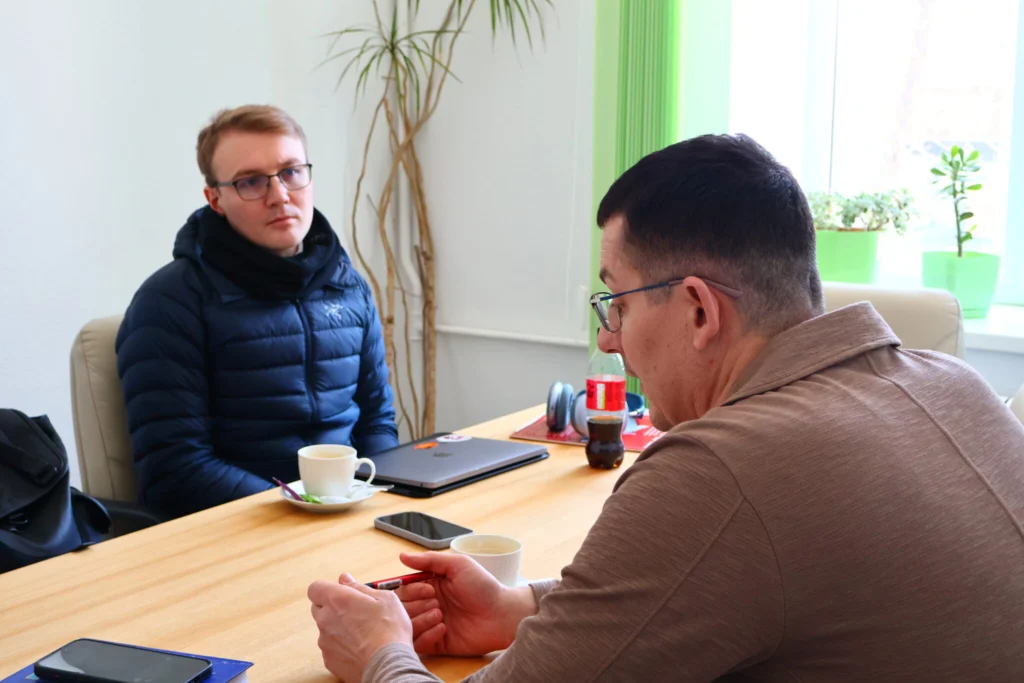
The full text of the interview is published on the website of The Good Men Project, an American media platform founded in 2009, specializing in social journalism, human rights and public debate. The publication publishes authored materials, interviews and analysis from more than 70 countries and is an open platform for contributors from different parts of the world.
NUJU Information Service







Discussion about this post