
 THE NATIONAL UNION OF
JOURNALISTS OF UKRAINE
THE NATIONAL UNION OF
JOURNALISTS OF UKRAINE
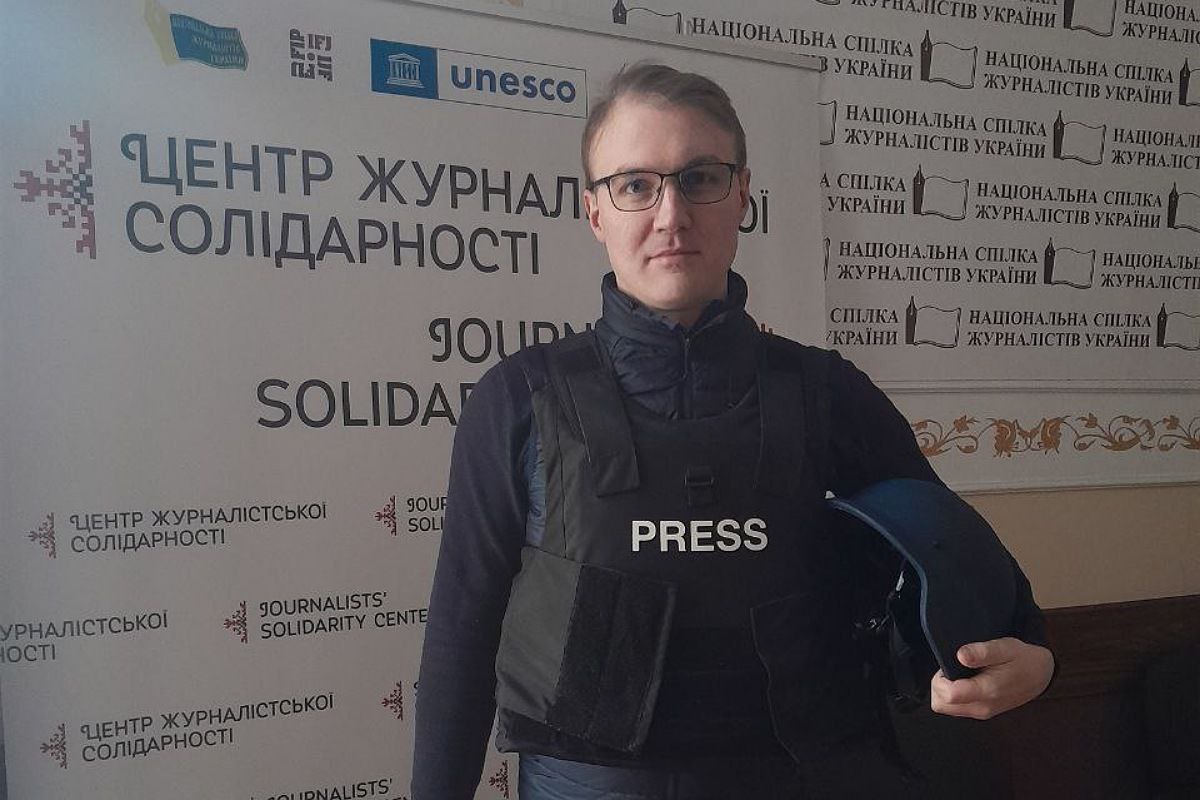
Nataliya Voitovych: How do russian disinformation narratives shape Western media framing of Ukraine, and how do Journalist Solidarity Centers protect frontline reporting?
Nataliya Voitovych is a Ukrainian journalist and disinformation researcher who coordinates the Lviv Journalists’ Solidarity Center within the National Union of Journalists of Ukraine’s nationwide network. Her work focuses on keeping reporters safe and operational during russia’s invasion: organizing coworking space during blackouts, arranging access to protective equipment, and connecting displaced journalists with practical support and training. Alongside this field role, she contributes to academic and professional literature on media literacy and countering disinformation, examining how propaganda spreads and how audiences can be inoculated against it. She collaborates with international partners, including UNESCO-backed programs, to sustain independent Ukrainian journalism nationwide.
In this interview, Scott Douglas Jacobsen speaks with Nataliya Voitovych, coordinator of the Lviv Journalists’ Solidarity Center, about how russian disinformation distorts Western coverage and how Ukraine’s resistance forced many outlets to revise early assumptions. Voitovych argues that the war began in 2014, not 2022, and critiques narratives that frame Ukraine as too small to endure. She describes propaganda shifts—from “protecting russian speakers” to claims of “returning lands”—and urges journalists to ground reporting in history. They also discuss press-freedom trajectories, wartime media centralization, and solidarity hubs that provide gear, training, and a safe workspace for frontline reporting amid blackouts, displacement, and escalating threats.
Scott Douglas Jacobsen: In conversations with Ukrainian lawyers and activists, three frames keep coming up about “Western” media: what it gets right, what it gets wrong, and what it misses entirely. From your vantage point, what does it get right, wrong, and miss?
Nataliya Voitovych: russian propaganda has had a strong presence in Western information spaces. This is an information war.
Some media outlets and commentators repeat russian narratives—sometimes for ideological reasons, sometimes to capture audiences, and sometimes because russian-language material is readily available. Many Europeans learned russian, and when people looked for information, they often turned to russian-language sources.
However, russian state-aligned sources and pro-Kremlin messaging do not provide a full or reliable picture of what is happening in Ukraine, which creates a distorted understanding.
The war did not begin in 2022. russia’s war against Ukraine has been ongoing since 2014, beginning with the seizure and annexation of Crimea and the start of russia-backed fighting in eastern Ukraine. Many European outlets treated the conflict for years as an internal Ukrainian issue—a “civil conflict” or “separatist” war—rather than as russian aggression against Ukraine. That misframing was one of the biggest problems.
Russia has major structural advantages: a much larger population, far larger territory, and far greater resources. Ukraine is smaller in both population and geography. Many people assumed a smaller country could not withstand russia.
The full-scale invasion began on February 24, 2022. As of now, it is in its fourth year. Over these years, the world has seen that a smaller country can resist and fight a much larger aggressor.
Ukraine is also defending the broader European security order. If Ukraine were conquered, the threat would not necessarily stop at Ukraine’s borders; it would increase the risk of further instability and coercion across Europe.
Ukraine has become a barrier to Putin’s expansion into Europe and beyond.
Before the full-scale invasion began, some people began practicing Ukrainian, but it was not widely prioritized. When russia’s full-scale invasion started in 2022, some European and “Western” media initially said Ukraine was a small country, and russia was a big country, so Ukraine could not defend itself.
However, our country—our people—became a clear example that Ukraine can defend itself. It is not only about size. European media contains a lot of russian propaganda, and that influences perceptions.
Early on, a common narrative was: ‘Russia is big, Ukraine cannot defend itself.’ Later, the media began to acknowledge what proved true: Ukraine can defend itself. However, that was not the first image; it came later.
Jacobsen: Many Western outlets revised early expectations once Ukraine resisted the initial assault.
Voitovych: I read questions from foreign media, including in Ukraine and in some European countries. Some people said they would not go and doubted that Ukraine would resist.
However, when the invasion began in 2022, people joined the defense in enormous numbers—men and women ready to stand up and defend the state. There were long lines of volunteers.
Painters, bakers, singers, musicians, seamstresses—ordinary people—ready to participate in the defense of the country.
In 2022, I was interviewed by Polish media and said that if the war came to Lviv, I would take up arms and defend my country because it is my land and I would not leave.
In Kyiv in 2022, when the full-scale invasion began, weapons were distributed, and people went out to defend the city, even facing armored vehicles with whatever they had. They defended Kyiv and Ukraine.
Voitovych: There were lines for weapons. They gave people weapons, and they went to defend their neighborhoods and their cities themselves.
Jacobsen: Your specialization is russian disinformation. What was the character of russian disinformation at the start of the war in 2014? How did it change in 2022? What is its character now—especially with EU and NATO delays, and the political chaos around Trump?
Voitovych: russian disinformation has centered on the claim of “returning russian lands,” despite Ukraine’s internationally recognized sovereignty after 1991: sovereignty, independence, and territorial integrity. They also pushed the narrative that they were “liberating” or “protecting” russian-speaking people.
That was propaganda. Sometimes it sounded as if they were afraid of Western Ukraine because we are Ukrainian-speaking and we value our language.
Even in Lviv, we had multiple schools that taught russian as a minority language. In the streets of Lviv, people spoke russian, and nobody forbade it.
Until around 2016–2018, much public life was bilingual: concerts and programs often had one line in Ukrainian and another line in russian. You cannot honestly claim there was “pressure” on the russian language.
In 2014, they started the war in the Donetsk and Luhansk Regions. They staged “referendums” about separating those territories, although many people were forced to leave and could not vote. They then claimed large percentages supported separation.
Russia also claimed it was a war inside Ukraine—Ukrainians fighting Ukrainians—and that russia had nothing to do with it. In Crimea, they used a similar line. They said russian troops were not there. That is where the phrase and meme came from: the “little green men.”
Jacobsen: When russians frame “liberation,” they mean “liberation” from the humiliation of the russian language.
Voitovych: russian officials said they were not in Crimea, but they were in Crimea—and they are still there.
In Ukrainian, it translates as “they are not there,” and it became a meme—”in one word.”
When other parts of the world—Europe, America, Canada, and others—say that russia occupied Crimea, russia responds by claiming that Ukraine is not really a country. They claim Ukraine was “founded” by Lenin.
However, Kyiv is far older than Moscow by centuries. It is illogical to say that a place with an older city, a long history, and an established culture was “created” recently by the Soviet Union. This is one of the biggest propaganda claims.
Ukraine existed as a historical polity and a cultural territory long before the USSR. There is historical evidence, including accounts by European travelers and researchers, describing the territory of Ukraine, its culture, and historical developments that differed sharply from those in russia.
Now, when they cannot credibly claim they are “protecting russian-speaking people,” they shift to another message: that Ukraine is “their territory” and they are “taking back what is theirs.” That is where the propaganda has moved.
European media—and world media—need to return to history and read it seriously: not only russian state narratives, but also French, Italian, Spanish, and other historians and travellers from the 15th and 16th centuries who documented the region and drew maps that included Ukraine. This matters.
Western media are often new to this context.
Russian propaganda claimed that russian-speaking boys were in danger in Lviv. You went to Lviv—I hope you did not see anything like that.
Western media, in general, does not know russian history very well either. russian propaganda says that in Lviv, our people “eat russian boys,” and similar absurd things. That is propaganda.
Jacobsen: In different contexts, there are historical analogies. People used to claim that Jewish people harmed Christian children centuries ago. This “child-eating” narrative is not a new tool.
Voitovych: Our biggest problem is that Ukraine was the world’s third-largest nuclear arsenal after the Soviet Union collapsed. Many argued it would not be safe for Ukraine to keep those weapons.
Ukraine was pressured into giving them up under the Budapest Memorandum in 1994. Ukrainians believed that the United States, the United Kingdom, and russia agreed to respect Ukraine’s independence and borders.
However, russia had intentions to restore control over the former Soviet territories. If Ukraine had kept nuclear weapons, maybe russia would not have attacked. Ukraine trusted that nuclear powers would preserve Ukraine’s integrity and help protect it.
When it came to protection, russia later claimed the memorandum was not binding and treated it as merely a political statement. That is what happened.
I feel personal regret about this, because Ukrainians are strong, hardworking, and brave. If you look at the broader story, Ukraine as a state has not attacked others; it has defended itself.
In the 1990s, the world acted as if Ukraine could hypothetically become an aggressor. That is strange, because historically, Ukraine has not been an aggressor.
Historically, Ukraine has defended itself. However, in the 1990s, other countries treated Ukraine as if it could pose a serious threat. They thought it would be better for Ukraine to give up its nuclear weapons, and they said they would defend Ukraine from other countries.
Jacobsen: This came up in another interview recently with a Ukrainian based in the United States, so I will take a minute to lay out the logic.
During World War II, Jewish people were integrated into German society and achieved success in many areas. Then they were persecuted in Germany, and conditions became catastrophic.
Many tried to flee to different countries, but large parts of the world refused to accept them. They experienced betrayal within their own society and then betrayal as refugees trying to escape.
The contexts differ in severity, but the logic of betrayal has a parallel structure.
Ukraine had the world’s third-largest nuclear arsenal. After gaining independence from the Soviet Union, Ukraine agreed to denuclearize. The United States and other powers offered assurances tied to Ukraine’s sovereignty and borders.
Then the russian Federation annexed Crimea in 2014 and launched the full-scale invasion in 2022, violating international law. The United States did not intervene militarily to defend Ukraine, so many Ukrainians interpret that as a second betrayal layered onto the first.
So there is a “double betrayal”: aggression from a former Soviet “brother,” and the absence of the hard protection Ukrainians believed the assurances implied.
That is why, when civilians, the military, and President Zelenskyy say “no territorial concessions,” I understand the position. Again, not the same degree of suffering as the Holocaust, but similar logic in geopolitical and cultural terms: after repeated betrayal, conceding territory feels like rewarding the aggressor and inviting future aggression.
Voitovych: If we make territorial concessions, it will be a disaster. You cannot give the aggressor what they want. If we agree to give them our territory, they will not stop.
The biggest message from the Ukrainian side is: do not let Putin achieve any of his political objectives, because then he will pursue more.
Jacobsen: In the Reporters Without Borders World Press Freedom Index, Ukraine ranked 106th out of 180 in 2022, while russia ranked 155th.
That is not the whole story. Ukraine improved to 62nd in 2025, while russia fell to 171st—a clear divergence.
For context, Moldova is 35th in 2025.
So, despite the war, Ukraine—alongside anti-corruption efforts—has improved on media freedom, while russia’s media environment has worsened.
There are concerns in Ukraine under martial law, including restrictions and occasional interference affecting journalists, especially near the front line. On the russian side, there are severe concerns: journalists being detained, abused, and credible reporting (including UN-linked documentation) indicating torture and systematic mistreatment of detained journalists.
What are the main concerns for journalists in Ukraine right now? How does that contrast with russia’s treatment of journalists, particularly detention, abuse, and torture? Moreover, in the bigger picture, press freedom is worsening in russia and improving in Ukraine. Ironically, fewer Western journalists come to Ukraine at the very moment more should, especially given the improved rankings.
Jacobsen: What is the Journalistic Solidarity Center?
Voitovych: It started in 2022, when the full-scale invasion led to mass displacement. Journalists from occupied or heavily attacked areas began fleeing, and Lviv became a hub. A community of journalists formed there to coordinate help. One of the first groups to assist us was a similar journalistic community in Greece.
In March 2022, they brought supplies—food, laptops, phones, cameras—because many journalists had fled without equipment.
We distributed aid, helped journalists find places to live, and supported them so they could continue working. Some stayed in Lviv; others moved onward.
In the summer of 2022, journalists in Kyiv decided it was necessary to create multiple hubs where they could come for help. We had hubs in Lviv, Chernivtsi, Ivano-Frankivsk, and Kyiv.
UNESCO began providing support—funding, bulletproof vests, helmets, and medical supplies—so journalists could have protective equipment.
We worked in that format through 2023. In 2023, we reorganized, and now we have hubs in Zaporizhzhia, Kharkiv, Dnipro, and Kyiv, with Ivano-Frankivsk, Chernivtsi, and Lviv grouped. In total, there are six hubs where journalists can come, borrow protective gear, and then go to the front with better safety.
Russia is attacking Ukraine’s energy system. For example, Lviv can experience blackouts. When there is no electricity or internet at home, journalists can come to the hub to work. It also serves as a workspace.
Once or twice a month, depending on circumstances, we run trainings and workshops on fact-checking, information warfare and propaganda, and journalistic ethics—especially how to report on war responsibly.
We also provide security and medical training, so when journalists go to dangerous areas, they can protect themselves and help others, including their camera operators.
These centers are genuinely helpful. They provide mutual support and practical consultation, helping journalists work more safely and stay connected.
Many journalists entered or re-entered the country in 2022, and many came from the east after fleeing their homes with no equipment and no protective gear. The hubs helped fill that gap.
Russia targets journalists—along with medics. Many journalists were forced to flee their homes, and Lviv became a hub because so many of them were there. There are now six such hubs in Ukraine.
There was a similar hub in Greece that supplied us with equipment and other support. If journalists want to go to the front line, they can come to our hub, receive protective equipment—like a bulletproof vest—and then go to the front with better safety.
We also hold lectures a few times per month about russian propaganda and disinformation.
Jacobsen: I have a question. What are her views, and the department head’s views, on “United Media”—bringing everything together under one centralized media platform? How did that centralization work in 2022? Was it an idea of the state, without taking journalists’ opinions into account?
The main concerns I have seen about media freedom in Ukraine have been martial law restrictions and the occasional persecution or obstruction of some journalists, primarily near the front line.
On the russian side, it is systematic: imprisonment of journalists, torture of detained journalists, and the deliberate targeting of journalists—including people clearly marked as “press”—and killing them. We see this through the Journalistic Solidarity work.
Voitovych: We also work with journalists, bloggers, and civic leaders—especially those in Crimea. We investigate the fate of journalists whom russia has taken and is holding in captivity.
We have supported the family of Viktor Roshchyna—no, sorry, let me be precise: please look up the story of Victoriya Roshchyna. We track the fate of Ukrainian journalists in Crimea in particular, and we also tracked the fate of Victoriya Roshchyna, who was killed in russia.
Recently, there was news that Victoriya Roshchyna asked for a psychologist and said that if she did not receive help, she would take drastic steps.
The Center for Journalism and the National Union of Journalists of Ukraine (NUJU) wrote a petition about Viktoriia and also about a broader list of journalists being held in russia.
Russia treats journalists in a fundamentally criminal way because, for them, journalists are a target that must be eliminated. Why? Because a journalist can arrive, see what is happening, go back to the newsroom, and publish that russia is not telling the truth.
So when we talk about the press freedom index in russia, for me it is not just low—it is below zero.
Jacobsen: You are saying the main target—the main aim—for russians is to kill journalists. Moreover, you are saying that, for you, russia’s press freedom is below zero [Ed. So low that it is below any listing. It is like Afghanistan or North Korea.
Voitovych: A lot of the problems for the media in russia started a long time ago. When Putin came to power, I am not a historian, but my understanding is that he did three major things.
First, he targeted independent journalists and moved to silence them.
Second, he consolidated power by aligning with and empowering the richest men—oligarchs—so wealth and political loyalty reinforced each other.
Third, he built a system of patriotic messaging designed to make russians feel proud and to mobilize them around the state.
It is noteworthy that before territorial expansion and patriotic mobilization, he moved against independent journalism.
It was not about the people’s good. It was about protecting his own power.
Jacobsen: The russian state is not the same thing as the russian population.
Voitovych: I had a friend in russia. In 2014, after consuming russian propaganda, he asked me why Ukraine attacked russia. He described it as “Ukraine is small, russia is big.” In other words, he had inverted the roles of aggressor and victim.
Jacobsen: That connects to the territory point, which comes up repeatedly: why does russia need more territory? It does not.
Voitovych: russia has a large population and a vast landmass, but its economy is not as strong as its size suggests. By some measures, russia’s overall economic output is comparable to that of large European economies. Still, because russia has a much larger population, its per capita wealth is lower than that of many Western European countries. That is not a precise economic claim.
I have also heard sentiments from Ukrainian civilians that some russians resented Ukraine’s quality of life. That may be true for some individuals, but it is not a strong general explanation.
The main point is that russian state propaganda has framed Ukraine in a way that justifies domination.
Jacobsen: I can make an analogy from the American case. As a Canadian, I heard this argument often: the U.S. invasion of Afghanistan was justified in the public mind as a response to 9/11 (including NATO’s Article 5 being invoked and with UN resolutions). At the same time, the extension to Iraq was sold on weapons of mass destruction—claims that did not hold up. However, many people conflated the two conflicts in their minds into “the same war.” So, in the American public mind, Afghanistan and Iraq became conflated.
There is a history here. Americans had troops in Afghanistan for a long time. Many Americans thought the war was beneficial or necessary, regardless of what Afghanistan was experiencing. Moreover, there is an underlying slogan logic that appears in many countries: “They hate us for our freedom.”
The main problem is that russian propaganda uses a familiar kind of slogan-logic—something like, “They hate us for our freedom,” but, as some Ukrainians expressed, they were jealous of Ukrainian prosperity. You could say that might be true for some people, but not broadly. It is not a serious explanation of what is happening.
Sometimes this is not about popular grievances at all—it can be the will of an authoritarian leader and a ruling system trying to rebuild an empire and imitate figures like Catherine the Great or Peter the Great.
Oleksandra Matviichuk said in late 2025, in a clip I saw, that humanitarian aid numbers matter, and counting the killed and the equipment destroyed matters. Still, we should not lose the human stories. Otherwise, we turn human losses into statistics rather than a narrative. That struck me.
My first trip in 2023 was mainly to get acquainted. My second trip was more about politics, activism, and human rights. My third trip was supposed to come through Odesa, but after russia bombed bridges, routes were disrupted, and I came through Poland.
This time, I decided to do the regular work but devote much more attention to human stories—profiling young journalists, visiting art centers, and speaking with people like you and other leaders involved in Ukraine’s cultural regeneration.
So the character of this third trip is oriented around capturing human stories like yours. Are you noticing any loss of the human element in foreign media coverage? Are you noticing any loss of the human stories in foreign media?
This is from Rivne.
Voitovych: I have not noticed it much in foreign media because I do not usually consume it closely. However, I have noticed it in our media. When we show the deaths of soldiers, it often becomes statistics.
However, when we show a person’s death through their story, it is different. It is the death of a son. It is the death of a father. It is the death of a brother. It is the death of a friend. We can demonstrate someone’s death through their story.
My cousin was 25 years old. She went to the front line at the beginning of the full-scale war, when she was barely 18. She served as a medic. She said she could not stay at home because her country was invaded. She died two days before her birthday. russia killed her. She was also a journalist.
She is a Hero of Ukraine. She will be 24 forever. Her story shows the depth of the Ukrainian nation. If you report deaths among the Hospitallers, it is sad. However, when you tell the story of a young woman who chose to go and serve, it becomes more than sadness—it becomes recognition.
If we write only that someone died, it is sad. If we write about the person they were, it becomes an honor.
Jacobsen: Death is personal, and honor never replaces the person. There are four broad categories of men in Ukraine: those who left the country, those who hid within the country, those who were coerced or forced into mobilization, and those who chose to go to the front and stayed.
The word “brave” probably belongs primarily to the last group. People may use the terms “brave” or “courageous” to describe foreign journalists like me who come to Ukraine. That is not appropriate. It may be insensitive because we choose to come here and can choose to leave. Calling us “brave” in the same way is unfair and irresponsible.
So, what is your expert opinion on the context for men and women—bakers, artists, journalists—who went to the front line? What is your take on their stories: changing an ordinary life into becoming someone on the front line? What do you think about their stories?
Voitovych: We mentioned those who left, those who hid, and those who went to fight. I do not blame those who hid or those who left, because fear is human. However, I have great respect for those who, regardless of their profession—whether they are singers, artists, teachers, or journalists—went to the front to defend the country.
Moreover, I also respect those who stayed here and continue doing what they can. Sometimes it looks like indifference, but it is not. It is resilience.
Today, on my way to work, I saw a scene that really touched me: two young girls, about 18 years old, carrying a large container of gasoline and pouring it into a generator so a café—or some small place—could keep working during a blackout. That is not typically considered “girls’ work,” but they stayed, and they did what was needed. Those are small steps, but they mean a lot.
It is hard to describe. At home, we may have electricity for only about four hours a day, and then we have no light. However, we live on. We go outside between buildings, set up barrels, light a fire, and cook food. Life continues.
For me, it is all part of the same resilience. Those who are physically and mentally ready to go to the front go and fight. However, I cannot dismiss any of the four categories, because people’s circumstances and limits differ, and even small acts of endurance and mutual support matter.
Jacobsen: Some questions can feel taboo. For example, what are we to make of russian families who want nothing to do with the war, but feel they have to take part in it—especially if, financially, it seems like the only viable option in their village? What should we make of their stories? I do not want to make the same mistake as Westerners, framing this almost theologically as a war between pure good and pure evil.
Voitovych: You mean families whose men are sent to the front, and the family feels they have no other normal option. I recommend you watch videos where russian prisoners are filmed while speaking with their families.
In these recordings, you can hear how they talk. They often describe the war as a way to reach something—to get something. That is not normal, especially for an aggressor.
Some of them neglect their husbands or sons. It is not about love. russian people—again, this is my opinion—close their eyes. They do not want to see. They do not want to understand. Critical thinking is when you analyze.
Most russians do not analyze. They unquestioningly believe what they are given. Many russian families do not want to see the full situation. They close their eyes. That is not critical thinking. Moreover, it is not a small thing.
Jacobsen: The only symmetry I have seen in credible documentation comes from the UN system—particularly the Office of the High Commissioner for Human Rights.
In one UN report, 205 prisoners were interviewed—Russian and Ukrainian prisoners of war and detainees—and both groups reported torture or ill-treatment. However, there was an important distinction.
For Ukrainian prisoners of war, the torture is well documented and extensive, and it occurs systematically in detention facilities. For russian prisoners, the allegations were not primarily about treatment inside formal detention facilities. They were more about abuse at a transfer point—an “in-transit” or “way station” stage before arriving at detention.
So the alleged abuse against russian prisoners appears to be more concentrated in that transit phase, rather than in established detention centers. That is a nuance that rarely makes it into mainstream reporting. I would be very interested to see more coverage of what happens at those transfer points, because we already have substantial reporting on what happens to Ukrainians in detention.
In general, russian detainees appear to be treated far better than Ukrainian detainees, even acknowledging that abuses against russian prisoners—especially during transfers—are a serious human rights concern.
From a human rights perspective, that is one of the areas where things become more morally complex, because the question becomes: who controlled that transfer point, and what systems existed—or failed—to prevent abuse?
I also recall UN-verified cases in 2023–2024 involving the killing of russian prisoners by Ukrainian forces, though again, the scale and systematic character differ sharply from russia’s treatment of Ukrainian prisoners. The story of Victoriya Roshchyna is an eloquent example of what is at stake.
I am not standing on a pedestal here. I am well aware of Canadian failures and wider Western failures—Romeo Dallaire in Rwanda, and the context dramatized for popular audiences through films like Hotel Rwanda. During the genocide against the Tutsi in 1994, propaganda—especially radio broadcasts—was used to incite mass violence. It is a brutal example of what information warfare can do.
I bring up Rwanda because I am also aware of how grating it is when people in the West make beautiful speeches and then do little, or when Western states have committed serious wrongs themselves. It is important to emphasize that in this interview.
Voitovych: I have a question. Do you have any expectations—expectations or assumptions—coming into this?
Jacobsen: I have found that having fewer expectations and fewer assumptions is important for a more accurate view of things. There is a neo-Taoist idea of the “empty cup”: when you come open and receptive, you can take in what is actually there.
It might sound abstract, but the point is practical. Fewer expectations allow you to see things more as others do, rather than forcing everything through your own prior experience and interpretations.
Voitovych: So you mean: the fewer expectations you bring, the more clearly you can perceive what is in front of you, and the less you distort it through your own past experiences and assumptions.
Jacobsen: There is also an African pre-colonial idea—often associated with Ubuntu—that people are defined through one another: “I am because you are.” That can inform journalistic narrative construction in a way that is more intersubjectively accurate and therefore more comprehensive. My only expectation is the price of an espresso.
In two provinces over, in the city of Winnipeg, they expect the temperature to drop to extreme lows. One backpacker from Canada in Lviv can feel comfortable. For me, minus 20 is cold, and minus five is mildly uncomfortable. How about you?
Voitovych: For me, plus 20 degrees is comfortable.
Jacobsen: I used to work at a horse farm. I was doing journalism on equestrianism. I found it comfortable to do ranch labor and landscaping at around 25 Celsius.
My indication from recent statements by the Prime Minister of Finland, President Zelenskyy, Lavrov’s recent evasiveness, and the encouraged discussion in Alaska is that russians are losing as many—or more—than they are recruiting now. That raises another issue.
We know from reliable reporting that some Indian nationals were misled into serving in the russian army. We also know North Korean forces have supported russia, and that Iranian Shahed drones and related technology have been used by russia, with foreign-sourced components—including from China—showing up in russian drone supply chains. We also know some citizens of Western-aligned countries have volunteered in the Ukrainian forces.
I would love to see an investigative piece—from Ukrainian journalists or someone closer to this than I am—on two questions: how many other nationalities are being misled or coerced into russian service, and how many nationalities are volunteering on the Ukrainian side? If Indians are involved and there are reports of others from very different regions, that suggests the problem is wider than what is commonly discussed.
Voitovych: It is hard for me to answer precisely because I am not a military strategist. However, yes, we know there are foreign nationals involved.
Jacobsen: I also recently completed a book project—around 110,000 words—based on conversations with experts and victim advocates regarding clergy-perpetrated abuse in the Eastern Orthodox Church.
One relevant comparison: in the United States, the Archdiocese of Los Angeles agreed in 2024 to an $880 million settlement with survivors of clergy sexual abuse—just one archdiocese, in one metro area, and one settlement among others. However, I still hear a kind of deflection from some Orthodox voices: “We do not have that,” or “If we do, we are not as bad as the Catholic Church.”
It is bad in any case. No version of this becomes a joke. We do have a database now, and you can do a four-quadrant analysis of victims: adult women, boys as primary victims, with girls and adult men as minority victims. It is controversial, but the point is that the victim profile is not limited to any one group, even though some groups appear more frequently in reported and documented cases.
What we do know across Christian denominations is that when victims—men or women—come forward, the first institutional reflex is often to defend the church rather than protect the victim.
We also know false allegations are a minority. Estimates vary, but commonly cited ranges are roughly 2% to 10%. That means when one person comes forward, the odds heavily favor a genuine claim. When multiple independent complainants come forward—three, four, five—the likelihood that the accused engaged in misconduct becomes extremely high.
I get a lot of strange emails.
Security-wise, before I came here, my latest hate mail—or “fan mail”—was: “Your writing sucks, and I hope you die soon.”
Journalists get harassed constantly now. Women are more often sexually harassed.
I did a four-part interview with a British Pakistani colleague, and she described how she gets the same “your writing sucks, I hope you die” messages, but often with sexualized threats, like “I hope you get raped to death,” or similar.
It is American chaos, European delays paired with beautiful statements, Ukraine’s increasing self-sufficiency, and russia’s largely criminal conduct. Those four dynamics do not seem to be changing much.
Much of Africa has no direct stake in this beyond specific cases—such as some Kenyan nationals reportedly being deceived into russian service. Some in Africa may also view this, bluntly, as a European “white people’s war,” even though the consequences, e.g., food prices, energy shocks, rule-of-law precedents, recruitment scams, travel well beyond Europe.
Since those structural dynamics are shifting slowly, the areas where I can make a small contribution are often the less-covered parts: culture, civil society, and human stories—the things that keep human beings from turning into spreadsheet cells.
Jacobsen: Thank you very much for the opportunity and your time, Nataliya.
***
Scott Douglas Jacobsen is the publisher of In-Sight Publishing (ISBN: 978-1-0692343) and Editor-in-Chief of In-Sight: Interviews (ISSN: 2369-6885). He writes for The Good Men Project, International Policy Digest (ISSN: 2332–9416), The Humanist (Print: ISSN 0018-7399; Online: ISSN 2163-3576), Basic Income Earth Network (UK Registered Charity 1177066), A Further Inquiry, and other media. He is a member in good standing of numerous media organizations.
In this interview – https://goodmenproject.com/featured-content/natalka-voitovych-russian-disinformation-journalist-solidarity-centers-ukraine-sjbn/ – Scott Douglas Jacobsen is talking to Nataliya Voitovych.










Discussion about this post