
 THE NATIONAL UNION OF
JOURNALISTS OF UKRAINE
THE NATIONAL UNION OF
JOURNALISTS OF UKRAINE
Three journalists killed, 26 still behind bars: these figures alone sum up the grim reality of independent journalism in wartime Ukraine over the past year. Behind them, dozens of lives have been disrupted and destroyed due to russia’s war of aggression, which has from the very beginning also been a war on Ukraine’s free press and democratic system.
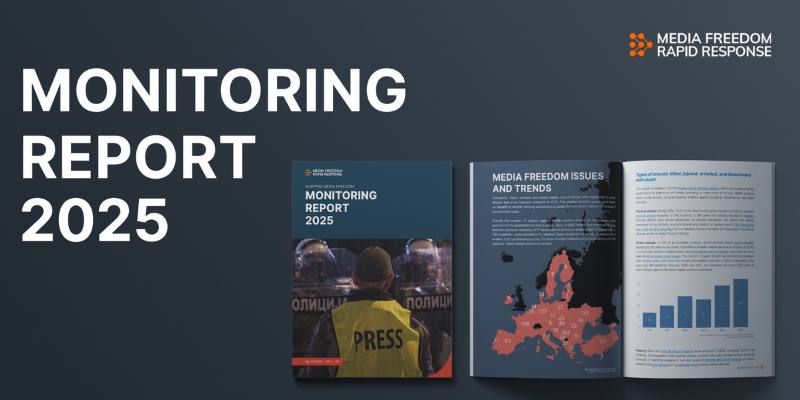
These numbers are reflected in the findings of a new report published today, 18 February, by the International Press Institute (IPI), together with our partners from the Media Freedom Rapid Response (MFRR) consortium, which includes five other European press freedom NGOs.
Our findings are based on the analytical work of our team of researchers across Europe, who daily monitor attacks on media in 36 EU member states and candidate countries, recording each attack as a press freedom violation. All in all, in 2025, we recorded 1481 such violations across Europe, including 124 in Ukraine.
As in previous years, the situation in Ukraine was central to our analysis of the overall health of press freedom in Europe.
Autumn 2025 – the deadliest period for journalists since the first months of the full-scale invasion
Independent journalism helps societies stay aware of important developments that eventually shape their future. In this context, frontline reporting from Ukraine is essential, as it brings crucial news to Ukrainian and international audiences.
However, over time, it has become increasingly difficult for frontline reporters in Ukraine to do their job. Our report highlights what local journalists already know all too well – that FPV drone technology has developed to such an extent over the past year that it is now dangerous to report from almost any area in the Donbas, even locations considered relatively safe until recently.
In addition to this, press markings, which according to international standards are required in zones of armed conflict in order to identify journalists as civilians, have increasingly become a target for russian armed forces, and no longer serve as protection.
In 2025, three media workers paid the highest price for trying to bring news from the frontlines: French photojournalist Antoni Lallican, as well as Ukrainian reporters Yevhen Karmazin and Aliona Hramova. At least 12 more were injured, according to data presented in our Mapping Media Freedom report.
This made 2025 – and more specifically autumn last year – the deadliest period for journalists in Ukraine since the first months of russia’s full-scale invasion in 2022.
Concerns over the safety of Ukrainian journalists in russian custody
While far from the headlines, the situation of Ukrainian journalists held by russia is more than worrying. The death of Victoria Roshchyna in 2024 fueled fears that the remaining media workers that russia continues to hold hostage could face a similar fate. Throughout 2025, russia released Vladyslav Yesypenko, Dmytro Khyliuk, and Mark Kaliush. 26 more Ukrainian journalists remain behind bars, in russia or regions of Ukraine currently under russian occupation.
Beyond the fully unjustified nature of their detention and the politically motivated charges that they were presented with, these journalists face regular mistreatment, if not outright torture, at the hands of russian authorities, according to multiple accounts of Ukrainian civilians who were released from russian custody.
In addition to this, the general lack of almost any information about the conditions in which they are held is particularly worrying, as the silence surrounding their cases exposes imprisoned Ukrainian journalists to even more wrongdoing at the hands of russian authorities.
The situation in Ukraine and that of Europe
Journalists in Ukraine are obviously faced with the most dangerous work conditions across Europe. In this sense, their situation cannot be compared to that in any other European country.
Across the continent, the main issues highlighted by our research team – aside from the safety situation in Ukraine – were attacks by domestic authorities, such as the development of foreign agent laws and other repressive legislation, for example, in Georgia and in Turkey. Other issues included the rise of lawsuits targeting journalists. They meant to discourage them from their work, generally known as SLAPPs.
Journalists in Ukraine also face multiple risks at the hands of domestic actors, which are underlined in our report. These include physical attacks on journalists, as well as obstruction of legal journalistic activities, such as refusal of access to courts or other public institutions.
However, these attacks are obviously not nearly as serious as those committed by russian occupying forces in Ukraine.
Conclusions and further steps
While our annual report on its own does not aim to provide solutions to these issues, the data we gathered can serve as a powerful tool in understanding the priorities to address and form the foundation for IPI and our MFRR partners’ advocacy in support of media freedom and independent journalism, in Ukraine, in Europe, and beyond.
In the case of Ukraine, this data exposes the most serious issues facing journalists and informs the international press freedom community on priority areas to address. As such, the need for concerted efforts for the liberation of Ukrainian journalists in russian custody stands out as crucial. Equally serious is the situation on the front line, where russia increasingly often targets reporters at work.
Given the frequency at which journalists have been shot at, wounded, or murdered, press markings have become an issue deserving reflection on the need to reform international standards for the identification of journalists as civilians in zones of armed conflict.
As russia’s full-scale invasion grinds on, IPI and our MFRR partners will continue to monitor press freedom violations, including russian attacks on the press, advocate for continued international attention and support, and provide direct aid to our colleagues in Ukraine wherever possible.
By Karol Łuczka, Eastern Europe Press Freedom Advisor at the International Press Institute (IPI)
Article by Ukrayinska Pravda online publication









Discussion about this post