 THE NATIONAL UNION OF
JOURNALISTS OF UKRAINE
THE NATIONAL UNION OF
JOURNALISTS OF UKRAINE
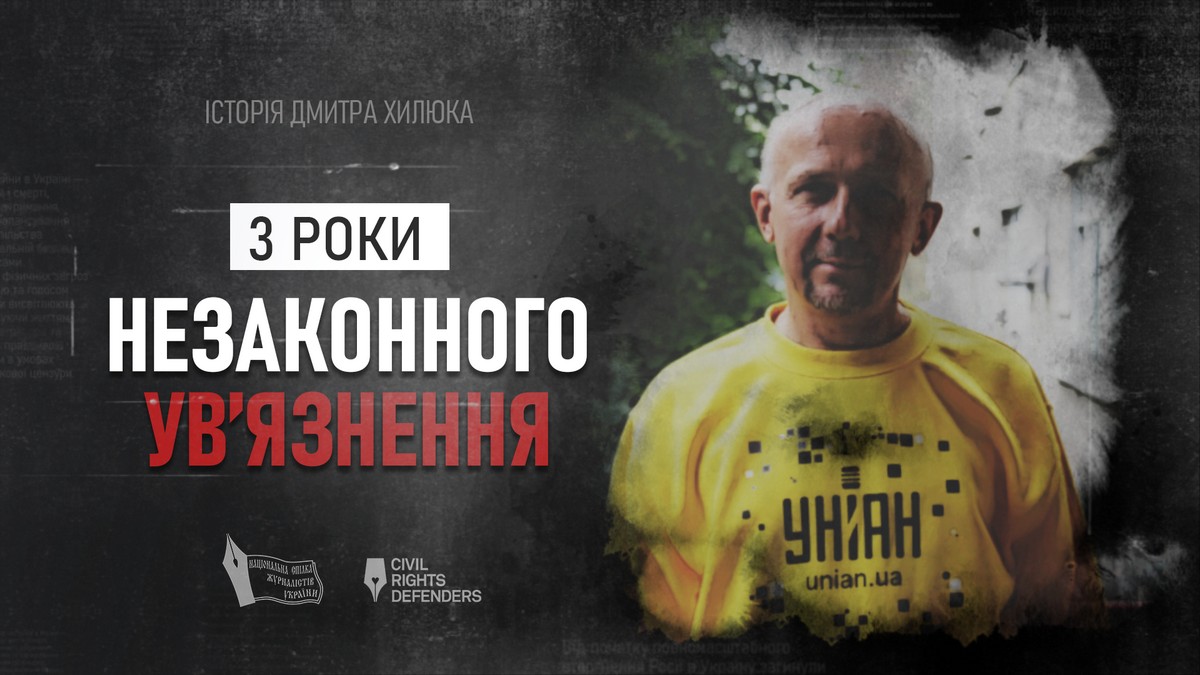
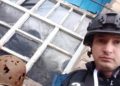
For more than three years, UNIAN news agency journalist Dmytro Khyliuk spent in russian captivity. In an interview with the National Union of Journalists of Ukraine (NUJU), the media personality talks about life in absolute information isolation and explains how the occupiers imitate compliance with the Geneva Conventions, hiding traces of torture from international observers. After his release from captivity, Dmytro uses his experience to document the war crimes of the russian Federation and protect the rights of those who still remain in captivity.
On March 3, 2022, he and his father were captured right in the courtyard of their home in Kozarovychy, Kyiv Region. They pointed weapons at him, put jackets on their heads, and took him in an unknown direction. At first, he was held in the occupied territory of Dymer, and later taken to russia. There he was held in the pre-trial detention center in the city of Novozybkov, Bryansk Oblast, and in the Pakino correctional colony, Vladimir Oblast.
“Back then, we already knew that the occupiers were going from house to house and taking away all valuables. But the idea that they would kidnap people and take them to russia never even crossed our minds,” recalls the events of several years ago, Dmytro Khyliuk. “On the morning of March 3, my father and I were returning from our neighbors. I was walking ahead, had already entered my yard, when suddenly I heard voices. I turned around – russian soldiers had pointed their weapons at my father. I ran up to him… Then they took us to the local logistics center and locked us in a dark room without windows. There were already two or three people there. At first, I thought they had been arrested because of my profession, but when I saw the others, I realized that it was not because of that.”
After the detention, they were separated. After some time, my father was released and assured that the war “would end in a few days and my son would come home.”
The most difficult test in russian prisons, according to Dmytro, was the absolute information vacuum. It was more oppressive than the cold, hunger, or beatings.
“The most difficult thing is the unknown and the lack of any communication with the world outside the prison cell door. It is even worse than the lack of food or medicine. If we knew that we were at home, with our relatives, it would be much easier to endure physical abuse,” recalls the media worker. “We tried to remain optimistic, because logically we understood: this would not last forever. We hoped that every day in captivity would be the last day.”
Dmytro received his first letter from his parents and colleagues only in March 2025. Until then, he had no information about his relatives.
“They opened a “window” in the cell door through which they gave food, and silently handed me an envelope marked Ukrposhta. A photo of my parents was stapled to the letter. I was incredibly happy and excited,” the journalist recalls. “Then I realized that they had survived. Then I paid attention to the date: the letter was sent back in June 2023. The message had been coming to me for almost two years. But still, it was a great joy to receive at least some news from home finally.”
According to him, the colony guards tried to turn Ukrainians into “weak cattle.” Laughing, playing sports, or being active in any way was forbidden in the cells. They did everything to make a person feel intimidated and depressed. The only connection with the outside world and the source of real news in these conditions were the newly arrived prisoners.
Instead, the real picture of what was happening behind the walls of the cells was carefully masked from “outsiders.” Dmytro recalls: before the arrival of the Red Cross representatives, the administration hid those who were beaten. Prisoners with noticeable bruises and traces of torture were moved to separate buildings, where they were not allowed to be checked.
“They know what they are doing and are fully aware that they are committing crimes against humanity and, ultimately, against common sense,” says Dmytro Khyliuk. “Perhaps the occupiers are counting on impunity, on the other hand – if they were not afraid of responsibility, they would not try so diligently to hide the traces of their actions and would not wear balaclavas.”
According to him, since the summer of 2024, the tactics of the invaders have become even more insidious – they began to beat in such a way as not to leave external traces. This was done so that when returning home, the Ukrainians would look “whole”, which allowed the russian Federation to cynically imitate compliance with the Geneva Conventions before the world community.
For a long time, Dmytro’s parents and friends were in the dark and did not know whether their son was alive. They received the first real news about the journalist’s detention from the words of Ukrainians who returned home during the exchanges.
All the time while Dmytro was in captivity, his parents waged their exhausting struggle. They kept in touch with international and human rights organizations to find out about their son’s whereabouts and to have him included in the lists for release.
“We did not stop calling: both the 16-48 hotline and the Red Cross. Later, they confirmed to us that Dmytro was in the Volodymyr region, but was recorded as a prisoner of war. This is absurd – he did not even serve in the army!” said his father, Vasyl Khyliuk. “But they had no right to just keep a civilian…”
Along with Dmytro Khyliuk’s parents, his colleagues, and human rights organizations, including the Media Initiative for Human Rights.
For the professional community, he has always been an example of a “field” journalist who prepared news for his newsroom until the last minute. His colleague and close friend Nataliya Bohuta recalls that Dmytro dictated news by phone when russian tanks were already entering his native village.
When it became clear that Dmytro was in captivity, his relatives and friends were faced with a difficult choice: to remain silent or, on the contrary, to tell the whole world about it. Nataliya Bohuta recalls that at first they were discouraged from publicity, saying that it could only harm. However, they rejected these fears and did everything to prevent him from being forgotten.
“In such a situation, publicity became not a threat, but the only weapon. Some colleagues advised me to sit quietly, but I said that they had already figured out everything about him a long time ago. They spent the night in his house, saw his journalistic ID card,” recalls Nataliya. “We need to look for options, not just sit around. What can we expect? Not everyone will return from captivity, unfortunately.”
According to her, to release Dmytro, his family and colleagues used all possible international platforms: the journalist’s father met with diplomats in Brussels, and Nataliya Bohuta represented his case in the European Parliament at a special event dedicated to captured media workers.
In the end, in 2025, on Ukraine’s Independence Day, a large group of Ukrainian citizens returned from russian captivity. Among them was Dmytro Khyliuk. He plans to continue his journalistic activities; however, he says, in a different format.
“Now I understand that journalism in wartime is completely different from what it was before the invasion,” says Dmytro, and adds, answering a journalist’s question: he will not create a public organization. “We have direct access to the people who make the decisions, and we can openly ask: why the process is stalled or why certain steps turned out to be wrong.”
Given his painful experience, the journalist considers it his duty to refute any “positive” reports about the conditions of the prisoners.
“Today I have a professional advantage, for which I paid too dear a price: I saw everything with my own eyes,” he says. “I was there, and everything is not good there. This must be talked about on the international stage. Speak loudly and speak to many. I think that Europeans do not get it into their heads that the methods of the Nazis are now successfully applied by russia. And these are not horror stories, but reality. At the same time, introduce even more sanctions.
In his opinion, at the state level, there is still a need to strengthen support for the families of prisoners, both in financial and mental aspects. Families should not be left alone with their grief while waiting for their loved ones. Dmytro experienced firsthand how exhausting the unknown is: during the years of his absence, his parents’ health deteriorated significantly due to constant stress. Dmytro Khyliuk is convinced that his testimony will help show the world the real conditions that the russian Federation is trying to hide behind the walls of its prisons.





Discussion about this post