
 THE NATIONAL UNION OF
JOURNALISTS OF UKRAINE
THE NATIONAL UNION OF
JOURNALISTS OF UKRAINE
In early 2025, the Institute of Mass Information published the results of a study of the psychological state of Ukrainian media professionals. 58.3% of journalists responded that they felt constant fatigue, 50.8% indicated sleep problems, 43.3% of media professionals noted difficulties in focusing, 19.2% reported eating disorders, and 20.8% mentioned physical manifestations of stress, such as headaches or heart pain.
This was reported by Detector Media, noting that systemic mental support remains relevant, as the full-scale invasion continues. Here are suggestions from organizations that provide free psychological support to media professionals.
Global initiative: Mental Support for Media
The Mental Support for Media program is organized by the Society Foundation and the BrainCult Center. Head of the mental support department for journalists, Andrii Sydorenko, said that assistance is offered to both individual media workers and the entire editorial staff. Support can be provided free of charge with the support of partners or at the expense of the editorial staff.
Ukrainian media can become participants regardless of size, location, or form of ownership, but the organization takes into account the integrity of the editorial staff. Both employed journalists and freelancers working on sensitive topics can apply individually.
Editorial staff can fill out an application at this link. For individual applications, the link is here.
Rest and recovery from Reporters Without Borders (RSF)
RSF opened a Press Freedom Center in Lviv, and then in May 2022, another one in Kyiv. This was stated by Pauline Maufre, Regional Manager of RSF for Ukraine. As of June 2025, assistance had been provided to over 2,000 journalists and 275 media outlets in partnership with local organizations.
RSF offers psychological assistance through two main programs, which 204 Ukrainian journalists have benefited from as of November 2025. These are individual psychological consultations: RSF offers Ukrainian journalists up to ten online or in-person consultations in Kyiv with a psychologist specializing in working with media professionals. Journalists can request support by writing to assistance2@RSF.org. RSF plans to continue providing this support throughout 2026.
RSF also offers a rest and recovery program: eight-day retreats in the Carpathians for Ukrainian journalists and their families. For more information, journalists and media professionals can contact RSF’s Kyiv Press Freedom Center: kyivpfc@RSF.org.
Lviv Media Forum holds residencies in the Carpathians
These residencies from the Lviv Media Forum are part of the Psychological Support Program for Media. The retreat program combines cultural and educational components: hiking in the mountains, watching and discussing films, rafting, walking, visiting museums, etc. To select participants, the LMF holds open calls, which are announced on social networks and on the website. The Lviv Media Forum also offers individual psychological consultations for media professionals.
The request is submitted through a short questionnaire. The LMF team considers the application within three working days. It reserves the right to refuse without a detailed explanation of the reasons.
The National Union of Journalists of Ukraine (NUJU)
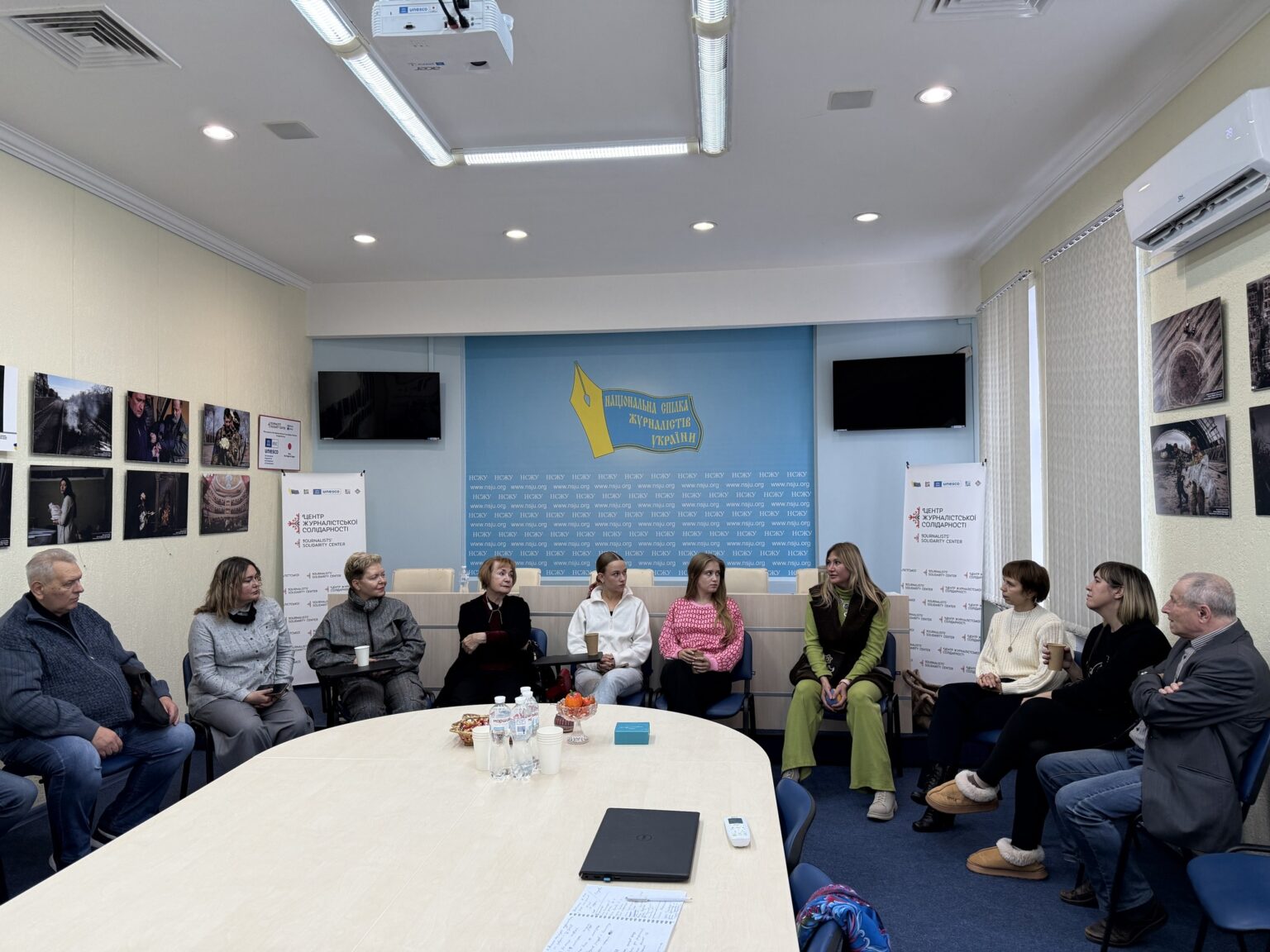
The NUJU holds offline meetings with psychologists. This was reported by the First Secretary of the NUJU, Lina Kushch. These monthly meetings last three hours.
These events take place within the framework of the network of JSC, of which there are six in Ukraine: in Kyiv, Zaporizhia, Dnipro, Ivano-Frankivsk, Lviv, and Kharkiv. The number of participants in such groups is limited – no more than 15 people.
In 2026, the NUJU will continue to provide psychological support; the number of events will be announced later, depending on psychologists and partner companies.
The first secretary of the NUJU also spoke about the practice of individual consultations, introduced in 2023. The project – a hotline for psychological support for journalists – was implemented throughout the year. In addition, webinars with psychologists were held once a month. However, the funding for the project has ended.
“We can inform journalists about those projects or associations of psychologists that continue to provide individual consultations, including for journalists,” explained Lina Kushch.
Regular monthly meetings are also organized on the basis of the Vinnytsia regional organization of the Ukrainian Women’s Union. The head of the Vinnytsia branch, Maryna Teplenko, said that psychological assistance to journalists is provided thanks to the support of the Office of Action non-governmental organization, and the International Association for Mental Health. In addition, the Vinnytsia branch cooperates with Doctors Without Borders.
“We conduct a lot of training in tactical medicine, training with emergency responders, with police officers on self-defense, and, in particular, we work with psychologists from all these structures. They provide practical skills,” she said.
Most of the events with psychologists are held in groups, but if necessary, journalists can be provided with an individual meeting. Five more monthly trainings are planned for the next year. According to Teplenko, announcements appear a week before the event on the pages of the Vinnytsia branch of the NUJU. Registration for training sessions is via a Google Form.
To join the events of the NUJU, you should contact the coordinators of the network of JSCs, or at these contacts: Acting Board Chairperson of the Vinnytsia regional organization of the NUJU, Maryna Teplenko-Didyk: +38067762450. In Kyiv, the responsible organizer is Larisa Portianko: [email protected], (044) 234-52-09.
2402 Foundation
The 2402 Foundation conducts training in physical, mental, and digital security, using innovative technologies, including VR simulations and field training. Special attention is paid to the development of mental resilience, changing behavioral patterns, and strengthening psychological health.
Co-founder of Daily Humanity (2402 Foundation), Kateryna Serhatskova, said that in 2026, it is planned to continue psychological safety programs, but details will be announced later. You can follow the announcements on the foundation’s website and social networks.
Women in Media
The Women in Media provides journalists with information and advocacy support, free consultations from experts in cybersecurity, psychological assistance, and legal protection.
The head of the organization, Liza Kuzmenko, spoke about the online attack map, which records cases of online violence against journalists. Thanks to the interactive map, you can track and analyze attacks, which will help reveal the scale of the problem and help overcome it.
Journalists who have been subjected to online attacks can report this on the Women in Media website by filling out a short questionnaire developed based on UNESCO recommendations and the OSCE Guidelines on Monitoring Online Violence against Women Journalists.
You can also receive appropriate assistance by sending a request to [email protected].







Discussion about this post