 THE NATIONAL UNION OF
JOURNALISTS OF UKRAINE
THE NATIONAL UNION OF
JOURNALISTS OF UKRAINE
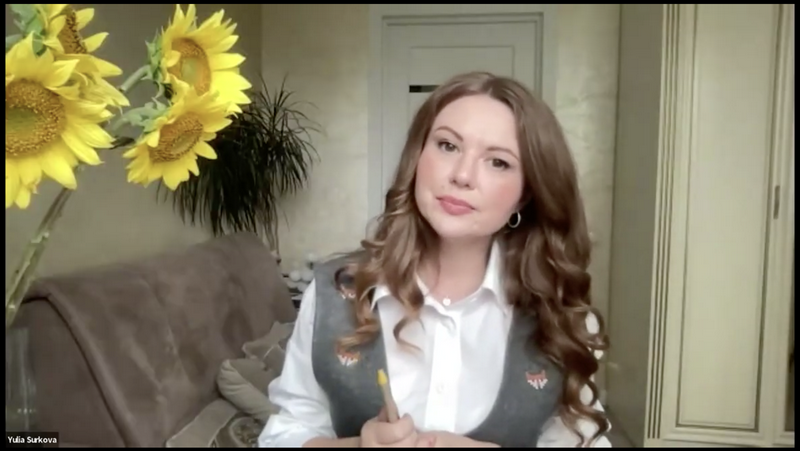
In journalistic material, text is no more important than photos, especially in the modern world, where visual content often prevails. Therefore, journalists should pay increasing attention not only to text, but also to illustrations. Historically, the most important are photos – more significant than texts or videos, because they provide the most vivid evidence of historical events. The issues of why illustrations are worth paying attention to in materials, which ones are better to choose, and how to shoot them were discussed during the third coaching session, conducted by journalist and media coach Yuliya Surkova for participants in the National Union of Journalists of Ukraine’s (NUJU) training course called Strengthening the Resilience of Frontline Media.
Not only the audience’s perception of the material itself, but also the perception of the situation in Ukraine in general, depends on the photo. Moreover, the decision to assist foreign governments or large non-governmental organizations. There are examples when, having seen a photo of the destruction in Kyiv after the russian shelling, one of the international organizations decided not to stop assisting.
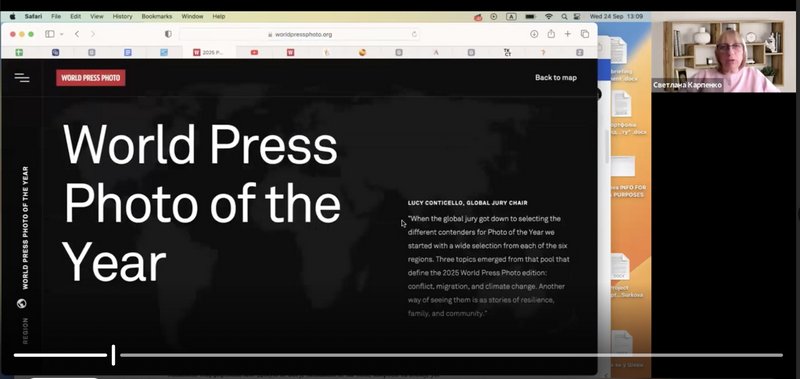
“Photo becomes a weapon. Because those photos that win in international competitions attract the attention of the world community. And a political struggle is also waged through photos,” emphasized Yuliya Surkova.
The coach gave an example: at one time, a wave of indignation was caused by the fact that the jury of the international World Press Photo competition combined two works —Underground Field Hospital by Nanna Heitmann and On the Other Side of the Trenches by Florian Bachmeier — into one visual pair. German photographers took both photos. One shows a Ukrainian girl suffering from panic attacks due to the war. The other shows a wounded russian fighter, who is also a mobilized resident of the occupied Luhansk region. Later, due to a wave of hate, the jury of the competition apologized for this combination.
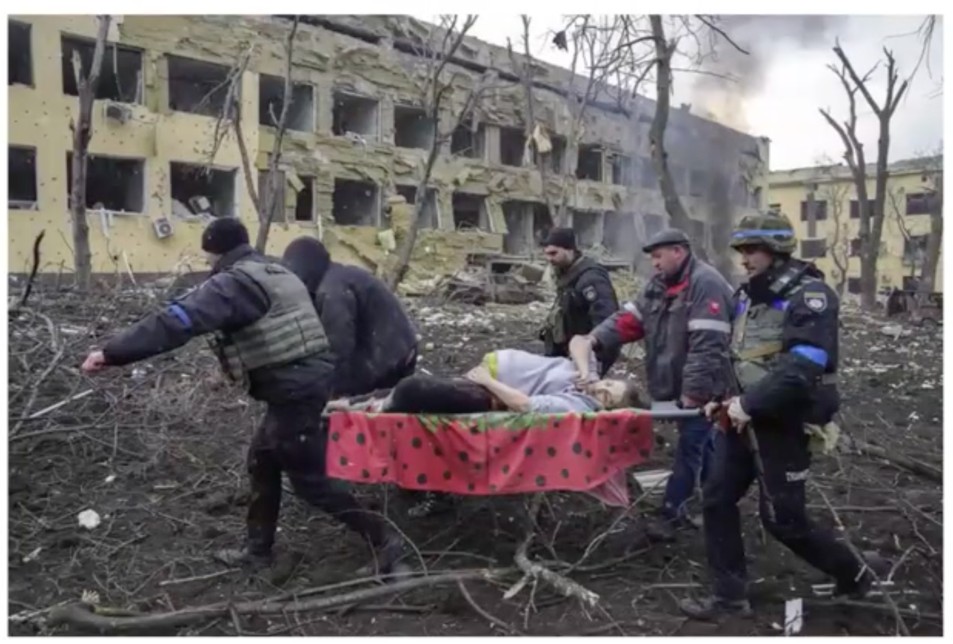
Unfortunately, such a perception (equating) exists in the international community. To prove to the world the truth about the war, it is worth showing it first and foremost, using photos.
“If our colleagues did not do their job, then the illustrations of occupied Mariupol would be shots of russian photographers,” added Yuliya Surkova.
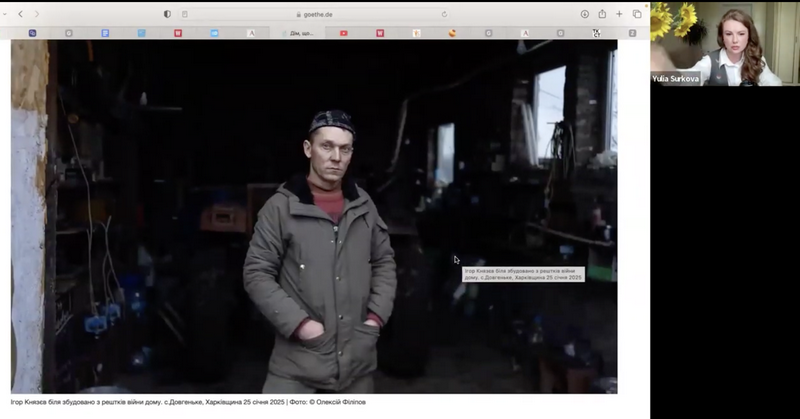
Medium shot is the “standard” for human stories
There are five shooting plans:
- Extreme long shot (ELS);
- Long shot (LS);
- Medium shot (MS);
- Close-up (CU);
- Extreme close-up (ECU)
An extreme long shot (ELS) is used to show a crowd, a rally, or the scale of an event; it can also depict a person or an object within an interior.
A long shot (LS) shows a person in full height, standing out from the group. This shot is used to illustrate the figure and gait.
A medium shot (MS) frames a person from the waist up. It is used to show gestures and to introduce a person. This is the so-called “classic” working shot for materials about people.
A close-up (CU) focuses on a person’s face. It can be used to convey facial expressions.
An extreme close-up (ECU) captures individual details — hands, scars, a ring on a finger, an earring in an ear, and so on.
For interviews, Yuliya Surkova advises using a medium shot (MS) (sometimes a close-up (CU)), but not a long shot (LS). It’s worth alternating shots to add dynamics to the footage. Alternating shots is also important for reporting.
It is a mistake to illustrate texts with a vertical photo. For newspapers, the main photo should always be horizontal, except in the case of extraordinary events. Vertical photos are more suitable for social networks (for smartphone screens or as magazine covers).
Analysis of illustrations of participants’ materials
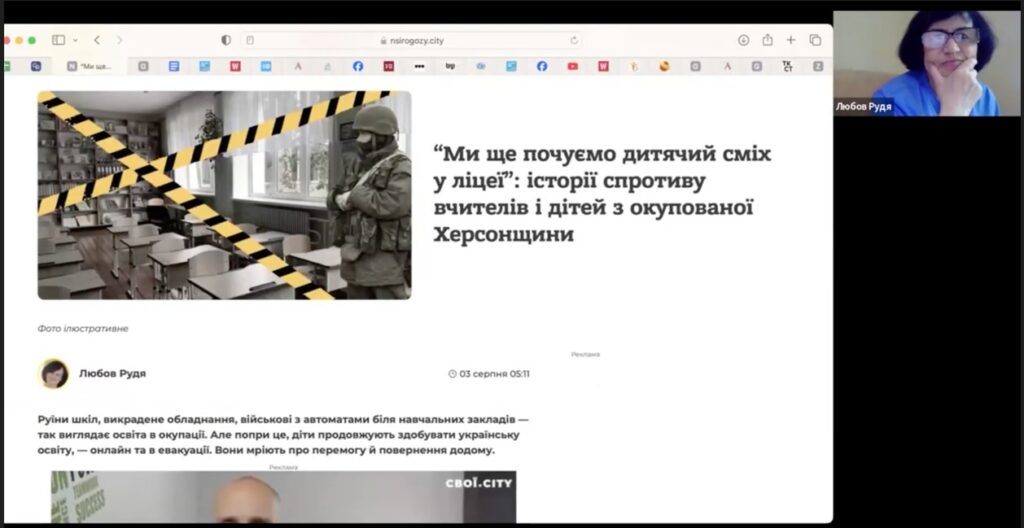
“It is always better when there is some action in the frame. If an official is sitting at a table, ask him to stand up at least,” noted Yuliya Surkova, talking about the peculiarities of photographing people.
The coach gave some advice, saying that it is better to shoot in daylight. You should ask the person to stand so that the light falls on his face. The exception is if you do not want to show his face (for example, if we are talking about military personnel, victims, etc.). Then you should use silhouette photography. Military personnel can be photographed in balaclavas.
For emotionality, you can use framing or a very close-up, for example, with a focus on the eyes. Photos of a person at work effectively illustrate the interview.
If the focus of the interview is not the hero, but rather their expertise or an event, you can also include a photo of the event after the main photo of the hero.
When taking a photo from social networks, it is worth considering the subject. Also, do not forget to obtain permission to photograph children.
If it is not possible to take your own photos, you can use screenshots from Zoom and a photo of the hero.
When interviewing a relative or friend of a deceased person, it is better to ask them to show a photo of the deceased in their possession.
Filming ethics:
Short tips when working at funerals
- respect human grief;
- turn off the shutter sound;
- turn off the flash;
- do not come close – it is better to shoot from afar and then frame;
- do not interfere with the service, the farewell ceremony;
- be dressed appropriately;
- do not run, do not make noise.
Short tips when filming at the scene of shelling/tragedy
- listen to the requests of people in the mountains (you can film in a public place until you are asked not to do so). At the same time, there is no restriction on filming officials at the place of arrival – the State Emergency Service, police, and officials;
- do not take close-up shots;
- do not interfere with rescuers;
- remember that victims have the right to look decent in the photo;
It is unethical to photograph uncovered bodies (relatives of the deceased should not learn about the death of their loved ones from your photos).
The project is funded by the Embassy of the Republic of Lithuania in Ukraine within the framework of the Development Cooperation and Democracy Promotion Programme.






Discussion about this post