
 THE NATIONAL UNION OF
JOURNALISTS OF UKRAINE
THE NATIONAL UNION OF
JOURNALISTS OF UKRAINE
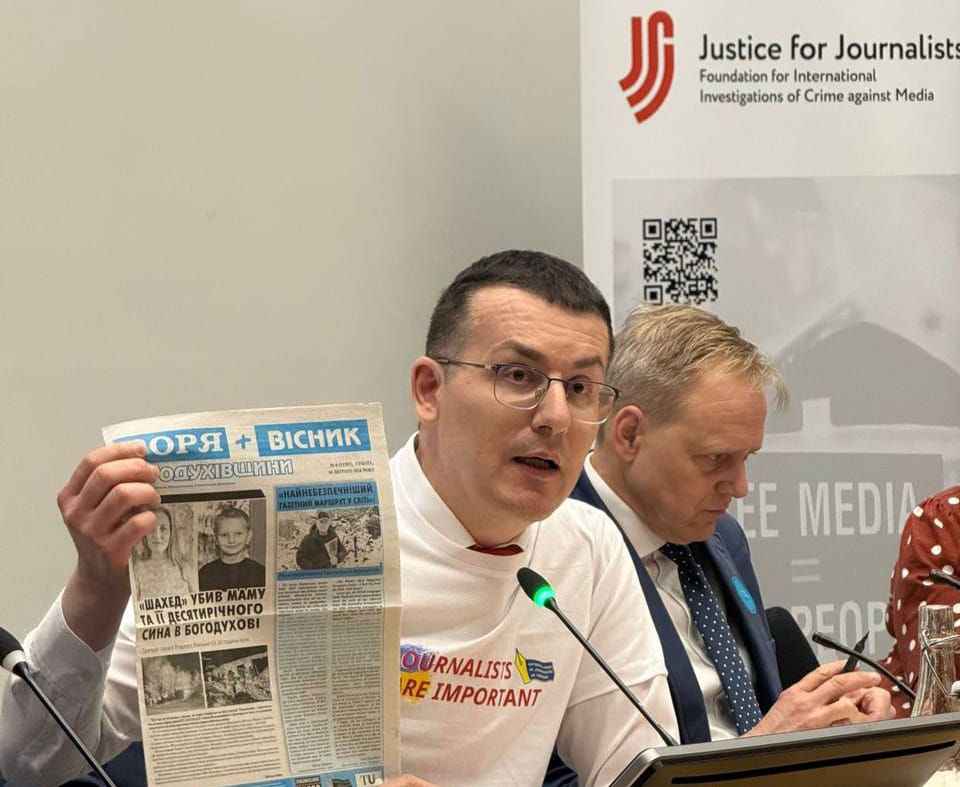
Even in the face of the full-scale war, energy shortages, and constant threats to their safety, Ukrainian journalists continue to deliver verified news from frontline regions. At the UK Media Freedom Forum 2026, Sergiy Tomilenko, President of the National Union of Journalists of Ukraine, spoke about the practical support provided to journalists through NUJU’s Solidarity Centres, safe workspaces, protective equipment, and training—and stressed that independent journalism in wartime is not just a profession, but vital infrastructure for democracy and truth.
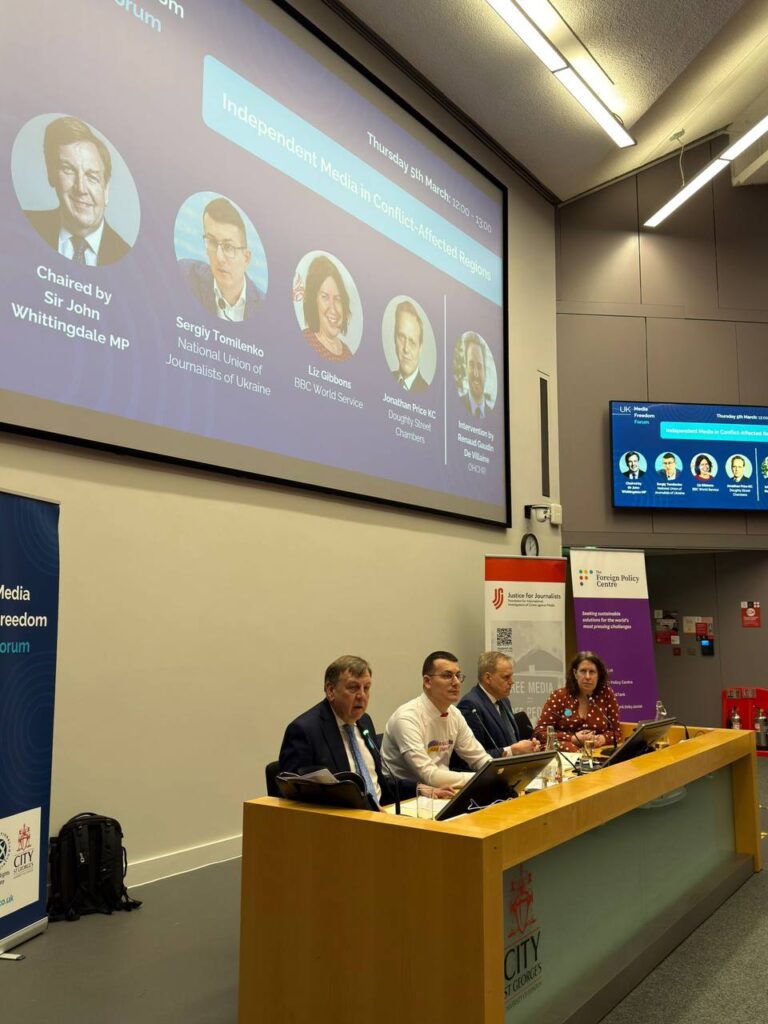
Below is the full text of Sergiy Tomilenko’s speech.
When we speak about “conflict-affected regions,” for Ukraine this is not a conflict. It is a full-scale war. I arrived in London a few days ago. I am staying near the Frontline Club. For three nights, in my hotel room, I have kept the heating at 23 degrees. And still, I cannot feel warm. Because this winter in Kyiv was the hardest winter of the war.
Since January, Russia has intensified attacks on energy infrastructure. In my apartment, the heating stopped three times during freezing temperatures. Our National Union of Journalists office in central Kyiv stood for a week without heating and without water. Electricity comes by schedule. And we are lucky if the schedule is respected. Often we have no power for 15 to 17 hours a day.
So here, in London, the light is bright in my room. Heating works. And I realise how fragile these things are. This is the reality from which I travelled to this Forum.
Independent media in war is infrastructure, not theory
In wartime, independent journalism is not only about democratic values. It becomes part of national resilience. If trusted information disappears, propaganda fills the space. At the National Union of Journalists of Ukraine we prioritise support for local and frontline media.
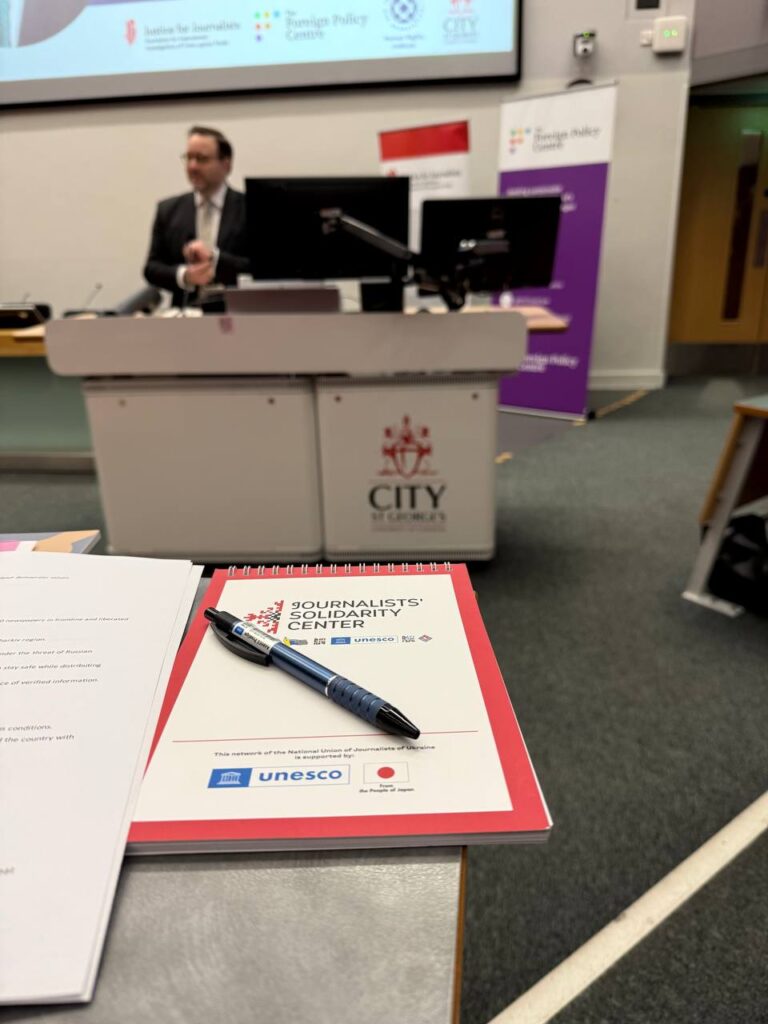
Since 2022, we have helped revive and sustain more than 40 newspapers in frontline and liberated regions. In my hands is one example—the newspaper Zoria from the Kharkiv region. Its editor, Vasyl Miroshnyk, personally delivers copies to villages under the threat of Russian drones. Recently, we provided him with a drone detection device to help him stay safe while distributing the paper.
For many communities, frontline newspapers are the only reliable source of verified information. When towns are in darkness, these newspapers become a stable point of truth.
Journalists continue to work — and many also defend the country
In Ukraine, journalists continue to work as civilians under extremely dangerous conditions. At the same time, many of our colleagues have been mobilised and now defend the country with weapons in their hands. We speak today about serious losses within our media community.
Since February 2022:
- 144 media workers have been killed.
- 21 were killed while directly performing their professional duties as journalists.
- In 2025 alone, three media workers were killed—all in Russian drone attacks.
Ukrainian journalists are also documenting war crimes and human rights abuses, often at great personal risk.
Today, 28 Ukrainian journalists remain in Russian detention. One of them is Iryna Levchenko. She was detained in May 2023. For almost two years, there was no communication. Recently, we received a short letter from her. Just a few lines. But proof she is alive.
Journalists must not disappear from diplomatic attention. Their names should be raised consistently in international forums and monitoring mechanisms. Protecting journalists in wartime is not only about media freedom. It is about human dignity and accountability.
Safe operational spaces are essential
Russia combines military aggression with systematic disinformation. Attacks on infrastructure directly affect media operations. Without electricity:
- newsrooms cannot function,
- equipment cannot be charged,
- reports cannot be transmitted.
This winter requests to rent drone detectors increased fivefold. Requests for secure workspaces with stable electricity tripled.
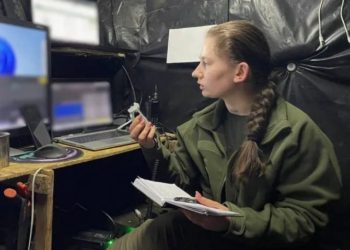
Our network of six Journalists’ Solidarity Centres now operates drone detector rental points in three frontline regions. These centres function as operational safety hubs. They provide:
- protective equipment,
- safety training,
- secure workspaces,
- legal and psychological support.
Since 2022, more than 9,000 Ukrainian and international journalists have received assistance. Today, however, we face a serious funding challenge. Yet demand for assistance continues to grow. Maintaining safe operational spaces for journalists during war requires predictable and flexible support. This is practical infrastructure that allows independent reporting to continue.
What policymakers can do
Let me suggest three practical steps.
First, ensure that detained journalists are systematically included in diplomatic negotiations and international monitoring mechanisms.
Second, support the creation and sustainability of safe operational spaces for journalists working in conflict zones—places where they can access protection, secure work environments, and emergency assistance.
Third, establish rapid and flexible funding mechanisms for local and frontline media operating under extreme risk.
Independent journalism in war requires infrastructure, not only courage. Supporting it is not only solidarity. It is an investment in democratic resilience and security.
Journalists in Ukraine are not asking for sympathy. They are asking for the tools and safe conditions to continue their work. If independent journalism survives war, truth survives.
And when truth survives, democracy has a chance to endure.
About the UK Media Freedom Forum
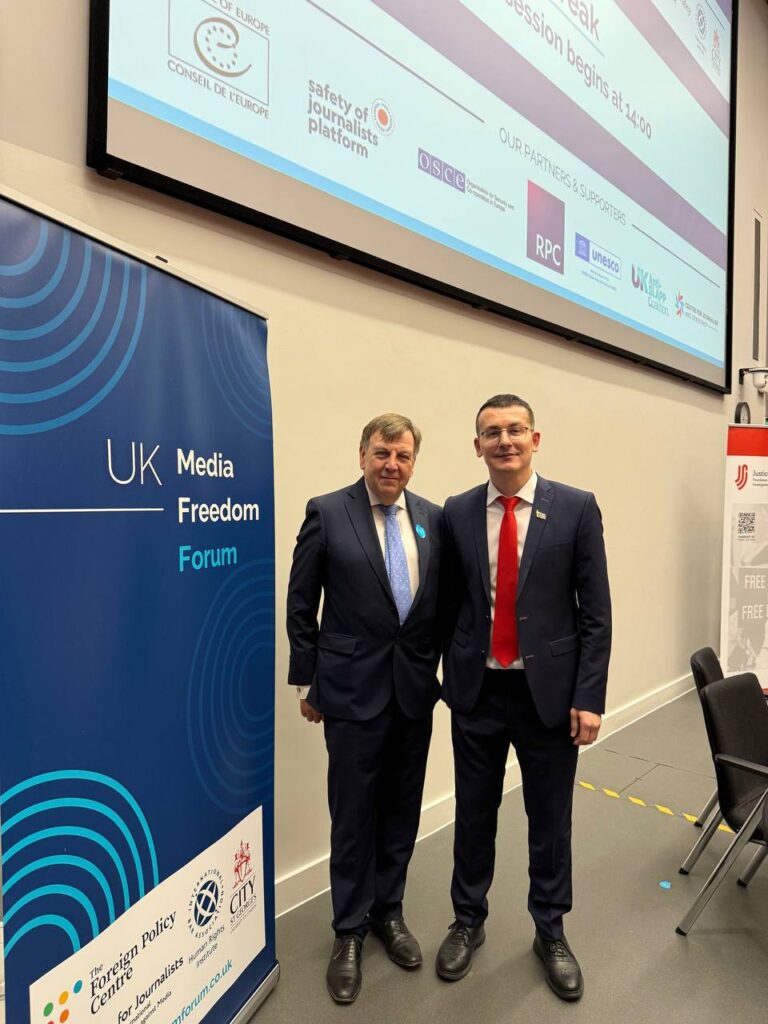
The Second UK Media Freedom Forum took place on 5–6 March 2026 in London at City St George’s, University of London. The event was organized by the Foreign Policy Centre, the Justice for Journalists Foundation, and the International Bar Association’s Human Rights Institute (IBAHRI). It brought together parliamentarians, government officials, human rights defenders, lawyers, journalists, and representatives of international organizations from around the world.
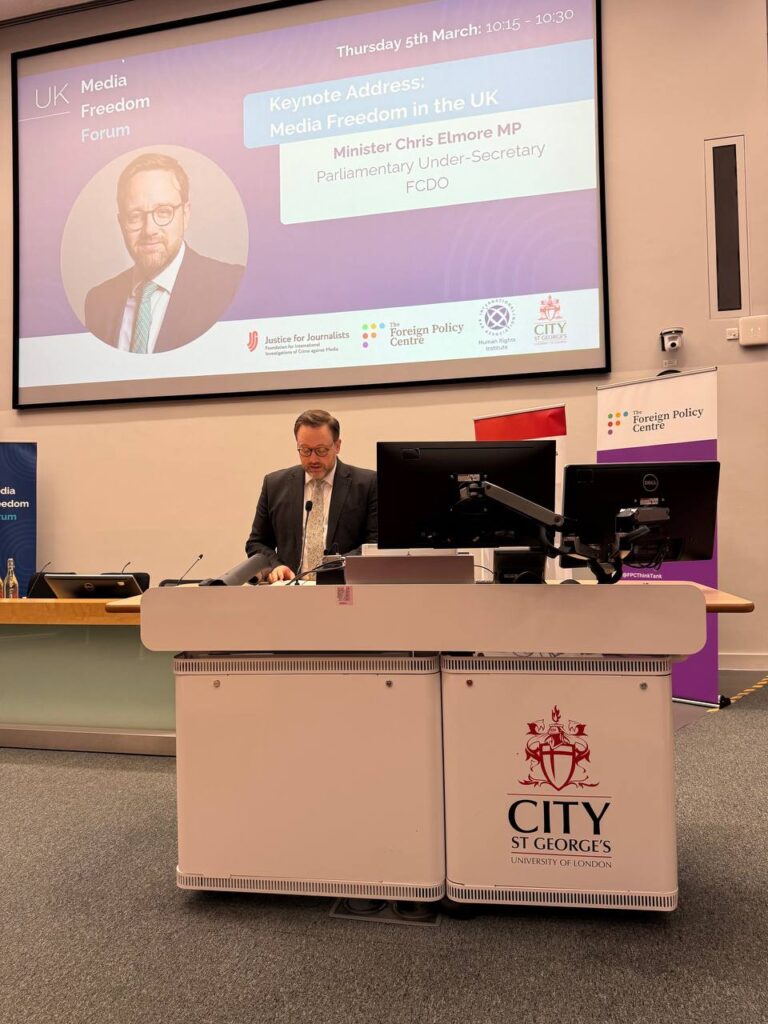
The forum’s profile was highlighted by the participation of UK government and parliamentary representatives. Sir Chris Elmore, Deputy Parliamentary Secretary at the Foreign, Commonwealth & Development Office, delivered the opening keynote. Emily Thornberry, Chair of the UK Parliament’s Foreign Affairs Committee, opened the second day, and Stephan Kossov, Head of Democratic Governance at FCDO, was a speaker in the closing session. Other participants included Baroness Helena Kennedy, Director of IBAHRI.
The two-day program covered a wide range of topics: transnational repression of journalists, independent media in conflict zones, legal protection of press freedom, countering SLAPPs, combating disinformation in the age of AI, media literacy, and support for local media. The event featured the annual Council of Europe Journalists’ Safety Platform report and the launch of a new Centre for Journalism and Democracy at City St George’s University.
Speakers and participants included representatives of OSCE, UNESCO, the UN Office of the High Commissioner for Human Rights, Committee to Protect Journalists (CPJ), Reporters Without Borders (RSF), the International Press Institute (IPI), Media Defence, as well as investigative journalists from The Guardian, OCCRP, and other outlets.

NUJU Information Service










Discussion about this post