 THE NATIONAL UNION OF
JOURNALISTS OF UKRAINE
THE NATIONAL UNION OF
JOURNALISTS OF UKRAINE
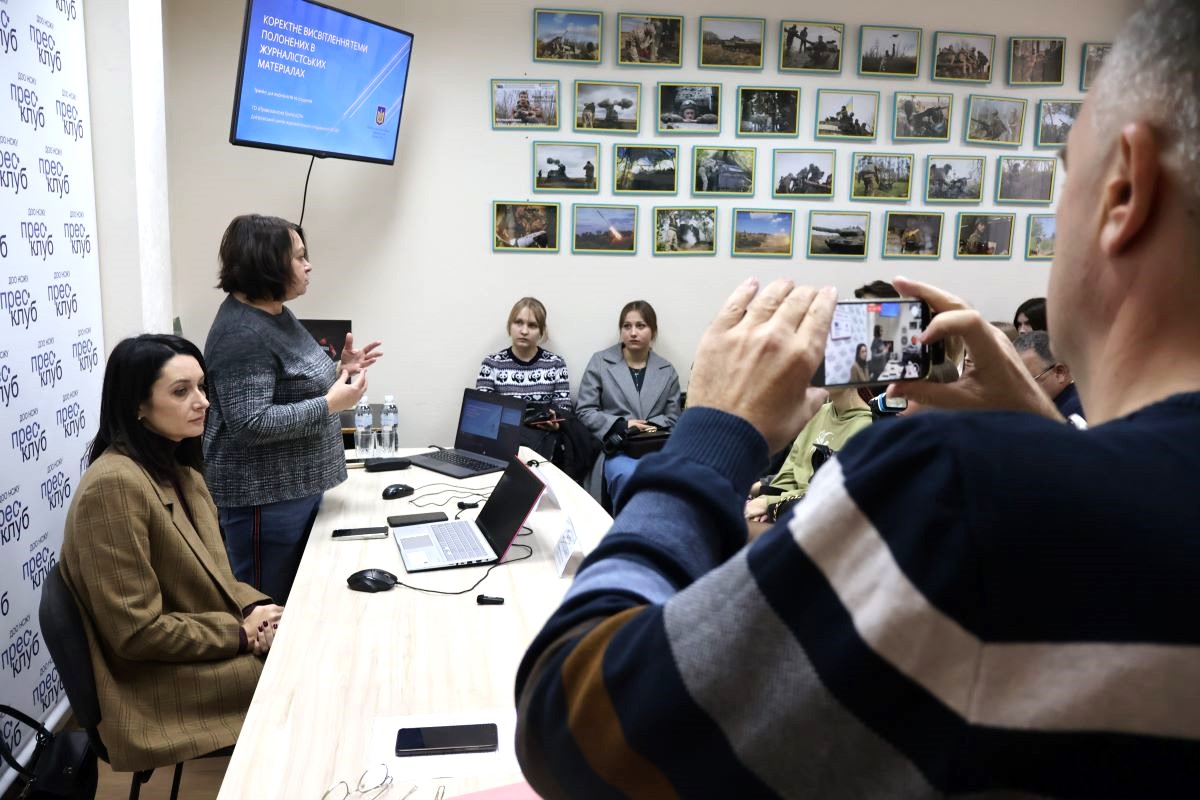
How should journalists cover the topic of illegally detained and detained Ukrainians in places of detention? What terminology should be used in materials to correctly define the legal status of civilians? What typical mistakes should be avoided? These were the questions discussed during training on proper coverage of the topic of prisoners in journalistic materials, which took place at the Dnipro Journalists’ Solidarity Center (JSC)of the National Union of Journalists of Ukraine (NUJU). Experts from the non-governmental organization SICH human rights group helped the participants of the event answer questions that have become particularly relevant after russia’s full-scale invasion of the territory of Ukraine.
The topic of captivity in Ukrainian media
“The topic of captivity and prisoners remains extremely painful and important. Thousands of Ukrainians are in enemy captivity. Among them are 28 journalists. A few weeks ago, the entire media community in Ukraine was shaken by the news that journalist Victoria Roshchina had died in russian captivity. She wrote for Ukrainian publications, worked in dangerous territories, and her publications raised the topic of the life of Ukrainians under occupation. Victoria understood the risks and threats, but, as colleagues recall, she lived with it – she simply could not do otherwise. In August of last year, our colleague disappeared. Only in May 2024, Victoria‘s family, after numerous appeals to all possible services, received confirmation that she was in russian territory. Efforts were made to include her on the list for exchange… Instead, they received information that she had died. So far, the aggressor country has not officially provided documentary confirmation of this,” noted the coordinator of the Dnipro JSC, Nataliya Nazarova.
The topic of captivity often appears in the Ukrainian media. Experts from specialized agencies and psychologists give recommendations on how to write about people who survived russian captivity. Much attention is paid to the nuances of communicating with Ukrainians who were liberated from the enemy hell. But Ukrainians are written about not only after liberation but also when they are still in russian prisons, are missing, etc. And there are nuances and important points here. Experts from the non-governmental organization, SICH human rights group, drew attention to them.
This NGO was established in 2014 and immediately began providing legal assistance to military personnel, civilians, IDPs, and those who were captured. In those years, human rights defenders encountered mainly prisoners of war. During the war, the captivity of defenders is understandable and described in various international acts. Experts could not have imagined that from the beginning of a full-scale invasion, a significant number of our civilians would be captured. These are people living in the occupied territory, loyal to Ukraine, who disagree with the regime and, because of this, become victims of war crimes.
All these actions are given a legal assessment. Accordingly, there are a lot of terms used by human rights activists. Journalists should also pay attention to terminology when they describe war crimes against civilians. Media workers are advised to remember the main rule: the status of detainees can change because they are held for a long time. The terminology changes accordingly.
The world does not understand our terms
Human rights experts encounter such concepts in journalistic publications as “civilian prisoner,” or “person who has disappeared.” Although in international law there is no such concept as “civilian prisoner” at all.
That is why experts from human rights organizations have prepared a Memorandum on the Procedure for Correctly Determining the Legal Status of Civilians in Russian Captivity. Media workers are also advised to be extremely careful with publishing information about both military and civilian personnel. Before writing, contact the police, the Coordination Headquarters, and authorized persons. Information should be disseminated, but it must be approved and verified.
Write professionally, prepare morally
Vasyl Dudko, a journalist for the national magazine Slava Natsii (Glory of the Nation), noted that he had learned much new information. He had not yet written an article on this sensitive topic and understood that he needed to prepare for it. Therefore, the training was valuable. In two hours, they learned not only about the correct terms but also where to turn for verified facts.
The training also aroused interest among future media workers. Oleksandra Lanevska, a first-year student at Oles Honchar Dnipro National University, believes that everyone should know this information.
Journalist Oleksandr Komaruk drew attention to the fact that today, a journalist writes on serious topics and must use terms that are enshrined not only in our legislation but also in international law. One should not invent things to attract the attention of readers and get more clicks.
Call the Dnipro JSC by dialing 050 919 8479 (JSC coordinator Nataliya Nazarova). The Center’s address is 8 Starokozatska Street.
ABOUT JSC
The Journalists’ Solidarity Centers is an initiative of the NUJU implemented with the support of the International and European Federations of Journalists and UNESCO. The initiative is designated to help media representatives working in Ukraine during the war. The Centers operate in Kyiv, Lviv, Ivano-Frankivsk, Chernivtsi, Zaporizhzhia, and Dnipro and provide journalists with organizational, technical, legal, psychological, and other types of assistance.
ABOUT UNESCO
UNESCO is the United Nations Educational, Scientific, and Cultural Organization. It contributes to peace and security by promoting international cooperation in education, sciences, culture, communication, and information. UNESCO promotes knowledge sharing and the free flow of ideas to accelerate mutual understanding. It is the coordinator of the UN Action Plan on the Safety of Journalists and the Issue of Impunity, which aims to create a free and safe environment for journalists and media workers, thus strengthening peace, democracy, and sustainable development worldwide. UNESCO is working closely with its partner organizations in Ukraine to provide support to journalists on the ground.
The designations employed and the presentation of material throughout this digest do not imply the expression of any opinion whatsoever on the part of UNESCO concerning the legal status of any country, territory, city, or area or its authorities or concerning the delimitation of its frontiers or boundaries.
The authors are responsible for the choice and the presentation of the facts contained in this digest and for the opinions expressed therein, which are not necessarily those of UNESCO and do not commit to the organization.
Dnipro JSC information service












Discussion about this post