

 THE NATIONAL UNION OF
JOURNALISTS OF UKRAINE
THE NATIONAL UNION OF
JOURNALISTS OF UKRAINE
As Russia’s full-scale invasion shattered newsrooms and communities, Ukrainian journalists transformed a professional union into a survival network — learning not only how to survive war, but how to help one another survive it.
By the National Union of Journalists of Ukraine
When Russia launched its full-scale invasion of Ukraine in February 2022, Ukrainian journalists found themselves in the same chaos as millions of other Ukrainians: shelling, occupation, destroyed homes, power outages and communication blackouts, and profound uncertainty about what would come next.
For the National Union of Journalists of Ukraine (NUJU), the war changed everything almost overnight.
“On February 24, we stopped being a traditional professional union,” recalls NUJU President Sergiy Tomilenko. “Very quickly, we became an emergency assistance system.”
Speaking at a Rotary Ukraine leadership forum for civic and community leaders on May 16, Tomilenko reflected on what Ukrainian journalists have learned during more than four years of war — not only about survival, but also about solidarity, trust, and resilience.
His message was simple: “in times of crisis, professional communities matter far more than most people realise”.
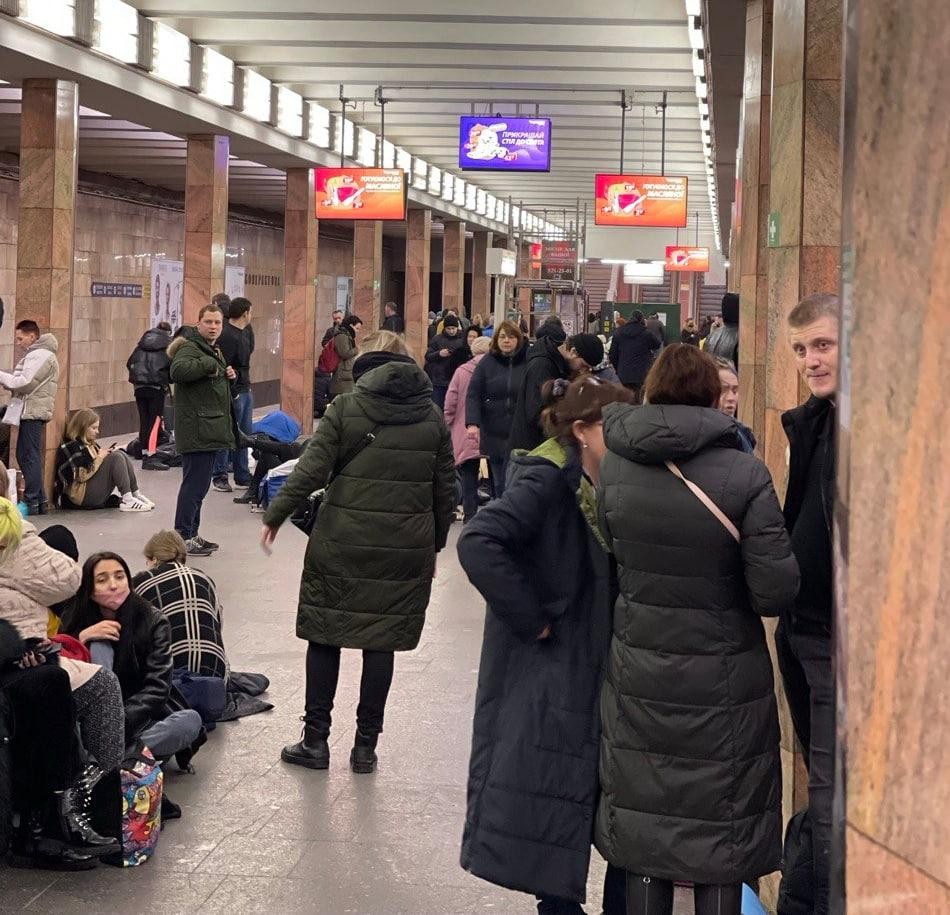
Photo: Sergiy Tomilenko
From a Journalists’ Union to an Emergency Hotline
In the first days of the invasion, the NUJU office no longer resembled the organisation it had once been.
The phones never stopped ringing.
Some journalists were trying to escape occupied territories. Others had lost their newsrooms and equipment. Some needed help evacuating family members. Others simply needed advice — or reassurance.
“We heard the same questions every single day,” Tomilenko recalls.
Our newsroom has been destroyed.
Where can we work?
How can we get protective equipment?
Who can help us evacuate?
“Sometimes people were simply exhausted,” he says. “And sometimes leadership simply meant answering phone calls.”
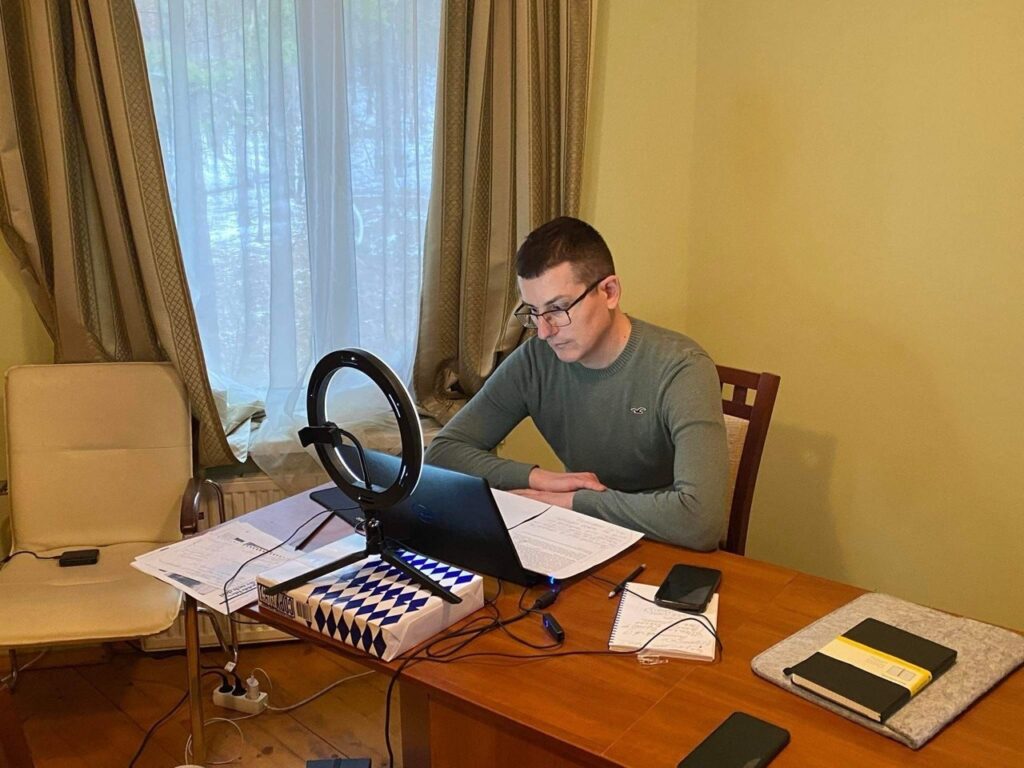
Photo: Mykyta Holovchenko
At the time, no ready-made model existed for supporting journalists during a war of this scale.
NUJU turned to international colleagues for advice.
One practical suggestion was straightforward: rent a hotel in western Ukraine, reserve dozens of rooms, and temporarily shelter displaced journalists and their families there.
But inside NUJU, something did not feel right.
“There was some hesitation within our team,” Tomilenko recalls. “We didn’t believe journalists only needed a bed for three days.”
Out of those internal discussions, a different idea emerged.
Instead of creating one large shelter, NUJU opted for something smaller, more flexible, and closer to the realities journalists were facing: regional support hubs.
Small centres staffed by just one or two people — teams capable of solving practical problems every single day.
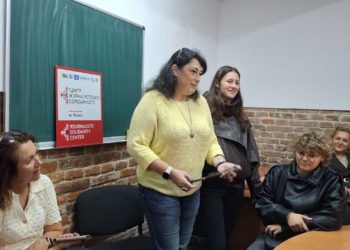
This became the beginning of the Journalist Solidarity Centres, first launched in western Ukraine in spring 2022.
As the war evolved, so did the geography of support.
Today, the network operates in six Ukrainian cities, with particular focus on frontline regions including Kharkiv, Zaporizhzhia, and Dnipro.
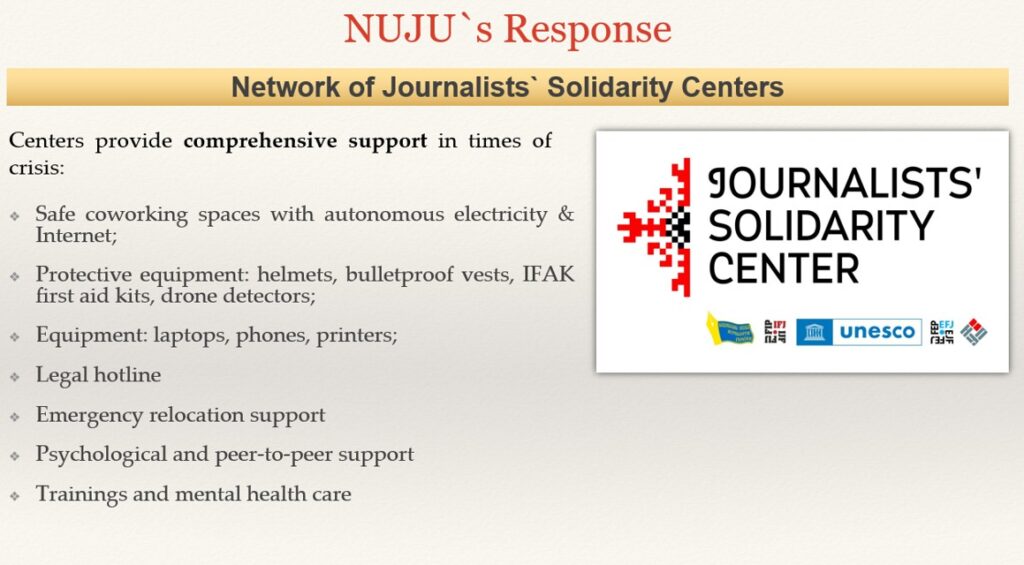
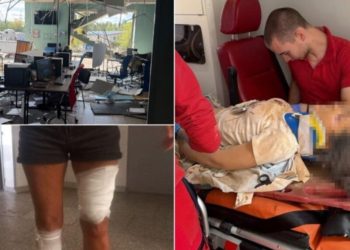
The centres provide protective equipment, evacuation support, legal and psychological assistance, safe workspaces with electricity and internet access, and increasingly specialised safety training responding to new wartime risks — especially drone threats.
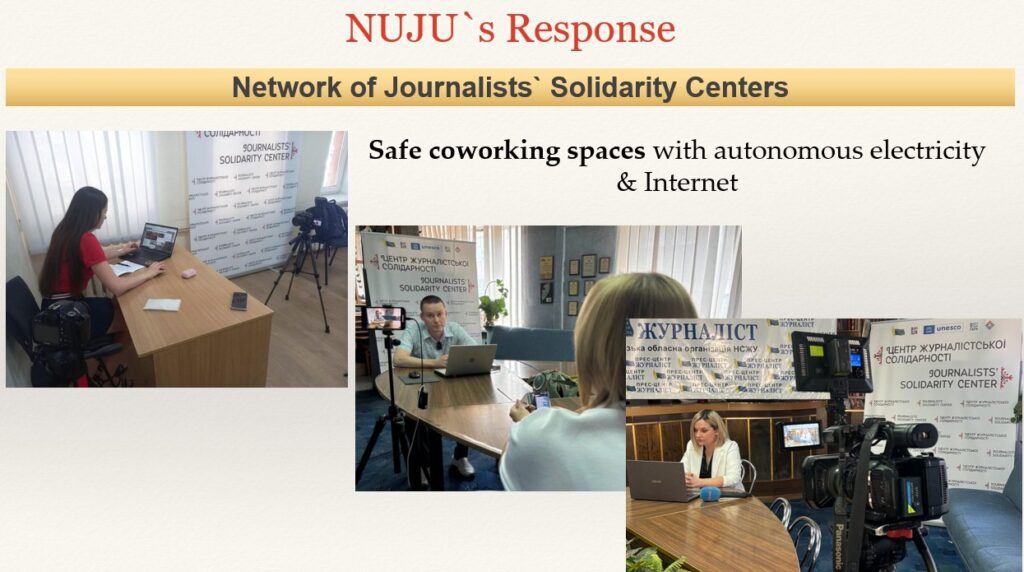
Source: NUJU presentation
Since April 2022, more than 9,000 Ukrainian and international journalists have received assistance through the network.
At some point, Tomilenko says, something important became clear.
“People were not calling us because we were a union,” he says. “They were calling because they trusted that someone would actually answer.”
A Moment in Paris — and Four Difficult Years Behind It
Just days before the leadership gathering, Tomilenko had returned from Paris, where the International Federation of Journalists (IFJ) held its centenary Congress, bringing together journalist representatives from around the world.
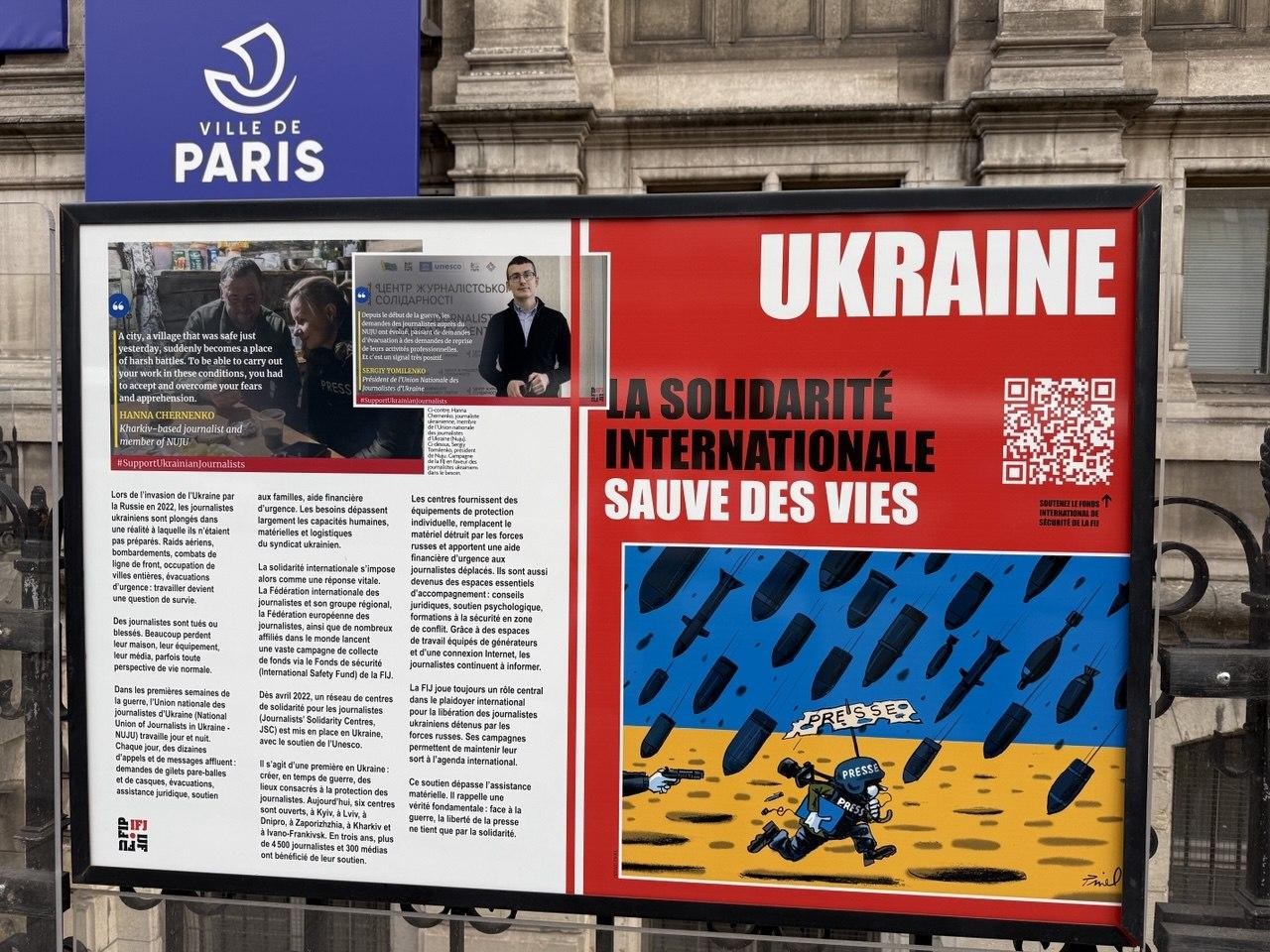
In the heart of the French capital, near the historic Hôtel de Ville, the IFJ organised a public photo exhibition dedicated to journalism and press freedom. One of the exhibition panels focused on Ukrainian journalists — including the work of NUJU’s network of Journalist Solidarity Centres.
For Tomilenko, the moment felt unexpectedly personal.
“I stood there for several minutes,” he recalls. “Not because there was a photo of me. But because suddenly I remembered how uncertain everything felt back in 2022.”
At the beginning of the full-scale invasion, nothing seemed guaranteed.
Would Ukrainian journalism survive?
Would local newsrooms continue to exist?
Would journalists remain in the profession?
Would the union itself withstand the pressure of war?
“Honestly, we simply did not know,” Tomilenko says.
The memory felt especially powerful because so much of what now appears resilient had once looked painfully fragile.
Source: NUJU presentation
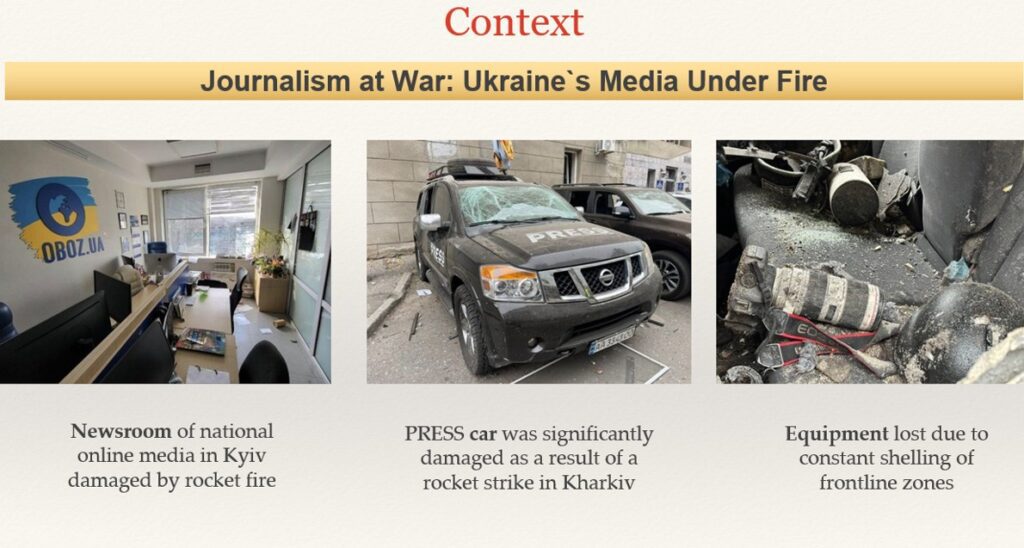
In 2022, many local media outlets lost offices, equipment, advertising revenue, and sometimes entire teams. Journalists were displaced. Some joined the military. Others left journalism entirely to support their families.
And yet, somehow, journalism continued.
To see that story publicly recognised — in central Paris, during the centenary of the world’s largest organisation of journalists — felt emotional.
“It took us a long road to reach that moment,” Tomilenko says. “But for me, it was really a reminder of hundreds of people who simply kept doing their jobs through all these years.”
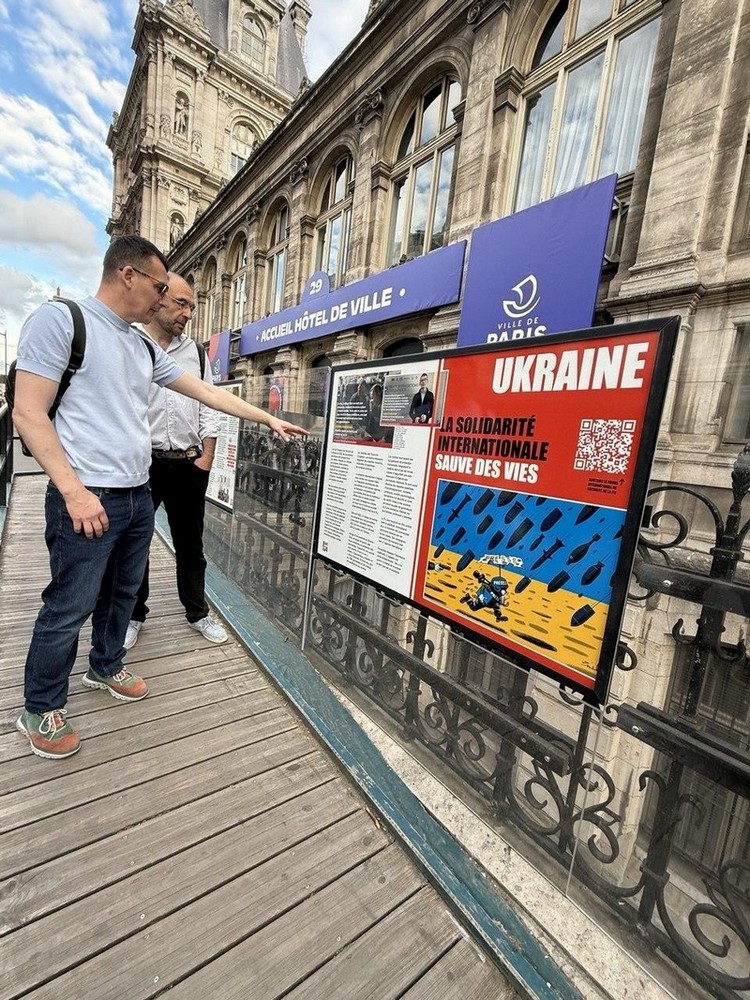
Photo: NUJU archive
Still, he insists, international recognition matters only if it translates into practical support.
Admiration alone does not keep journalism alive in wartime.
“The real question is not whether someone applauds your work,” he says. “The real question is whether tomorrow a journalist in Kharkiv will have a bulletproof vest, a drone detector, and a place where they can work.”
Trust First, Funding Later
One of the most important lessons Tomilenko shared was about international partnerships — and how meaningful support often begins not with proposals, but with trust.
As the network of Journalist Solidarity Centres expanded, UNESCO gradually became one of its key institutional partners.
But, as Tomilenko explains, the relationship did not begin with a polished concept note or a perfectly written application.
By the time international partners arrived, something more important already existed: people were actually using the system.
Journalists came to the centres. They returned. They recommended them to colleagues.
The demand was visible.
And international partners noticed.
“UNESCO approached us first,” Tomilenko recalls. “They told us: we want to support what you are doing.”
There was only one request.
UNESCO asked NUJU to integrate its logo into the visual identity of the Journalist Solidarity Centres so that support would be visible in the regions where journalists worked.
Over time, UNESCO became one of the network’s key institutional partners — helping fund equipment, operational work, safety training, and technical strengthening of the centres.
Source: NUJU presentation
For NUJU, the partnership meant something deeper than financial support alone.
“It gave us a sense that what we were doing actually mattered,” Tomilenko says.
And perhaps just as importantly, it confirmed something NUJU had learned early in the war: trust comes first — funding follows.
The War Changed — and So Did the Threats
If the first months of Russia’s full-scale invasion were defined by artillery shelling and missile strikes, today Ukrainian journalists increasingly face a different danger: drones.
According to monitoring by NUJU experts, drone-related risks have become one of the most urgent safety concerns for journalists working near the frontline.
“In 2022, the main threat came from shelling,” Tomilenko says. “Now danger increasingly comes from something watching you from the sky.”
The shift has forced NUJU to rethink journalist safety.
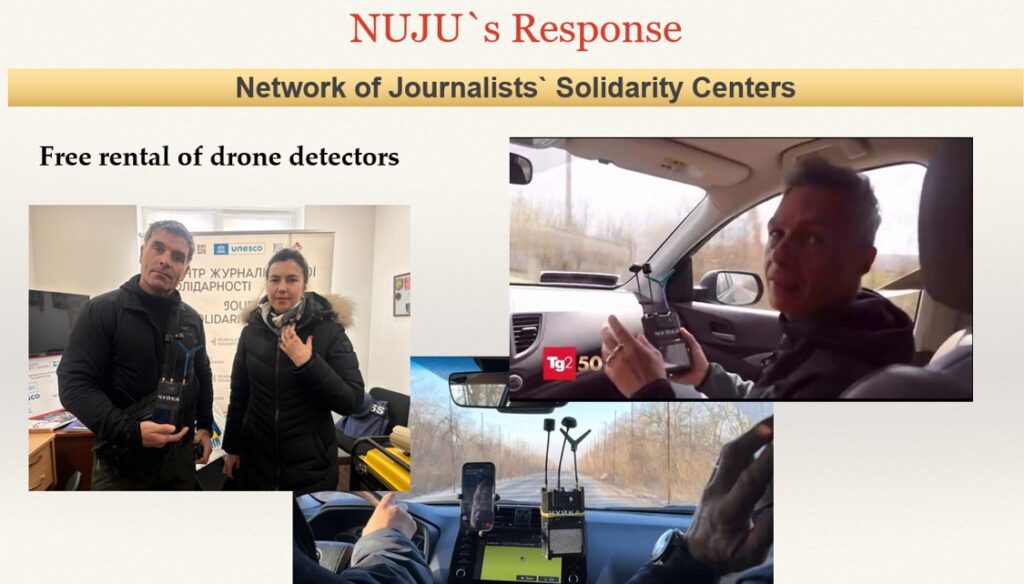
The Journalist Solidarity Centres began organising specialised safety training and providing journalists with access to drone detectors free of charge — a tool that has become increasingly essential for reporting in frontline regions.
Source: NUJU presentation
Following several fatal drone attacks on journalists, the issue became impossible to ignore.
“Journalists cannot simply stop working because technology changes,” Tomilenko says. “But safety systems have to adapt very quickly.”
One of the central lessons of the past years, he says, is surprisingly simple:
“Resilience is not always about heroism.”
“Sometimes it is simply about having the right equipment at the right moment.”
“When the Local Newspaper Arrives, It Means We Have Not Been Forgotten”
Perhaps the most personal moment of Tomilenko’s speech came when he spoke about frontline journalism and local newspapers.
In many international conversations, local print newspapers are often dismissed as outdated — relics of a fading media era.
The war in Ukraine has challenged that assumption.
Tomilenko recalled a visit to Orikhiv, a frontline town in the Zaporizhzhia region located just a few kilometres from active combat.
Electricity outages are frequent there.
Internet access is unstable.
Mobile communication often does not work.
And yet, the local newspaper still reaches people.
“I remember something an elderly man told me,” Tomilenko recalls. “It stayed with me.”
“He said: ‘When the local newspaper arrives, it means we have not been forgotten.’”
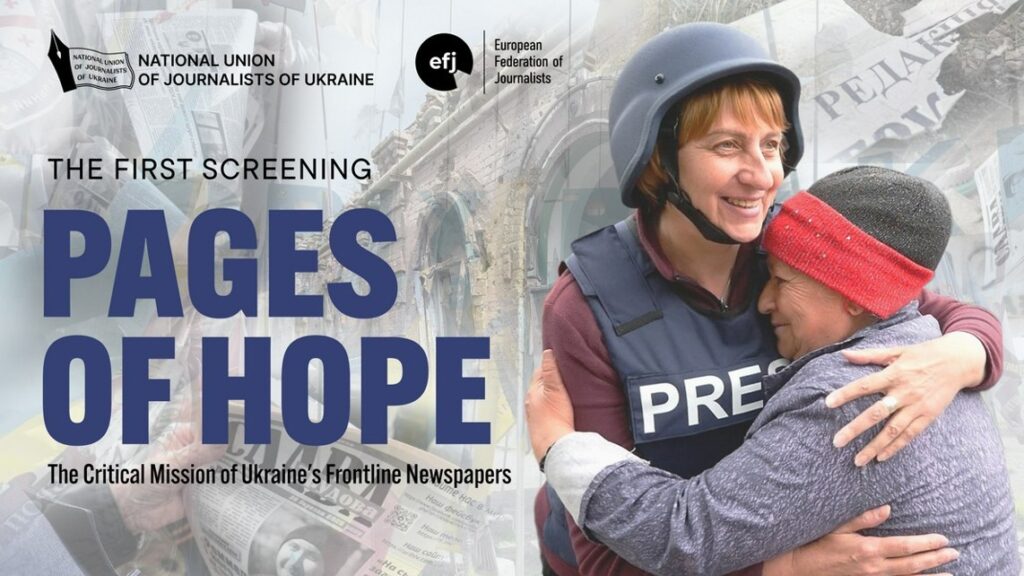
For people living in frontline communities, a newspaper often becomes something much larger than a source of information.
It becomes reassurance.
A sense of connection.
Proof that someone still sees their lives.
That someone still remembers them.
“For us, it may seem like simply another media outlet,” Tomilenko says. “But for people there, it is also about human dignity. About knowing that you have not been abandoned.”
This is precisely why NUJU sees support for local newspapers in frontline regions not as nostalgia for print, but as an essential part of community resilience and journalist safety.
And increasingly, Tomilenko argues, frontline journalism has become not only a media issue — but a matter of national security.
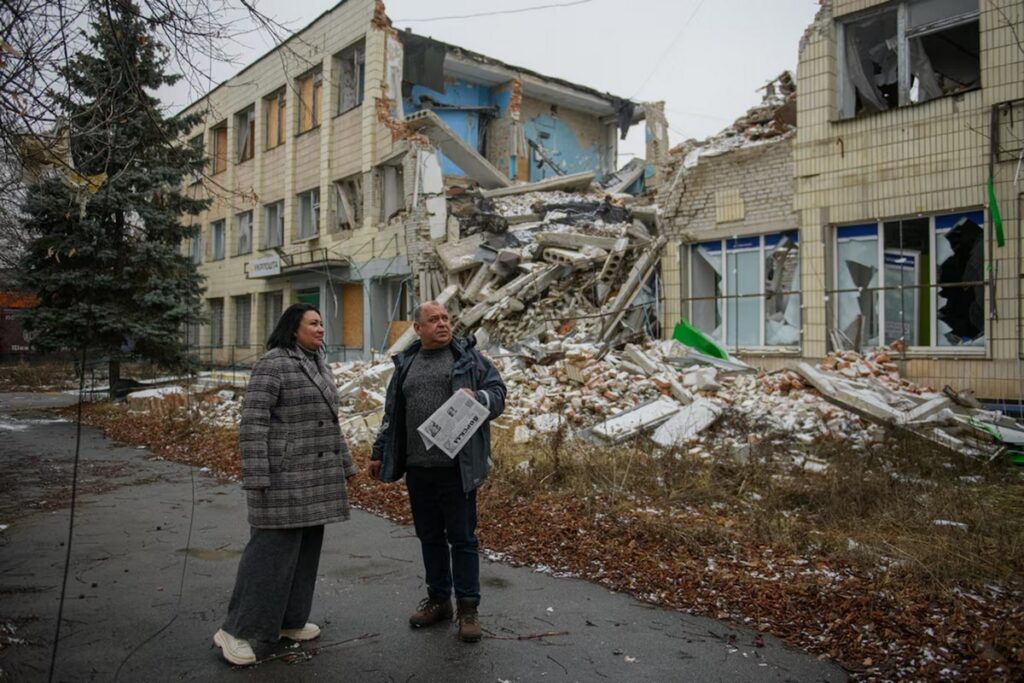
Photo: Olha Ivashchenko
Where trusted local information disappears, rumours, panic, and disinformation quickly take its place.
Russia understands this well.
After occupying Mariupol, Russian authorities quickly launched a fake version of the long-trusted local newspaper Pryazovskyi Rabochiy (Azov Worker), exploiting a familiar title that residents had trusted for decades.
“They understand the power of a local newspaper very well,” Tomilenko says. “They understand that people trust familiar brands. And that trust becomes a battlefield too.”
This is why NUJU today works not only to protect journalists — but also to help preserve frontline newsrooms.
For many communities, Tomilenko says, a local newspaper remains the only stable channel of reliable information.
“This is not nostalgia for paper,” he says. “It is about helping people remain connected to reality.”
Leadership During War
Throughout his remarks, Tomilenko kept returning to one central idea: war fundamentally changes what leadership means.
Before 2022, much of NUJU’s work focused on professional standards, defending journalists’ rights, media law, advocacy, and ethical issues.
Today, a significant part of Tomilenko’s role has changed dramatically.
It means constant travel between Kyiv, Warsaw, Paris, Stockholm, and Brussels — meeting diplomats, international organisations, journalist unions, and donor partners to ensure that Ukraine — and the needs of Ukrainian journalists — do not disappear from international attention.
“Honestly, it is exhausting,” Tomilenko admits. “But the thing I fear most is that the world will simply get used to the war.”
That fear has made international advocacy part of everyday survival.
Again and again, NUJU finds itself explaining why journalism still matters.
Why local newsrooms matter.
Why supporting journalists in frontline communities is not charity — but an investment in democratic resilience.
“We constantly have to explain why journalism still matters,” Tomilenko says. “Why local newspapers matter. Why frontline journalism matters.”
Because where trust in information disappears, communities become dramatically more vulnerable.
And rebuilding trust is always harder than losing it.
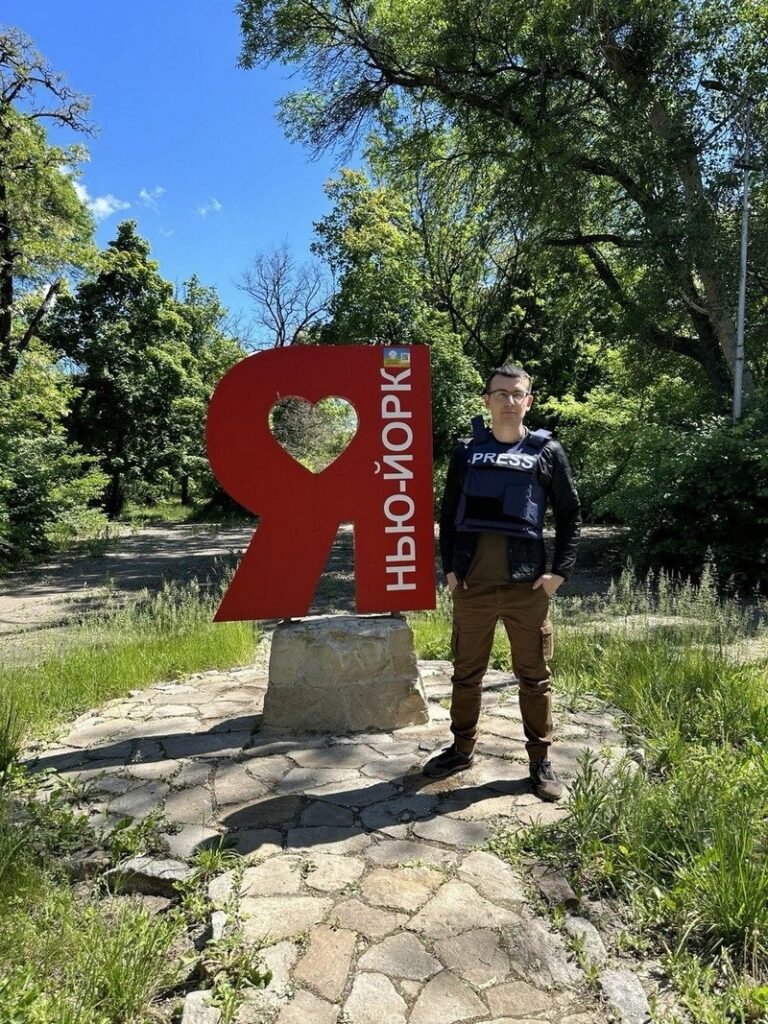
Photo: NUJU archive
For Tomilenko, one of the defining lessons of the war is that institutions survive not because they avoid crisis, but because people inside them adapt faster than circumstances change.
What began as a professional union suddenly became an emergency support network.
What began as an emergency response gradually evolved into a long-term system of resilience.
And perhaps that transformation itself became one of the most important leadership lessons of wartime Ukraine:
sometimes leadership is not about having perfect answers.
Sometimes leadership simply means staying present long enough for trust to grow.
“Wars Are Won by Communities”
In his closing remarks, Tomilenko drew a parallel between journalists and community leaders.
Both, he said, rely on trust.
Both often continue working because ordinary people decide not to step back when systems stop functioning.
And very often, that work remains invisible.
“Major crises are rarely overcome through grand speeches,” Tomilenko said at the conclusion of his talk.
“More often, they are overcome by communities of people who simply decide not to retreat.”
“To volunteer. To keep doing their jobs. To help one another.”
After more than four years of war, this may be one of the clearest lessons Ukrainian journalists have learned: resilience is rarely built by institutions alone. It is built by people who keep showing up — for their communities, for one another, and for the belief that truthful information still matters, even in the darkest moments of war.
Since April 2022, NUJU’s Journalist Solidarity Centres have supported more than 9,000 Ukrainian and international journalists, becoming one of Europe’s most extensive wartime journalist support networks.
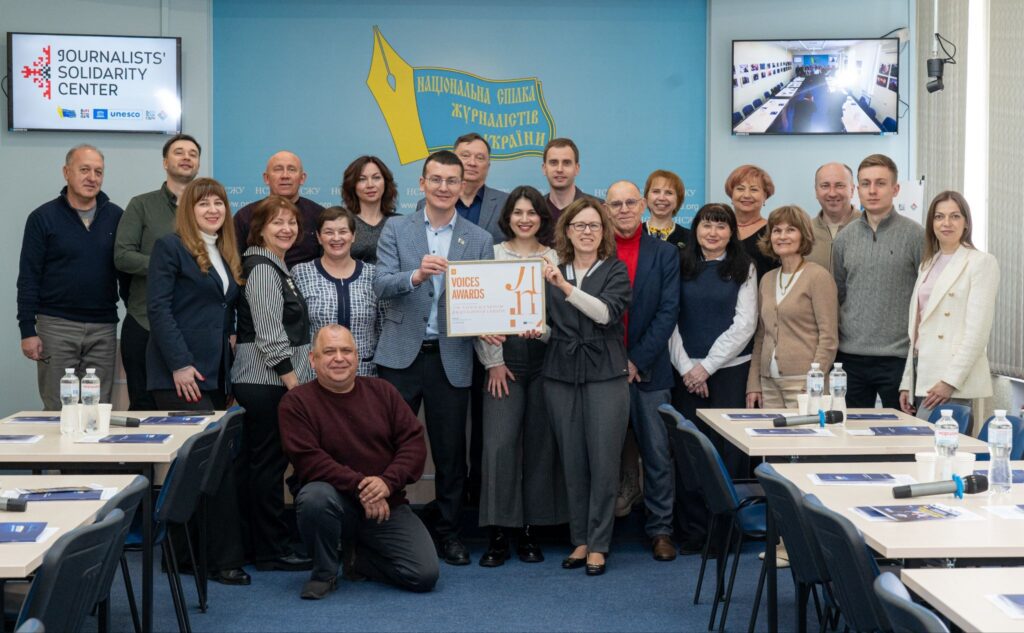
Photo: Yevhen Zinchenko










Discussion about this post