

 THE NATIONAL UNION OF
JOURNALISTS OF UKRAINE
THE NATIONAL UNION OF
JOURNALISTS OF UKRAINE

The ongoing full-scale war has radically changed the rules of media work in Ukraine, especially in frontline regions. A trip there is always a challenge; it is not only about a professional mission, but also about daily risks.
Clear algorithms of actions, technical training, and thoughtful decisions on organizing editorial processes will help Ukrainian and foreign journalists maintain the efficiency and stability of their work even under fire.
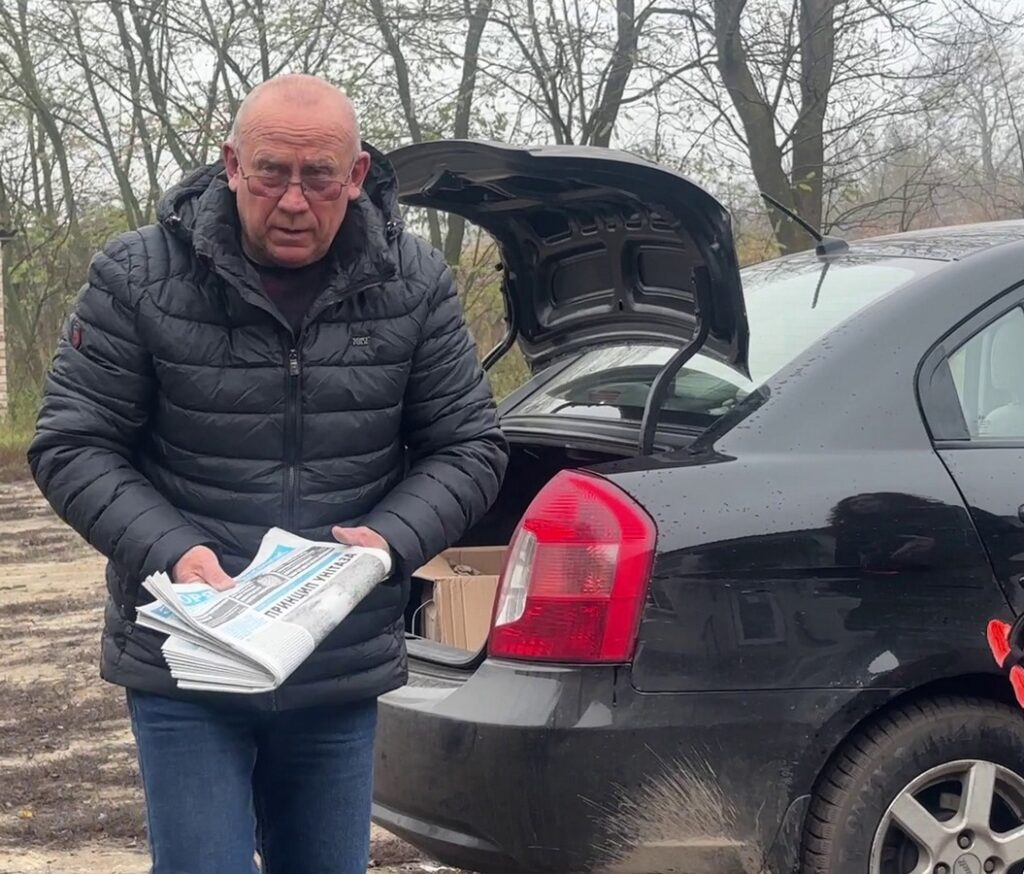
This is the experience shared by Vasyl Myroshnyk, the editor of the newspapers Zoria and Visnyk Bohodukhivshchyny (Zolochiv, Kharkiv Region), who works under constant fire and hunting by enemy drones.
- Logistics and mobility: A car as the main tool
In the conditions of a frontline zone, a car is not just a means of transport, but a mobile office and a means of salvation.
Parking rule: always park your car with its nose facing the exit. You should not waste time turning around in case of danger.
Car condition: the battery should be perfect, and there should be at least half a tank of fuel. The car should be able to start immediately.
Drive type: it is advisable to have a four-wheel drive car. Even old models (such as the Renault Kangoo 4×4) are a lifesaver on broken roads or off-road.
Camouflage: avoid bright ‘Press’ signs and bulletproof vests, if the locals do not wear them. For the enemy, a journalist is a priority target. The ‘Press’ sign on the glass should be used only briefly, and in dangerous areas – remove it so as not to stand out among civilians.
- Drone protection and surveillance
Today, enemy drones can see faces and license plates from kilometers away.
“Drone detector”: an indispensable thing for a driver. If the device gives a signal, you have been seen. You need to immediately seek shelter (trees, stops, houses).
Listen to the sky: outside the car, the main sensor is your ears and eyes. If you hear the drone before it notices you, the chances of salvation increase.
Night crossings: now they have become more dangerous than daytime ones. Drones hunt for headlights. The safest time to drive now is in the fog.
Refusal of weapons: do not try to shoot down drones with a gun. This will only unmask you, and the enemy will begin a targeted hunt for your car.
- Energy independence and communication
When the infrastructure is broken, the newsroom must rely on its own resources.
Generator vs EcoFlow: EcoFlow stations are convenient and quick to charge, but in the event of a prolonged absence of light (several days), a reliable gasoline generator remains indispensable.
Maintenance: do not skimp on fuel and a high-quality carburetor for the generator. The equipment must work without fail.
Starlink risks: in the immediate vicinity of the front, using Starlink can be dangerous. According to the military, the enemy can calculate the signal. Sometimes it is safer to drive away in search of mobile communication than to “pull” a projectile to the house through an activated terminal.
- Minimum set of equipment for filming
The principle of operation in the frontline zone: “approached – filmed – disappeared”.
Smartphone instead of cameras: use modern smartphones (Pixel, iPhone) with good internal stabilization. Bulky stabilizers in the cold or in extreme conditions often fail.
Sound: Be sure to use external microphones. Wind in the field can ruin the most important material.
Optics: Have a monocular or binoculars with you. This allows you to distinguish a bird from an enemy drone from afar.
Lifesaving tips: always carry a power bank (in case you have to leave your car) and a powerful flashlight.
- Information security
Digital hygiene: be careful with strangers who get in touch on social networks. Often, under the guise of readers, the enemy tries to determine your exact location.
The fight for brains: technical stability is meaningless without content. If journalists remain silent out of fear, the information space will instantly be filled with hostile propaganda.
Advice to colleagues: “We prevent them from lying, so we are a target for them. Work quickly, do not stand out and always have a way to retreat.”
REFERENCE INFORMATION: The online conference took place within the framework of the Frontline Press program, which is implemented jointly with the Swedish Media Business Association (Tidningsutgivarna / TU) and is aimed at supporting local newsrooms in frontline regions of Ukraine. The conference was also broadcast on the National Union of Journalists of Ukraine’s (NUJU) Facebook page. You can watch the broadcast at the link.
Earlier, we reported that the National Union of Journalists of Ukraine held an online conference dedicated to practical solutions for technical support of newsrooms during the war. Media leaders from frontline and rear regions shared their experiences, who daily overcome the challenges of the energy crisis and security risks.
We also published advice from Oleksandr Solomko, the director of the Yampil Information Agency (Sumy Region) – he shared a practical case: from a minimum set of equipment for “field” installation to solving energy independence issues.
NUJU Information Service













Discussion about this post