 THE NATIONAL UNION OF
JOURNALISTS OF UKRAINE
THE NATIONAL UNION OF
JOURNALISTS OF UKRAINE
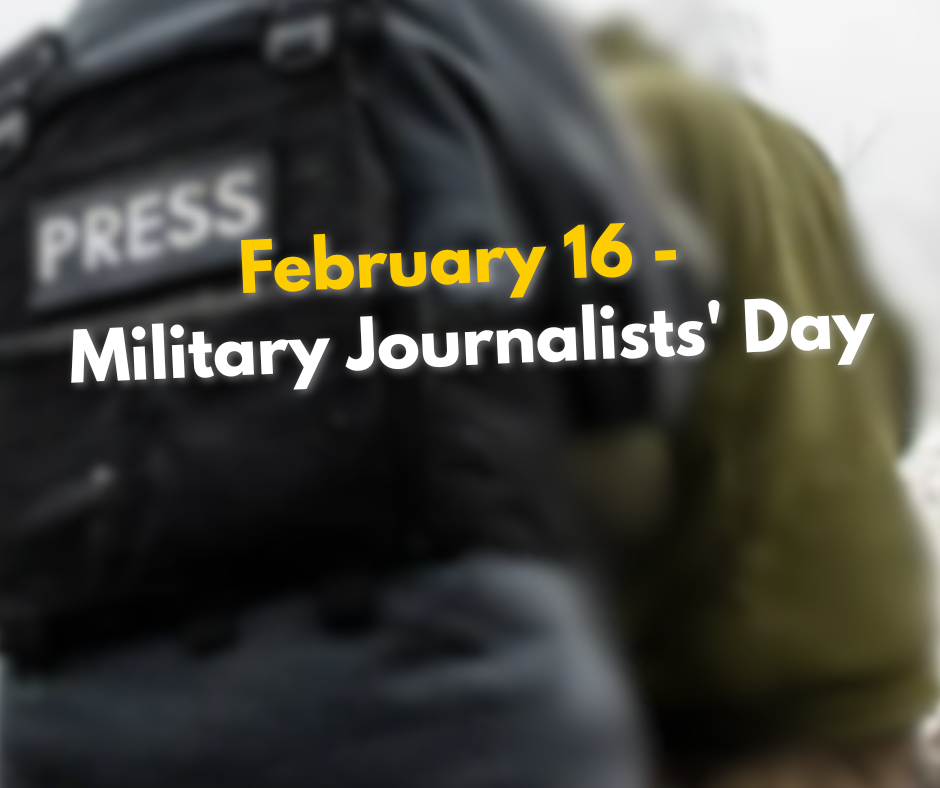
Every year on February 16, Ukraine celebrates Military Journalist Day. This is not a holiday in the usual sense, but a day of remembrance, honor, and recognition of those who risk their lives documenting the war and become the eyes of this confrontation for the world.
The date was established in 2018 by order of the Ministry of Defense of Ukraine. It was not chosen by chance. It was on February 16, 2015, that Captain 3rd Rank Dmytro Labutkin, the editor of the Ministry of Defense’s television and radio studio Briz, was killed near Debaltseve. Until his last breath, he continued to film the battle, fulfilling both his military and journalistic duties. His figure has become a symbol of dedication to the profession and service.
Since then, this day has become an occasion to remember all military journalists, including those who died during the russian aggression against Ukraine, from 2014 until the full-scale invasion.
In wartime, information also becomes a battlefield. Military journalists do not just report news — they document history, record war crimes, preserve the memory of events and people who reveal the world’s truth from the front lines.
For many journalists, war has become not only a professional challenge but also a personal choice.
And so has Kateryna Petrenko, a former photojournalist for the Airborne Assault Forces who now pilots combat drones. She continues to create documentaries, convinced: “There are no such things as former journalists.”
“There is something more than death — it is courage, gratitude, and memory,” Kateryna notes.
The National Union of Journalists of Ukraine (NUJU) systematically works to support journalists on the front and in the rear, cooperates with international partners, and advocates for the safety of Ukrainian media workers at the global level.
In 2024, the NUJU presented the documentary Press Officers Are Important, which told about the work of military communications from four brigades: Volodymyr Fitiyo, Kateryna Petrenko, Andrii Polukhin, and Yevhen Alkhimov.
In the same year, the NUJU introduced an award to recognize the contribution of military journalists to cover events at the front. Its laureates were Serhii Cherevatyi, Roman Chop, Illia Yevlash, Serhii Skibchyk, and other colleagues.
“The idea of introducing our own community award was not accidental. With the beginning of russia’s full-scale invasion of Ukraine, the role of military journalism has increased like never before,” says Sergiy Tomilenko, the President of the NUJU.
Modern war has significantly changed the working conditions of media workers. The massive use of drones, high-precision weapons, and the constant threat of shelling have turned every trip to positions into a mortal risk. Some journalists were forced to adapt, mastering new roles, while others continue to work under fire, in danger.
The President of the NUJU has repeatedly emphasized that the safety of journalists and the protection of freedom of speech are key advantages in wartime.
“Military journalists found themselves on the front lines not just of the informational, but also of the military front. We saw how our colleagues, military journalists, risk their lives every day to convey the truth about the war. They work in conditions that are even difficult for a civilian to imagine,” notes Sergiy Tomilenko.
In short, russian aggression is directed not only against the territory of Ukraine, but also against the right of society to know the truth. Murders, injuries, and captivity of Ukrainian media workers are a violation of international humanitarian law and an attempt to destroy independent information about the war.
According to verified data from the Ukrainian Military Journalists Association and the International Federation of Journalists, among the dead are 113 representatives and media representatives mobilized to defend Ukraine in the ranks of the Ukrainian Defense Forces. Each name is a separate story of courage and responsibility.
February 16 is an opportunity to recall:
- independent journalism during war is an element of democratic security;
- documenting war crimes is of global importance;
- protecting journalists is a shared responsibility.
Military journalists of Ukraine are not just reporters. They are witnesses of history who work in extraordinary conditions so that the world does not turn away and the truth remains recorded.
This day is about memory, honor, and solidarity with those who hold the information front.
Yuliya Turovets
NUJU Information Service








Discussion about this post