

 THE NATIONAL UNION OF
JOURNALISTS OF UKRAINE
THE NATIONAL UNION OF
JOURNALISTS OF UKRAINE

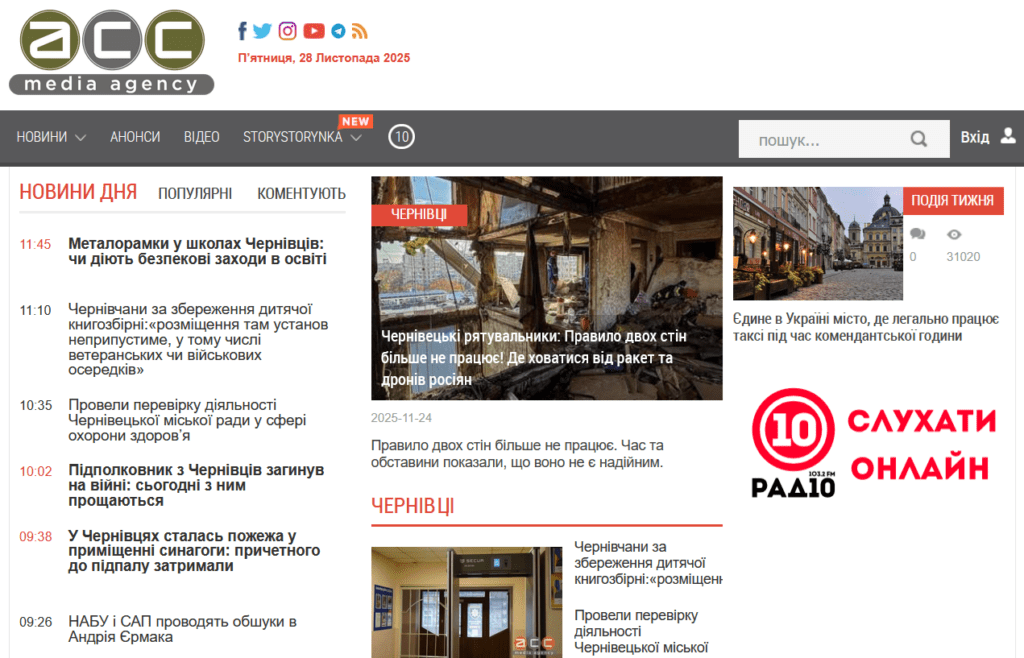
The Information Service of the National Union of Journalists of Ukraine (NUJU) is launching a series of articles about Ukrainian regional online publications — their challenges, development strategies, and mission in wartime. The first article is about Chernivtsi Media Agency A.C.C., which maintains professional standards despite all the difficulties of the media market.
“The information sector has never been profitable. It was not profitable before the start of the full-scale war. It is not profitable today,” Oksana Danyliuk, the head of Chernivtsi TV and radio company A.C.C., of which Media Agency A.C.C. is an integral part, states the reality in which the absolute majority of Ukrainian media live. However, the editorial staff does not lose its bearings, looks for solutions and solutions to difficult problems, and finds them.
The history of Media Agency A.C.C. is the history of a regional online publication that fulfills its mission despite all the challenges of the market, war, and technological development.
Media market realities: lack of funds, energy shortages, staff shortages
Previously, a certain safety cushion was created by grant projects. In the first two years of the full-scale war, international donors actively supported Ukrainian media.
“Grantors with an open mind supported a considerable number of media outlets; these were media outlets from different regions, both from the east and from rear areas,” Danyliuk recalls that period. “But the situation has changed. Today, the vast majority of grant programs focus on front-line zones. The logic is clear: it is most difficult for journalists there, the infrastructure is collapsing there, and the risks are greatest there. But this logic also has a flip side: in relatively safe cities, media outlets that have also lost advertisers and audiences are left without donor support. Previously, it was possible to achieve some zero indicators by attracting grant projects. Now, a zero balance is an unattainable goal.”
In conditions of financial deficit, the introduction of a paid subscription seems to some to be an economically rational step. Some Ukrainian online media are already experimenting with this model. But Media Agency A.C.C. deliberately refused this path.
“We still want to remain accessible to the broad masses of the population,” explains Danyliuk. “By introducing paid content, we will close a certain category of people’s access to verified information, and people will turn to unverified, but free Telegram channels, with sometimes fake information and pro-russian narratives.”
Against the backdrop of economic difficulties, there is still an indicator that the newsroom can be proud of: the growth in the number of subscribers on Facebook. But this audience, unfortunately, is not monetized, since such an option is not available in Ukraine. Regarding the site, there was an experience of placing a button for readers to donate, but with the start of a full-scale war, they decided to remove it.
“It’s better for people to donate to the Armed Forces; it’s a priority,” explains Danyliuk.
When russia began periodic massive attacks on Ukraine’s energy infrastructure in the fall of 2022, many newsrooms, along with financial ones, began to experience an energy deficit. Without electricity, it is impossible to publish news, maintain the site, or work on social networks. For small newsrooms that do not have their own generators or powerful backup power systems, each blackout meant a forced stoppage of work.
On February 24, 2022, six journalists worked in the newsroom of the A.C.C. Two of them volunteered to go to the front in the first days. One of them, photojournalist Maksym Shvartsman, was killed in the summer of 2023.

“He was an extremely friendly and sociable, but at the same time modest, taciturn person, alien to any publicity. Maksym didn’t even have a Facebook page,” recalls Oksana Danyliuk.
The second colleague, Pavlo Tokar, who went to serve at the beginning of the war, is still fighting.
No one came to replace them. The personnel crisis in the Ukrainian media industry has several reasons: the mobilization of men, the emigration of women and men who are not subject to conscription, and not very high salaries in the media. All this pushes people to change their profession. And those who remain become the object of fierce competition between employers…
“The main painful issue that has arisen as of today and concerns everyone is the personnel issue,” Oksana Danyliuk notes with sadness.
For small media, this is a vicious circle: without money, it is impossible to retain qualified staff, and without staff, it is difficult to produce quality content. Without quality content, it is impossible to attract an audience and advertisers. Without them, it is impossible to earn money.
How does the newsroom manage to overcome all these challenges?
Support that allows it to work
Each challenge that the media faces requires its own approach. And the people of Chernivtsi are looking for it.
A certain part of the problems can be solved thanks to internal financing. The parent company is engaged in buying (purchasing advertising time) and selling advertising on the radio. These funds cover the constant deficit of the information direction. This internal subsidy allows the newsroom to live, although confidently developing with this resource is not easy.
The problem of energy supply is solved by A.C.C. thanks to the support of the NUJU.
“We are grateful to the National Union of Journalists of Ukraine for the fact that we can afford to work uninterruptedly,” says Danyliuk. “The NUJU provided the newsroom with energy supply systems – charging stations, which allow us to continue working even during long blackouts. When we have power outages, having the energy supply systems provided to us by the Union, we can work calmly and not have any hassle with it.”
Dozens of newsrooms throughout Ukraine have received such support from the NUJU. Without it, newsrooms would either have to stop working during power outages or switch to a completely remote format, which for small teams of news outlets could mean the loss of proper coordination and speed of response to events.
This is an example of how systemic support of the media community can solve specific technical problems and allow newsrooms to continue to fulfill their mission even in the most difficult conditions. Energy supply from the NUJU has become not just a help for many publications, but a condition for survival.
And the newsroom is also persistently looking for its niche in the market and its approach to each segment of the audience. So we can say that the A.C.C. media agency is the result of a long evolution, but at the same time, a structure that is constantly evolving. In the 1990s, the publication began as a TV channel, later became a representative office of Channel 5, and then completely moved online.
“Television journalism in our country has transformed into an online publication,” Danyliuk sums up the long-term process.
These many years of experience allowed the newsroom to develop a clear understanding of different platforms and their features. The newsroom has developed a detailed content strategy for various social networks, taking into account the specifics of each of them. Instagram receives visual, light content with a minimum of text, focused on youth. Facebook is a universal platform for various formats of materials, focused on an older audience. There are attempts to work on TikTok and YouTube, but there are currently insufficient resources for the video content that these platforms require.
Such a differentiated strategy allows for the most efficient use of limited human resources and reaches different segments of the audience. Instead of scattering efforts equally across all possible platforms, the newsroom focuses on those where it can provide the best quality content.
The result of this strategy was 83,000 subscribers on Facebook – evidence of reader trust and content quality. For a regional publication, this is a serious audience – many national media have less.
Unable to pay high salaries and compete for ready-made specialists with large media, A.C.C. developed its own personnel policy strategy.
The publication has to “grow” journalists from the student ranks, from the first years, investing time and resources in their development.
“We are not afraid of the fact that young girls work for us; they actually develop their professional skills with us and continue to both study and apply their knowledge in practice,” says Oksana Danyliuk.


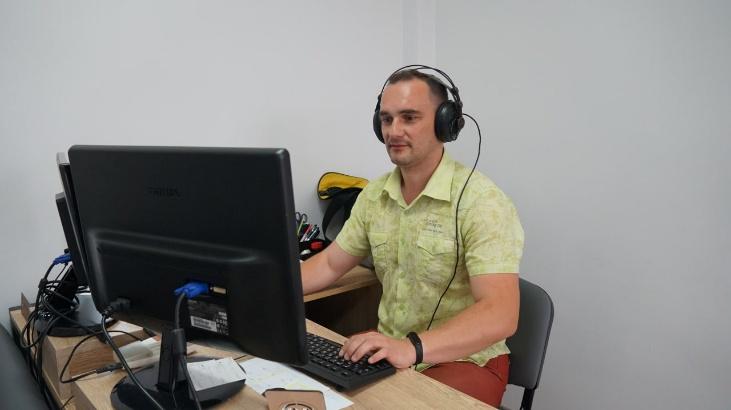
Of course, this strategy has its vulnerability: young specialists can later be lured away with better salaries. But without such an approach, the newsroom would not be able to work at all. In addition, it is an investment in the future of Ukrainian journalism: even if one of the graduates of the A.C.C. school moves to other media, they will bring there the professional standards and ethical principles that they learned in the newsroom.
Financial pressure for all publications creates a constant temptation to compromise. Advertisers, of course, offer commissioned materials that they want to present as regular news, without labeling, without the word “advertisement”. For publications with a chronic shortage of funds, this could be a salvation. But A.C.C. says that they do not agree to such proposals. Even when the content “can be pulled by the ears and presented as information that has an info-driven motive,” the newsroom insists on labeling.
This principledness has a price, because for the media, it is lost revenue. But such a policy helps maintain the trust of the audience. In the long run, the trust of readers turns out to be more important than instant profit. Newsrooms that make ethical compromises for the sake of money can quickly lose their audience, and it is much more difficult to restore trust than to maintain it.
This approach is consistent with the decision not to introduce a paid subscription and not to place a button for donations – the newsroom wants to remain accessible to all segments of the population and not compete with the Armed Forces for donations from citizens.
Audience trust as a key element of development strategy
Nowadays, when long-term plans are impossible, a one-year horizon is more or less realistic.
A.C.C. sets itself the task of “building a system in such a way that the work of the newsroom reaches the payback level”. This is an ambitious but achievable goal, provided that current support is maintained and work on process optimization continues.
Strategy The editorial team’s main goal is “to remain a trusted, respected, valued and respected media outlet.” This goal may seem abstract, but it determines all concrete decisions: from refusing to label advertising as news to the decision not to introduce paid content. In times of war and economic crisis, trust becomes the most valuable asset of the media, which cannot be bought with money, but can be lost with one thoughtless action.
The experience of A.C.C. shows that even in the most difficult conditions, regional media can maintain professional standards if they have the support of the media community, a clear work strategy, and an unwavering commitment to their mission. Survival under such conditions is a success in itself, but for the editorial team, it is important not just to survive but to maintain the quality and trust of the audience.
Maksym Stepanov
NUJU Information Service
Photo by А.С.С.
















Discussion about this post