 THE NATIONAL UNION OF
JOURNALISTS OF UKRAINE
THE NATIONAL UNION OF
JOURNALISTS OF UKRAINE
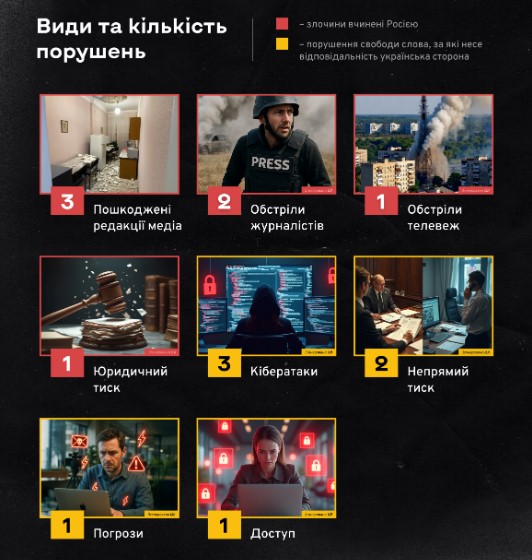
In November 2025, the Institute of Mass Information (IMI) recorded 14 cases of violations of freedom of speech in Ukraine. The majority of these crimes – seven cases – were committed by the russian federation. Russian war crimes against the media included shelling of journalists, damage to newsrooms and television towers, as well as legal pressure on media workers in the occupation. The data of the monthly monitoring of IMI Freedom of Speech Barometer evidence this.
According to IMI, in addition to war crimes, the report contains information about the death of two Ukrainian media workers who defended the country from the russian invasion, and also records cases of violations not related to the war: threats, cyberattacks, indirect pressure, and restrictions on access to information.
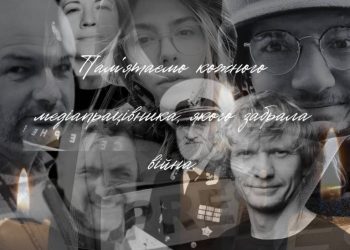
November brought sad news about the deaths of two Ukrainian media workers who exchanged their cameras and microphones for military uniforms:
- Kostiantyn Huzenko is a photographer, media producer, and member of the Ukraїner team. He served in the 35th Separate Marine Brigade named after Rear Admiral Mykhailo Ostrohradskyi, serving as a press officer.
- Anton Bondarenko is a military man known for his work as a fixer for the French TV channels TF1 and LCI. He went missing on September 15, 2025, while performing a combat mission on the Kharkiv Axis. A DNA test confirmed his death.
Russia continues targeted attacks on journalists and media infrastructure, trying to complicate the coverage of its crimes and undermine the information stability of the regions.
In November, two cases of drone attacks were recorded, directed directly at civilian vehicles with media representatives:
- On November 8, the russian military hit a vehicle of the humanitarian mission “Proliska” with a drone at the entrance to Kostiantynivka (Donetsk Region). There were four people in the car – volunteers, as well as two journalists from Spain and Austria. All managed to survive.
- On November 20, a russian FPV drone attacked an evacuation vehicle near Lyman (Donetsk region). Radio Liberty correspondent Serhii Horbatenko was in the car together with volunteers.
Massive drone and missile attacks by the enemy led to damage to the premises of a number of regional media outlets:
In Dnipro, on the night of November 15, a drone attack damaged the premises where the newsrooms of the Visti Prydniproviya newspaper and the online media Novyny Pidhorodne are located. The blast wave broke windows, damaged frames, furniture, and some office equipment.
On the evening of November 17, the building of the regional newsroom of Suspilne was damaged as a result of massive shelling of Dnipro.
The premises of the Suspilne Zaporizhzhia branch were damaged on the night of November 26. Although the team was not injured, part of the wall of the building was destroyed, and windows were broken. And the damage is currently being assessed.
In Dnipro, a TV tower was damaged as a result of the russian attack. This caused the broadcasting of local terrestrial channels and radio to be suspended.
Russia continues to use legal mechanisms to persecute Ukrainian media workers in the occupied territories. A russian court sentenced citizen journalist Vilen Temeriyanov from occupied Crimea to 14 years in prison. He was detained in 2022 on trumped-up charges of terrorism.
In parallel with war crimes, IMI recorded seven cases of violations of freedom of speech not related to russian aggression. These cases concern issues of access to information, security of journalists, and attempts to influence editorial policy.
Journalist Andrii Hryn of the Kramatorsk District received threats of physical violence from the person whose story he was reporting. After the police initially failed to file a report with the ERDR, the journalist went to court. The court ordered law enforcement to launch an investigation into the death threats.
The Komyshuvakha Village Council refused to provide answers to 21 information requests to SODA journalist Veronika Khorolska, sending only a single formal “reply”. IMI lawyers confirmed that such a response is a direct violation of the legislation on access to public information.
Ukrainian media continue to be a target for cybercriminals and hackers:
On the night of November 14, unknown individuals tried to steal passwords to accounts on the website Nakipilo. The attempt, made from different IP addresses (mainly from Kyiv and Odessa), was blocked by the security system.
At the same time, unknown individuals tried to hack the social networks of all journalists of Poltava Wave and Sil Media. Due to the massive attacks, Meta temporarily blocked the profile of the founder of the publications, which critically affected the work of the media pages.
The Cherkasy media 18000 received several phishing emails disguised as messages from Meta. The emails offered to get a “blue tick” on Facebook and contained a suspicious Google form aimed at stealing data. The editorial staff recognized the fraud.
Two serious attempts at indirect pressure and influence on the activities of investigative journalists have been recorded:
It became known that the defendants in the Midas corruption case were collecting dossiers on journalists, politicians, officials, and NABU detectives. The list of particular concern includes 10 magazines investigating corruption, including Yurii Nikolov and Oleksa Shalaiskyi.
Slidstvo.Info received a file with the plan of the anti-crisis campaign of the Ruslan Shostak Foundation. The campaign was aimed at neutralizing the investigation into the evacuation of children to Turkiye. The plan included the involvement of bot farms, controlled influencers, and working with media editors, which creates significant risks for sources of information and editorial independence.
We previously reported that trade unions, employers, and civil society at the European Economic and Social Committee (EESC) have joined forces to demand concrete measures against the alarming instability of journalists, which poses a serious threat to democracy.
NUJU Information Service










Discussion about this post