 THE NATIONAL UNION OF
JOURNALISTS OF UKRAINE
THE NATIONAL UNION OF
JOURNALISTS OF UKRAINE
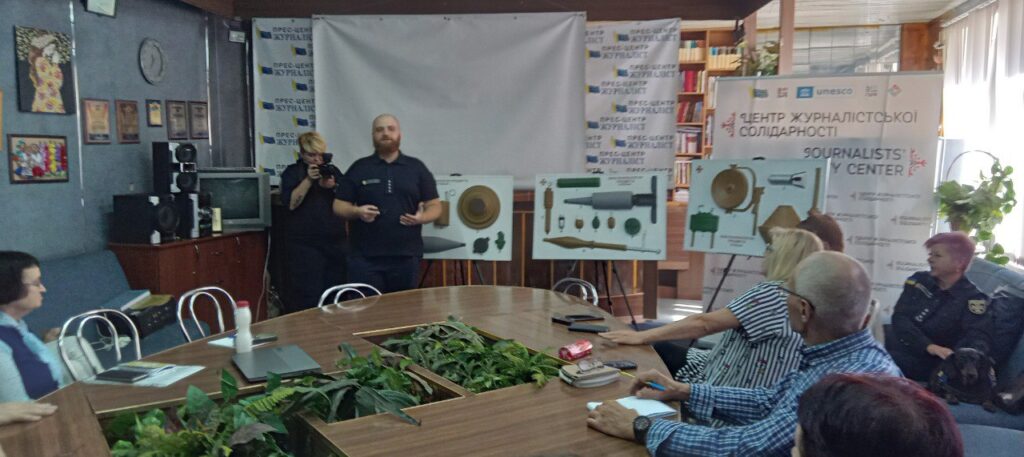
Training on compliance with mine safety rules and handling explosive objects was conducted for media workers at the Zaporizhzhia JSC of the National Union of Journalists of Ukraine (NUJU). Certified coach/specialist of the State Emergency Situations Service (SESS) in the Zaporizhzhia Region, Artur Davydenko, introduced the media workers in detail to the dangerous “collection,” which includes, in particular, anti-tank, vehicle, and anti-personnel mines, including those banned by the Ottawa Conference of 1999.
The coach’s story was accompanied by illustrations – the stands displayed models of various mines, which are very often found in areas near combat operations and pose a mortal danger to people.
“A so-called “witch” or “frog” mine is an ordinary can weighing up to eight kilograms, filled with explosives and cut nuts and bolts,” Artur Davydenko told the media. “It is placed on a stretcher that can be seen, but the russians have made electronic detonators for it that are triggered when a person approaches the mine.”
The “butterfly” mine, also called the “petal,” is particularly dangerous. These mines are small, weighing up to 80 g. They explode upon direct contact or have a time detonator, that is, a self-destruction element.
Artur Davydenko also drew attention to other types of mines that lie in wait for people in fields, forest belts, and empty houses. Some mines are thrown by a rocket; they descend to the ground on parachutes and completely bury themselves in the soil. Our sappers have already studied them and are liquidating them from a distance.
“When you see ammunition or a mine, stop, do not touch anything,” warns Artur Davydenko. “Stay calm, avoid panic. Remember the place where you found the suspicious object and report it to law enforcement agencies or special services. Do not allow unauthorized people to this place. Also – beware of dugouts, stay away from power lines, where the enemy often carries out mining.”
Algorithm of person’s actions in case of detection of an explosive and suspicious object:
- in no case touch or move the suspicious object with your hands;
- mark the place where the suspicious object is with sticks (clothes, stones, etc.);
- warn other people nearby about the discovery. Take them away and move yourself to a safe distance (at least 100 meters);
- the only official channel for reporting the detection of suspicious explosive objects is a call to the emergency numbers “101” or “102”;
- do not use telephones or other means of radio communication near a suspicious object;
- do not try to disassemble a suspicious object, remove an explosive substance or detonator from it;
- remember that a dangerous find can be found in unexpected places (fields, forests, reservoirs, vegetable gardens and ruins);
- pay attention: even the slightest external influence (impact, shock, friction, heating, etc.) can activate dangerous objects.
Call the Zaporizhzhia JSC at 096 277 5352 (Nataliya Kuzmenko and Valentyna Manzhura, the Zaporizhzhia JSC coordinators). The Center is located at 152 Sobornyi Avenue.
ABOUT JSC
The Journalists’ Solidarity Centers is an initiative of the NUJU implemented with the support of the International and European Federations of Journalists and UNESCO. The initiative is designated to help media representatives working in Ukraine during the war. The Centers operate in Kyiv, Lviv, Ivano-Frankivsk, Chernivtsi, Zaporizhzhia, and Dnipro and provide journalists with organizational, technical, legal, psychological, and other types of assistance.
ABOUT UNESCO
UNESCO is the United Nations Educational, Scientific, and Cultural Organization. It contributes to peace and security by promoting international cooperation in education, sciences, culture, communication, and information. UNESCO promotes knowledge sharing and the free flow of ideas to accelerate mutual understanding. It is the coordinator of the UN Action Plan on the Safety of Journalists and the Issue of Impunity, which aims to create a free and safe environment for journalists and media workers, thus strengthening peace, democracy, and sustainable development worldwide. UNESCO is working closely with its partner organizations in Ukraine to provide support to journalists on the ground.
The designations employed and the presentation of material throughout this digest do not imply the expression of any opinion whatsoever on the part of UNESCO concerning the legal status of any country, territory, city, or area or its authorities or concerning the delimitation of its frontiers or boundaries.
The authors are responsible for the choice and the presentation of the facts contained in this digest and for the opinions expressed therein, which are not necessarily those of UNESCO and do not commit to the organization.
Valentyna Bystrova
Photo by the author










Discussion about this post