

 THE NATIONAL UNION OF
JOURNALISTS OF UKRAINE
THE NATIONAL UNION OF
JOURNALISTS OF UKRAINE

Over four years of the full-scale war, Ukrainian newsrooms have learned to go on air, print, and update websites despite long-term outages. Newspapers went to press late at night and before dawn, journalists looked for ‘points of invincibility’ to charge their equipment, newsrooms bought generators, batteries, and power banks – each at their own expense and taking into account their own capabilities. Energy independence has become a separate area of editorial work that media outlets are building on their own every day.
In fact, the war has rewritten the very concept of editorial infrastructure. Until 2022, electricity, the Internet, and mobile communications were background conditions for journalistic work – only accountants thought about them. Now, these are independent production resources that the newsroom must provide itself, just as it provides itself with computers or recorders. In this new reality, the charging station is not an accessory, but a part of the production cycle on a par with editorial equipment.
This year, 16 Ukrainian newsrooms have increased their autonomy thanks to a joint program of the National Union of Journalists of Ukraine (NUJU) and the Ukrainian Media Fund Nordic – they received portable EcoFlow charging stations. Six newsrooms – more powerful EcoFlow DELTA 3 models, another ten – more compact EcoFlow RIVER 3 Max.
The geography of the program covers mainly those regions where the cost of power outages is the highest. In particular it covers the frontline Sumy Region – the newspapers Peremoha (relocated from Krasnopillia), Nash Krai from Lypova Dolyna and Yampil Information Agency; the city of Zaporizhzhia and its region – Chervonyi Promin, Radio Na Dotyk, the Nashe Zhyttia newspaper and the publication RIA Pivden relocated from Melitopol; the Donetsk Region – Visti from Sloviyansk (the oldest publication in the region); the Dnipropetrovsk Region with its frontline communities – Stepova Zoria from Petropavlivka, Novi Rubezhi from Krynychany, Radio Nostalzhi from Nikopol; the Chernihiv Region – Novi Horyzonty from Korop; and also the Cherkasy Region – the Procherk information agency; Bukovyna – the local non-governmental organization Ty-Media, the region of Prykarpattia – the Ivano-Frankivsk-based TV and radio company RAI and the national online publication OBOZ.UA (for a regional journalist in Dnipro).
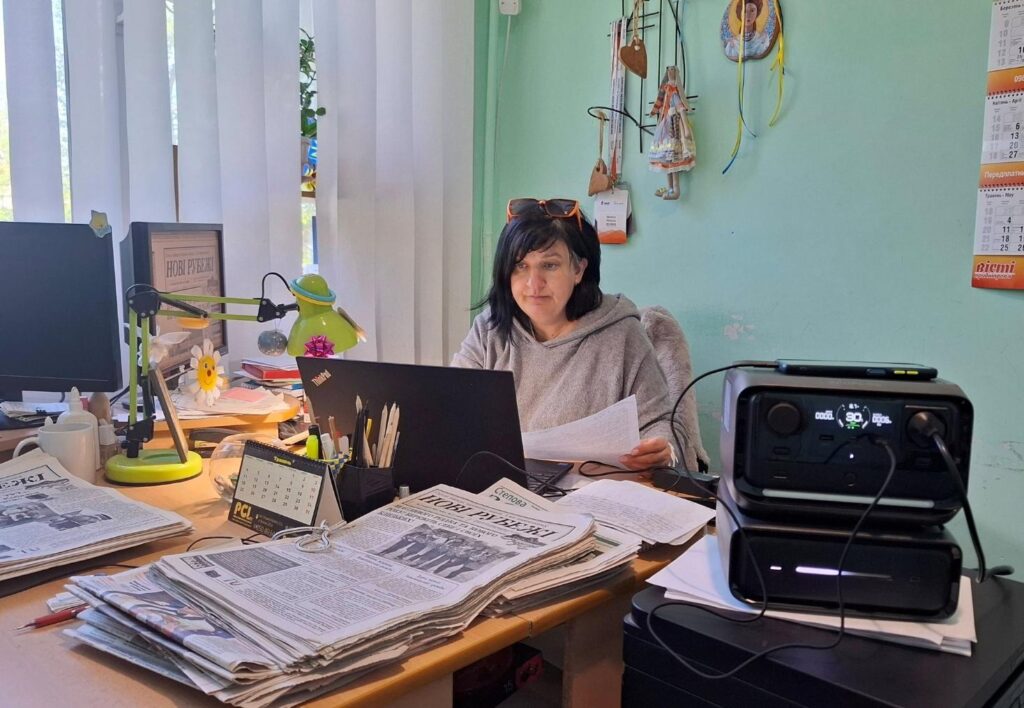
This geography is not accidental. Among the recipients are media that are either physically located in frontline communities, or relocated from temporarily occupied territories, or serve audiences that live under regular shelling of energy facilities. For them, a power outage is not a household inconvenience, but a direct threat to the release of an issue, broadcast, or news feed.
The way newsrooms themselves fight for their right to access the audience is best seen in their daily stories. In Petropavlivka in the Dnipropetrovsk Region, after a strike on a substation, the lights were turned on for one or two hours a day – and the newsroom still published two regular issues of the newspaper. Stepova Zoria has long been looking for a solution for energy sustainability, and when in conversations with partners we discussed the greatest needs, the answer was unchanged.

“We are constantly under fire. Shahed, Molniya, Gerbera drones – every day something flies either at houses or at infrastructure,” says Iryna Sytnik, the editor-in-chief of Stepova Zoria. “We need energy, we need power to work.”
In Krynychky in the Dnipropetrovsk Region, Novi Rubezhi has never disrupted the publication of the newspaper in four years of full-scale invasion – even this year’s 14-degree frosts and prolonged winter blackouts did not stop the editorial team. As the editorial staff admits, they are constantly looking for grant opportunities to strengthen their energy sustainability. The new EcoFlow station is another step in this direction.
Korop-based Novi Horyzonty from the Chernihiv Region reminds us: since the newspaper has clear publication days and hours of submission for printing, the lack of electricity can cost printing another issue. Therefore, the editorial staff understood long ago that there must be an alternative energy source, and not just one. Now, as the journalists themselves note, “there is no threat of disruption of the newspaper’s publication due to a power outage.”
As we can see, for local media, energy sustainability is not a one-time project, but so to speak, an accumulative process. Each new piece of equipment is layered on top of the previous ones, gradually forming a multi-level redundancy system. One station holds a laptop, the second a router, the third a photojournalist’s equipment. This is the logic not of comfort, but of media survival.
In Krasnopillia, Sumy Region, last winter was a real test – there was no electricity for up to 20 hours a day, and the available charging station worked for only three or four hours and did not have time to charge in the short windows between outages. The newsroom of the Peremoha newspaper still published issues – it simply shifted the work schedule.
“We had to type the issue late at night and very early in the morning,” recalls Olha Kyslenko, deputy editor-in-chief of the Peremoha newspaper. “Now the newsroom has two stations – and this is not just technical assistance, but a sense of support.”
Olha’s words demonstrate another adaptation that hundreds of media outlets across Ukraine are using – the time. The newsroom adjusts his work cycle to the schedule of power outages. The journalist starts working not at nine, but when the light comes on. This layer of work, invisible to the reader, is not included in any job description, but without which the publication cannot be published.
The Sloviyansk-based Visti – the oldest newspaper in the Donetsk Region – also prepared in advance for possible scenarios of another war winter.
“We understand that the availability of electricity during war is a fragile blessing. But now we are not afraid of power outages. Journalists will no longer have to look for the nearest “points of invincibility” to charge their work gadgets,” says the editor-in-chief of Visti, Oleksandr Kulbaka.
If you look at these stories together, a common pattern emerges. Ukrainian local media in wartime have turned into organizations with a double contour of resilience: journalistic – the ability to continue to collect and verify information – and infrastructural – the ability to physically deliver it to the audience. The second circuit existed mostly out of the media management’s attention until 2022; now it has become no less important than the first. And it is here that the dependence on external support is most acutely felt: it is impossible to buy editorial ethics and professional standards for money, but a charging station is quite possible.
All these stories are united by one idea, which is formulated differently in Nikopol, Sloviyansk, Krasnopillia, Petropavlivka, Zaporizhzhia, Chernivtsi, Cherkasy, and Dnipro: the energy independence of the newsroom is not a question of technology, but a question of informing people during wartime. Ukrainian media do not wait for someone to solve their problems – they look for opportunities, submit applications, establish partnerships, restructure schedules, purchase equipment with their own funds. And when a reliable partner is nearby – like the NUJU together with the Ukrainian Media Fund Nordic – this daily struggle for continuity of work becomes a little easier.
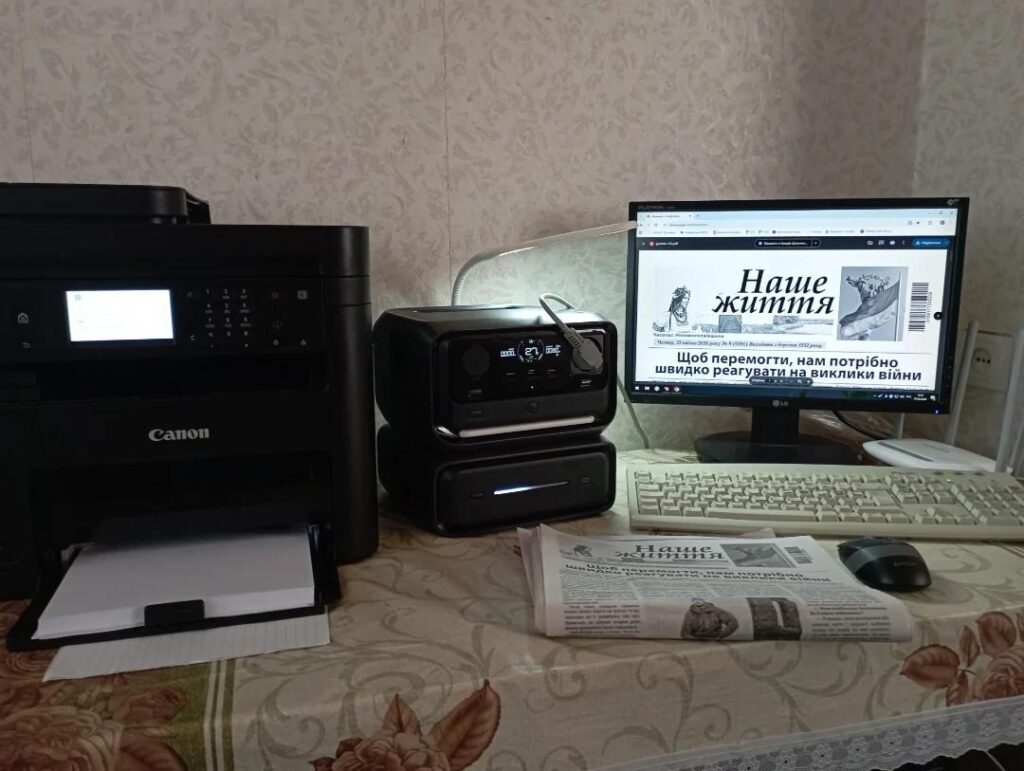
This is the peculiarity of the model that the NUJU is building together with international partners: support is not directed ‘top down’ according to a predetermined list but is formed from the bottom up – from specific requests of specific newsrooms. The NUJU constantly studies the technical needs of the media, their requests. This helps attract financial donors for further support – so that Ukrainian newsrooms can work regardless of the circumstances.

NUJU Information Service














Discussion about this post