

 THE NATIONAL UNION OF
JOURNALISTS OF UKRAINE
THE NATIONAL UNION OF
JOURNALISTS OF UKRAINE

The main request of Ukrainians is security information about their region, said today the President of the National Union of Journalists of Ukraine (NUJU), Sergiy Tomilenko, during a meeting with journalists from different areas in Kyiv.
He presented the analytical report Information Needs Of Residents Of Frontline Territories Of Ukraine”, prepared by NUJU experts within the framework of the project Strengthening The Resilience Of Frontline Media As A Tool For Combating Disinformation.
“The key request of Ukrainians is a request for security information that directly concerns their region. That is, security on the neighboring street, security in their neighborhood,” explained Sergiy Tomilenko.
According to the results of the study, Ukrainians consider themselves sufficiently informed about the general situation in the country. At the same time, they are better informed about security challenges in Ukraine in general than about the security situation directly in their city or region. It is precisely such adapted local information that is the top request of residents of frontline areas.
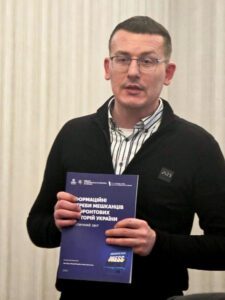 The study was attended by 400 respondents from frontline and deoccupied communities of the Dnipropetrovsk, Donetsk, Zaporizhzhia, Mykolayiv, Sumy, Kharkiv, Kherson, and Chernihiv Regions. Tomilenko noted the high accessibility of digital media for Ukrainians.
It is important that the presentation of the study, Local Media in Ukraine: Audience Use, Trust and Content Preferences (2025), took place on the same day. The study was conducted by Umbrella with the support of our project donors — Swiss Solidarity. The results show trends in how Ukrainians consume local news, what topics and formats of local content the audience wants to see the most, and which Ukrainian media are most important for consumers. Here, too, the topic of security was among the priorities.
The NUJU President emphasized that Ukrainians have access to digital platforms and social networks, but trust in information noise is low. Instead, trust in professional media or publications that Ukrainians identify as responsible is higher.
“Up to 90 percent, despite the power outage, check Telegram or social networks. But when the audience realizes that these are materials prepared by professional journalists, the level of trust in such materials and media is higher,” Tomilenko emphasized.
At the same time, he drew attention to the problem: professional media lack economic opportunities to increase the level of penetration, to print more newspapers, invest in digital work, or expand the staff. Tomilenko noted that there is no alternative to professional media, but this is also a big challenge for journalists – to transform their activities.
“We cannot just publish material on the website and relax. We must invest time and effort in promoting what is written on social networks,” he urged.
The President of the NUJU added that those editorial offices that transform their activities become leaders, although regional and local media have limited access to financial and educational opportunities.
“In my opinion, the best educational projects in Ukraine are currently being implemented by the Institute of Regional Press and Information in partnership with Fondation Hirondelle (Switzerland). These are initiatives focused on regional and local media. And most of our colleagues would dream of participating in such projects.
Tomilenko also expressed concern about the reduction in donor support for Ukraine, despite the growing threats and the exhausting war.
“This is a big challenge for all of us – to survive with limited opportunities,” he concluded.
Nazarii Vivcharyk












Discussion about this post