 THE NATIONAL UNION OF
JOURNALISTS OF UKRAINE
THE NATIONAL UNION OF
JOURNALISTS OF UKRAINE
The destruction of newsrooms, forced cooperation in the occupied territories, captured colleagues for whom charges of terrorism are fabricated, and the new reality, where the “PRESS” label has turned from protection into a target for russian drones – these are not isolated incidents, but a systemic policy of Moscow.
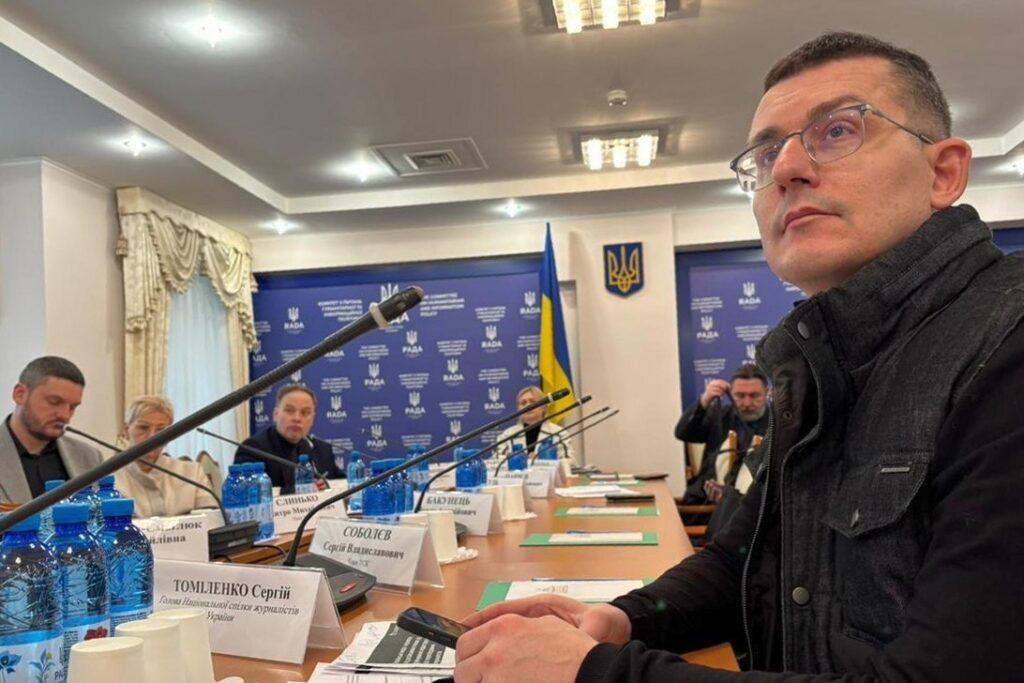
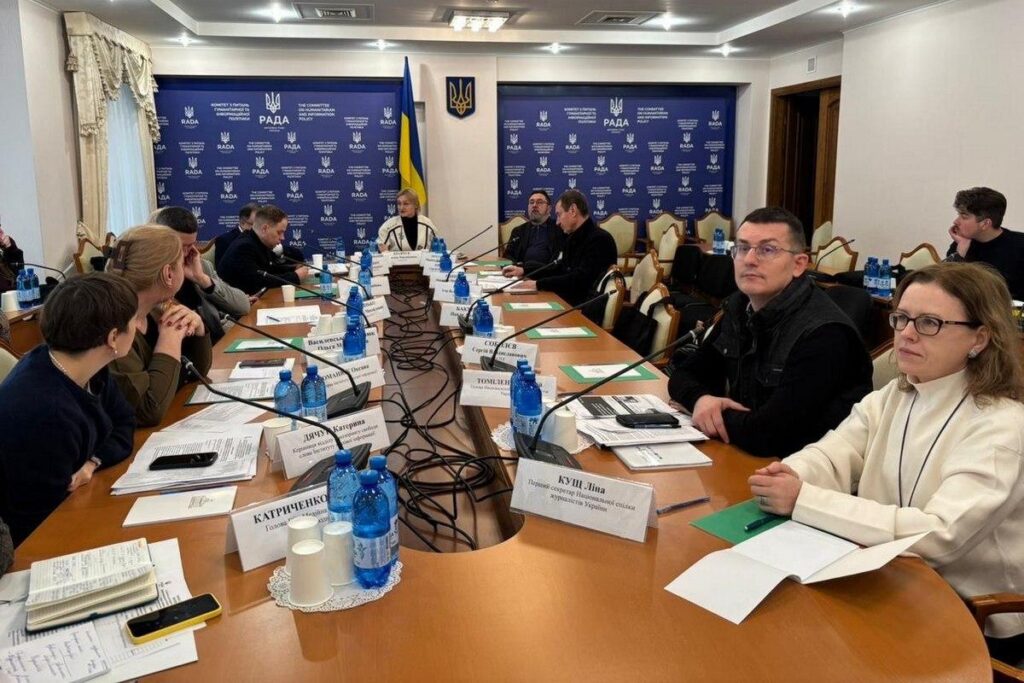
This position of the National Union of Journalists of Ukraine (NUJU) was confirmed by its President, Sergiy Tomilenko, at a meeting of the Interim Investigative Commission (IIC) of the Verkhovna Rada, to whose Expert Council he joined, representing the NUJU.
“There is no justice without truth. Without journalists, there is no truth,” NUJU President Tomilenko outlined the essence of the problem that the IIC should investigate not only to record the facts, but also to form a political assessment, increase international pressure on russia to release captured journalists, and make recommendations for changes in state policy.
Sergiy Tomilenko emphasized the scale of NUJU’s losses as a result of the full-scale invasion.
“At the beginning of the war in 2022, there were 19,000 members in our ranks; now we estimate the number of our members at 10,000-12,000. We have four regional organizations operating in a limited mode – these are the Donetsk, Luhansk regional unions of journalists, Kharkiv, and Kherson.”
The President of the NUJU demonstrated the systematic nature of the destruction of regional media, showing photos of destroyed newsrooms in Izium, Mezhova, and other cities.
“Russia is targeting and destroying regional media, because these are sources of truth that people trust. They form resistance to propaganda and, accordingly, they are also very vulnerable,” explained Sergiy Tomilenko.
He paid special attention to the practice of theft of Ukrainian media brands by the occupiers.
“The russians steal or try to use traditional media brands in the occupied territories in propaganda. Pryazovskyi Rabochyi is a publication with a long history, which everyone in Mariupol knew and knows. Three weeks after the occupation, a falsified newspaper was printed in Rostov-on-Don, where not a single Mariupol journalist was involved, but the logo, fonts, and printing were stolen and imported in a circulation of many thousands to Mariupol,” said the President of NUJU.
Sergiy Tomilenko believes that this can be qualified as one of the crimes against journalism.
The President of NUJU showed a letter from Iryna Levchenko, a journalist from Melitopol, illegally imprisoned by the russians. This letter became the first public evidence that she is alive and being held in the russian prison system.
“According to preliminary information, she was held for more than a year without even being registered in the russian prison system, kept in an apartment in Mariupol, and only then was she entered into the system,” said Tomilenko.
He emphasized the need for targeted support for the families of captured journalists.
“They need both constant qualified legal and material support, because the fate of each prisoner means large material expenses for their families – these are visits to prisons, jails, and shipments of medicines,” said Sergiy Tomilenko.
He drew attention to a new danger for journalists – targeted drone attacks.
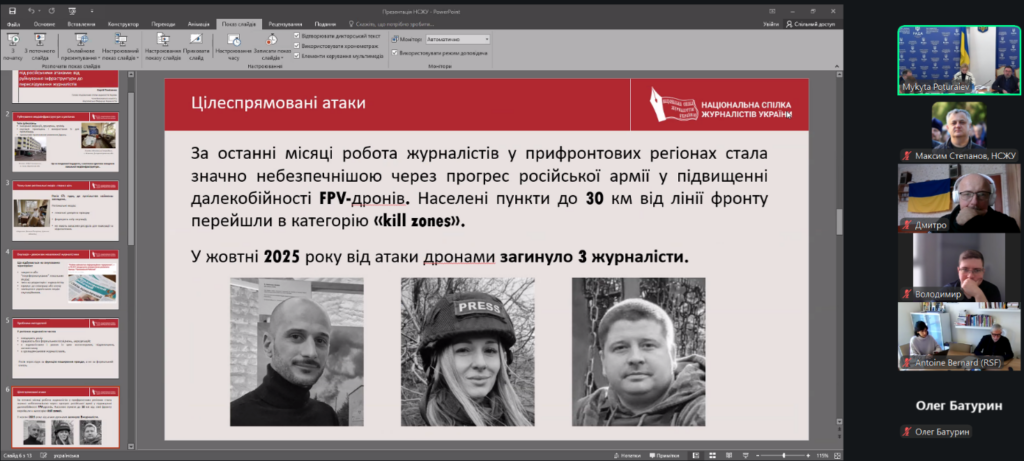
“Our key recommendations, as well as those of international experts, are not to use ‘PRESS’ stickers. In 2022, with the support of Reporters Without Borders, we translated a safety manual, where the key recommendation was to use ‘PRESS’ body armor to mark journalistic activities. Now, on the contrary, we call for the use of neutral black, neutral blue body armor and helmets, and to remove ‘PRESS’ stickers,” said Sergiy Tomilenko.
According to him, representatives of the General Staff confirmed that the operator of the russian drone “clearly sees that this is an unarmed civilian with a large camera, with a large camera, and strikes anyway”.
The President of NUJU presented the achievements of the Union for international advocacy.
“Since 2022, we have been documenting the testimonies of journalists and media workers about evacuation, about harassment, about checks, about how they hid journalistic credentials, about interrogations. We already have over 130 of these testimonies under the heading Freedom of Speech Shot Down, translated into English with dubbing,” said Sergiy Tomilenko.
He also presented three videos about the work of newsrooms in front-line territories and the film Free the Voices about captured journalists.
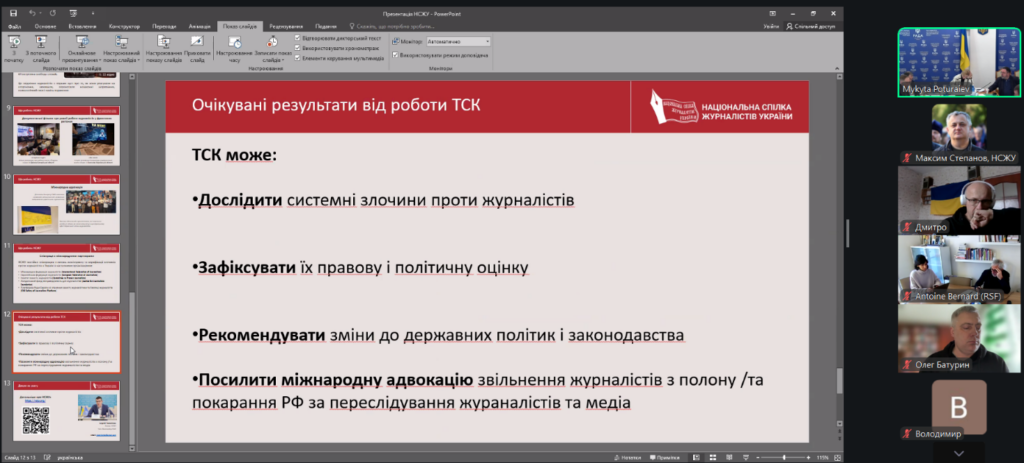
Sergiy Tomilenko proposed holding an IIC field meeting at the NUJU office on Khreshchatyk Street to hear testimonies of affected journalists from the regions.
“With all due respect to our expert reports, it is important to hear first-hand testimonies of our journalists and media workers about persecution,” he emphasized.
Sergiy Tomilenko also proposed coordination with international journalistic organizations during visits by IIC members and confirmed NUJU’s readiness to provide expert assistance in the work of the commission.
As earlier reported, the meeting approved the personal composition of the Expert Council at the IIC. It included representatives of leading media and law firms, including Sergiy Tomilenko from NUJU, Oksana Romaniuk and Kateryna Diachuk (Institute of Mass Information), Tetiana Katrychenko (Media Initiative for Human Rights), and other experts.
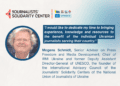
“For me, this is an opportunity to bring the voice of the journalistic community to where decisions are made,” said Sergiy Tomilenko. “And an opportunity to use what we record: more than 130 video testimonies of the Executed Free Speech project, the experience of six Journalists’ Solidarity Centers (JSC), connections with international partners — European Federation of Journalists (EFJ), International Federation of Journalists (IFJ), Committee to Protect Journalists (CPJ), and Council of Europe.”
NUJU Information Service





Discussion about this post