

 THE NATIONAL UNION OF
JOURNALISTS OF UKRAINE
THE NATIONAL UNION OF
JOURNALISTS OF UKRAINE
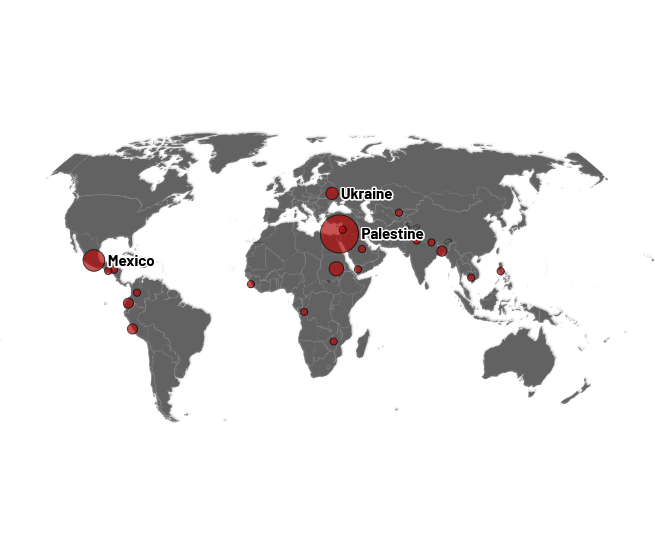
The international organization Reporters Without Borders (RSF) has published its annual report on violence against journalists around the world. In 2025, a total of 67 media representatives were killed – one more than last year. Ukraine remains one of the most dangerous countries for journalists, along with Sudan, Mexico, and the Gaza Strip.
According to RSF, three journalists were killed in Ukraine in the course of their professional duties in 2025 – all from russian drone attacks. Among the victims is French photojournalist Antoni Lallican, who was killed by a russian drone near Kramatorsk on October 3 while covering the construction of fortifications. His Ukrainian colleague, Heorhii Ivanchenko, lost a leg in the attack.
Twenty days later, on October 23, Ukrainian journalists Aliona Khramova (Hubanova) and Yevhen Karmazin were killed by a russian drone in Kramatorsk. Their colleague, Oleksandr Kolychev, was seriously injured.
All three of the dead were marked PRESS, had protective equipment, and were about 20 kilometers from the front line. RSF emphasizes that these were targeted attacks on civilians, which qualify as a war crime under international law.
Since the start of the full-scale invasion in 2022, a total of 16 media workers (according to the National Union of Journalists of Ukraine (NUJU) – 21 media workers) covering the war in Ukraine have been killed.
Russia ranks second in the world in terms of the number of imprisoned journalists – 48 people as of December 1, 2025. Most alarmingly, 26 (according to the NUJU – 28) of them are Ukrainian journalists. This is the largest number of foreign journalists imprisoned by a single country.
RSF has joined a coalition of human rights organizations in opposing a possible amnesty for crimes against journalists as part of any agreement to end the war.
The largest “prisons for journalists” remain China (121 prisoners), russia (48), and Myanmar (47). In total, 503 journalists are in custody in 47 countries around the world. One hundred thirty-five journalists are missing in 37 countries, some for over 30 years.
“This is what hatred of journalists leads to! It has caused the deaths of 67 journalists this year – it is no accident, they were not collateral victims. They were killed, they were targeted because of their work,” said RSF Director-General Thibaut Bruttin. “It is legitimate to criticize the media – criticism should serve as a catalyst for change that ensures the survival of a free press, a public good. But it should never descend into hatred of journalists, which is largely born – or deliberately fueled – by the tactics of armed forces and criminal organizations. This is where impunity for these crimes leads us: the failure of international organizations, which can no longer guarantee the right of journalists to protection in armed conflicts, is the result of a global decline in the courage of governments that should implement protective state policies. Key witnesses to history, journalists have gradually become collateral victims, inconvenient witnesses, bargaining chips, pawns in diplomatic games, men and women who need to be “eliminated.” We must guard against misconceptions about reporters: no one gives their life for journalism – it is taken from them; journalists don’t just die – they are killed.”
RSF calls on the international community to strengthen the protection of journalists and hold accountable those responsible for crimes against media representatives.
















Discussion about this post