 THE NATIONAL UNION OF
JOURNALISTS OF UKRAINE
THE NATIONAL UNION OF
JOURNALISTS OF UKRAINE
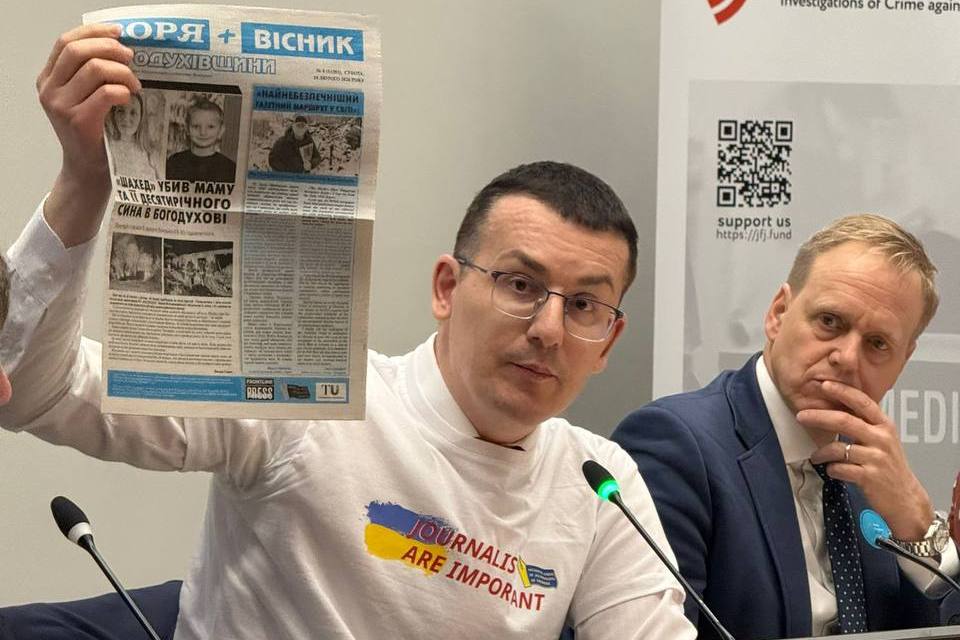
“Today we are talking about ‘conflict-affected regions” But I want to note: for Ukraine, this is not a conflict. For us, this is a full-scale war,” emphasized the President of the National Union of Journalists of Ukraine (NUJU), Sergiy Tomilenko, speaking at the panel discussion Independent Media in Conflict-Affected Regions within the framework of the British Media Freedom Forum in London.
The session was moderated by Sir John Whittingdale, a member of the British Parliament, head of the cross-party group on media freedom.
The President of the NUJU told what the everyday reality of Ukrainians looked like this winter, the most difficult during the war. Since January, russia has intensified attacks on energy infrastructure. In Sergiy Tomilenko’s apartment, the heating went out three times during the cold snap, and the NUJU office in the center of Kyiv was without heating or water for a week. Electricity is supplied on a schedule, and it is often out for 15–17 hours a day.
“Here in London, in my room, the light is bright, the heating is working – and I realize how fragile these things are,” said Tomilenko.
According to the NUJU President, in times of war, independent journalism is not only about democratic values, but also about national resilience. If verified information disappears, if the media disappears, this space is filled with propaganda and disinformation.
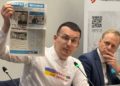
The NUJU focuses its efforts on supporting regional, local, and frontline media. Since 2022, the Union has helped revive and support more than 40 newspapers in frontline and de-occupied regions. Sergiy Tomilenko demonstrated one example – the Zoria newspaper from the Kharkiv Region. Its editor, Vasyl Myroshnyk, personally delivers the newspaper to villages near the russian border, under threat from russian drones. The NUJU recently provided him with a special drone detector so that he could deliver the newspaper more safely.
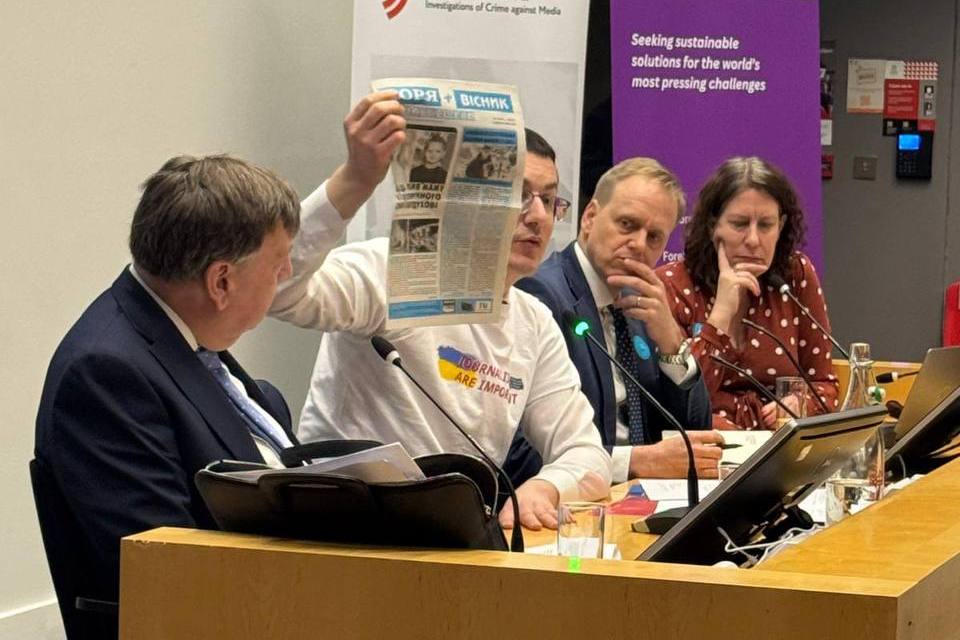
“For many communities, frontline newspapers – such as a seemingly old-fashioned media format – are the only reliable source of verified information. When settlements are plunged into darkness, these newspapers become a fulcrum for the truth,” Sergiy Tomilenko emphasized.
The President of the NUJU cited tragic statistics. Since February 2022, a total of 144 media workers have been killed, 21 of them directly in the performance of their professional duties. In 2025 alone, three media workers died while performing their journalistic work – all from strikes by russian drones.
Ukrainian journalists document war crimes and human rights violations, often risking their own lives. Currently, 28 Ukrainian journalists are in russian captivity.
Among them is NUJU member Iryna Levchenko, a well-known journalist from the temporarily occupied Kherson Region. She was detained by the russians in May 2023. There has been no contact with her for almost two years. Recently, a short letter from her came from a russian prison – just a few lines, but this is confirmation that she is alive.
“Journalists captured by the russians should not disappear from the diplomatic agenda. Their names should consistently be heard at international forums and in monitoring mechanisms,” urged Sergiy Tomilenko.
Russia combines military aggression with systematic disinformation, and strikes on infrastructure directly affect the work of the media: without electricity, newsrooms cannot work, equipment cannot be charged, and materials cannot be transmitted.
This winter, the number of requests from journalists to rent drone detectors increased fivefold, and requests for safe workspaces with a stable power supply tripled.
The NUJU has created a network of Journalists’ Solidarity Centers (JSC), which act as operational security hubs. They provide protective equipment, security training, safe workspaces, and legal and psychological support. The network also operates drone detector rental points in three frontline regions. Since 2022, more than 9,000 journalists have received assistance through this network.
However, the Union currently faces a serious funding challenge, while needs continue to grow.
Sergiy Tomilenko proposed three concrete steps for the international community:
- systematically include the issue of detained journalists in all diplomatic negotiations and monitoring mechanisms;
- support the creation and operation of safe working spaces for journalists working in war zones;
- introduce mechanisms for rapid and flexible funding for frontline and local media operating in conditions of extreme risk.
“Independent journalism in war requires infrastructure, not just courage. Support is not just solidarity, it is an investment in democratic resilience and security,” concluded the President of NUJU. “Journalists in Ukraine are not asking for sympathy. We are asking for tools and safe conditions to continue our work. If independent journalism survives the war, then truth will survive. And when truth survives, democracy has a chance to survive.”
Session moderator, John Whittingdale, thanked Sergiy Tomilenko for his speech and for coming to London despite the difficult journey, and most importantly, for everything he and his colleagues are doing to bring the truth about Ukraine to the world.
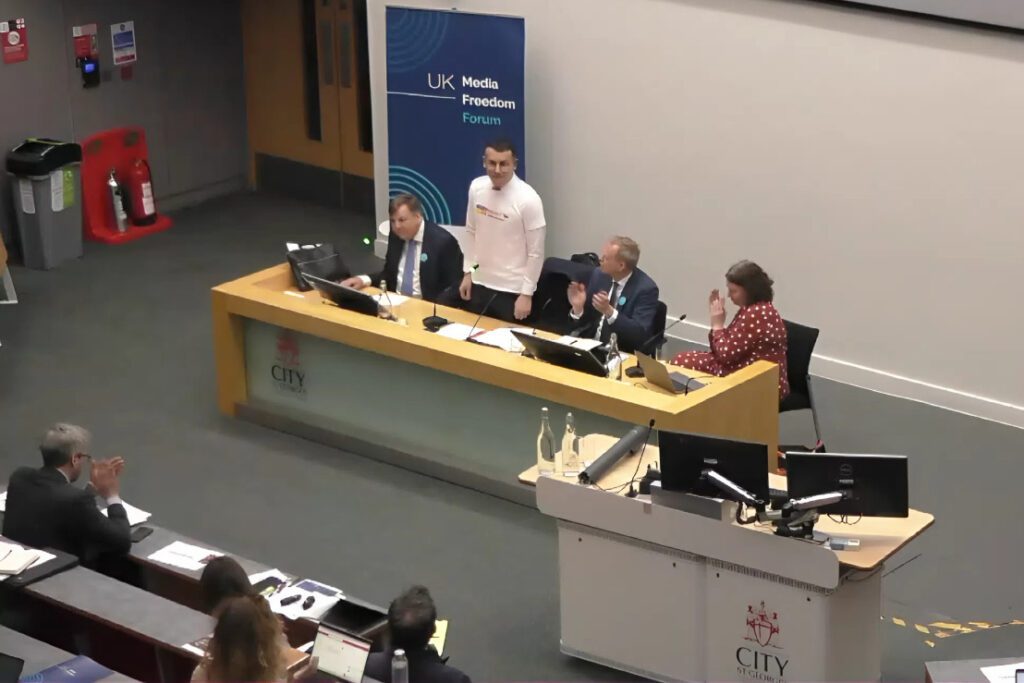
The session Independent Media in Conflict-Affected Regions was attended by the Executive Editor of Long Formats and Investigations at the BBC World Service, Liz Gibbons, and Jonathan Price, a media and human rights lawyer at Doughty Street Chambers. Renaud Gaudin De Villaine, Adviser on Media Freedom and Safety of Journalists at the Office of the UN High Commissioner for Human Rights, also took part in the discussion.

About the Forum
The Second UK Media Freedom Forum, which will be held on 5–6 March 2026 in London at City St George’s, University of London, is organised by the UK Foreign Policy Centre, the Justice for Journalists Foundation, and the International Bar Association Human Rights Institute (IBAHRI). The event brought together parliamentarians, government officials, human rights activists, lawyers, journalists, and representatives of international organisations from around the world.
The forum’s status highlights the participation of representatives of the UK government and parliament. The keynote address was delivered by Chris Elmore, Parliamentary Under-Secretary of State at the Foreign Office. Emily Thornberry, Chair of the UK Parliament’s International Affairs Committee, will open the second day of the forum. Stefan Kossoff, Head of the Foreign Office’s Democratic Governance Directorate (FCDO), will be one of the speakers at the final session. Also participating is Baroness Helen Kennedy, Director of the Human Rights Institute of the International Bar Association.
The two-day program covers a wide range of topics: transnational repression of journalists, the work of independent media in conflict zones, the legal protection of press freedom, countering SLAPP lawsuits (strategic lawsuits against public participation), combating disinformation in the age of artificial intelligence, media literacy, and supporting local media. Separately, the annual report of the Council of Europe Platform for the Safety of Journalists was presented, and the new Center for Journalism and Democracy at City, St George’s University was launched.
Speakers and participants at the forum include representatives of the OSCE, UNESCO, the Office of the UN High Commissioner for Human Rights, the Committee to Protect Journalists (CPJ), Reporters Without Borders (RSF), the International Press Institute (IPI), Media Defence, as well as investigative journalists from The Guardian, OCCRP, and other publications.
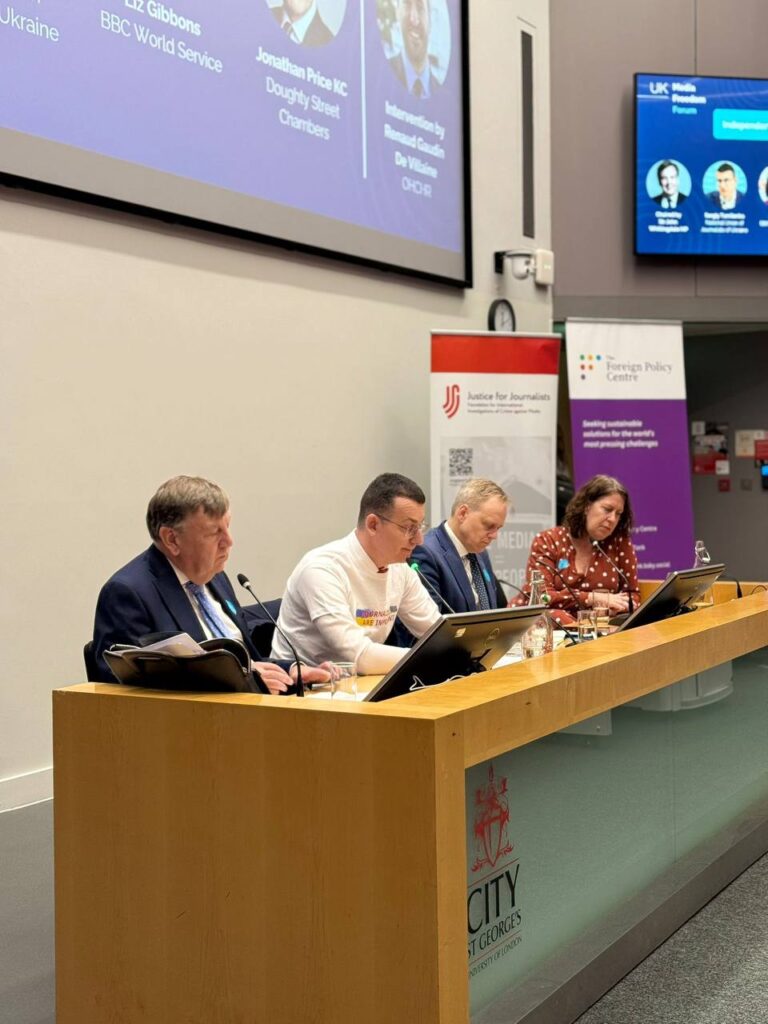
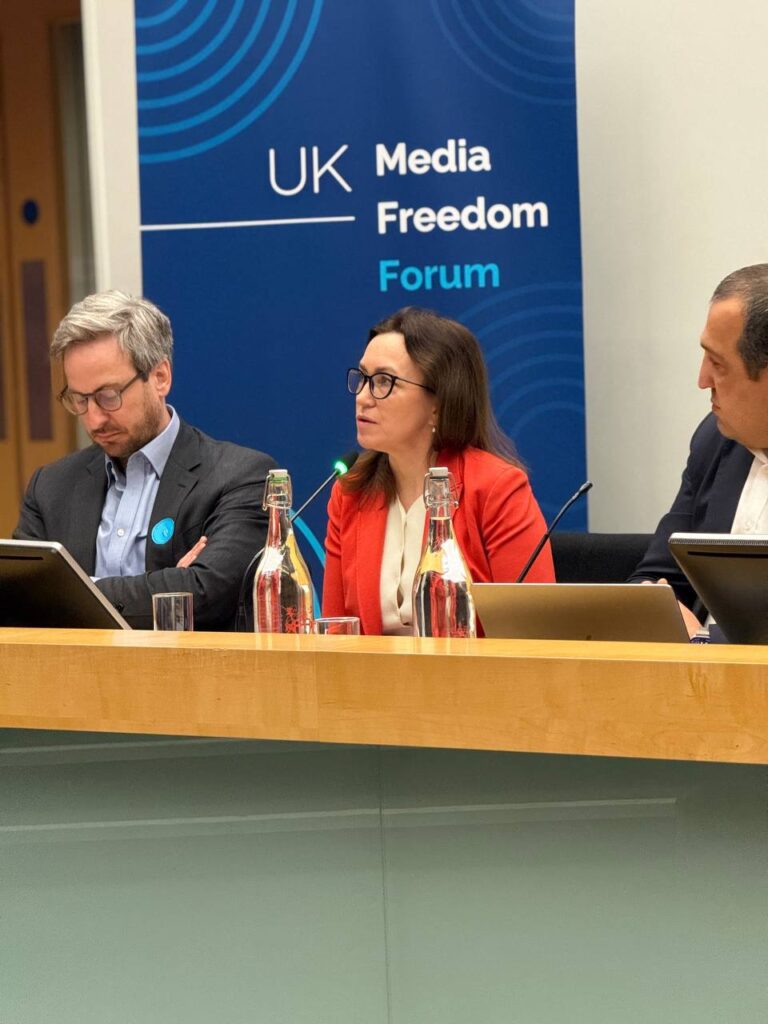
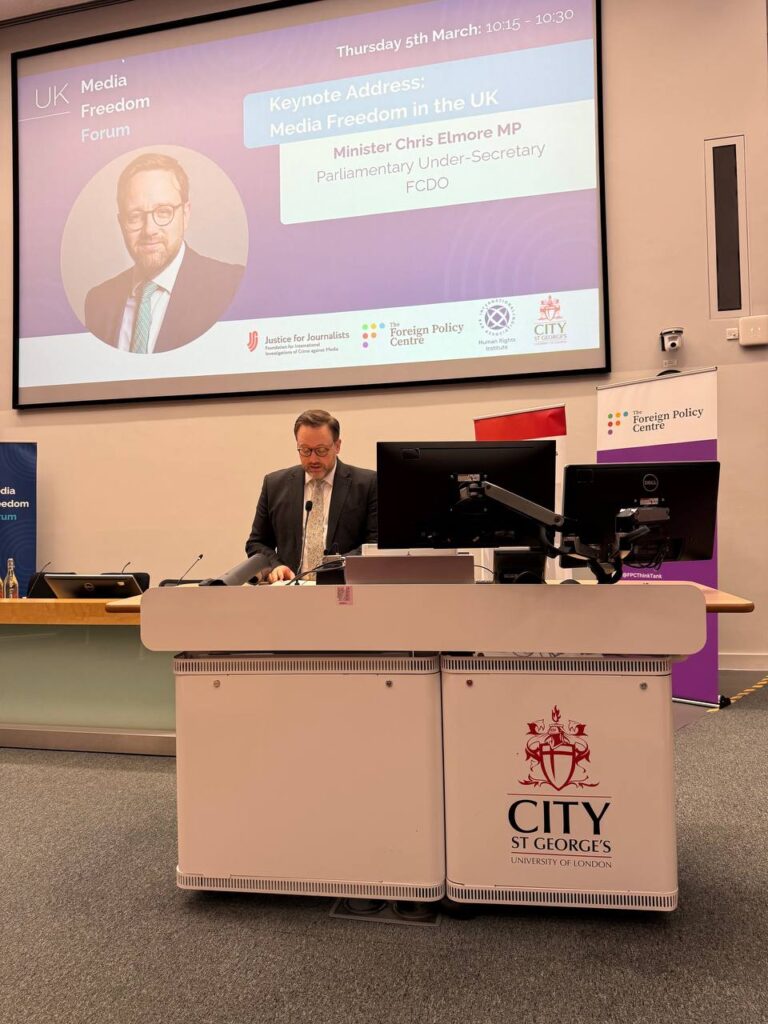
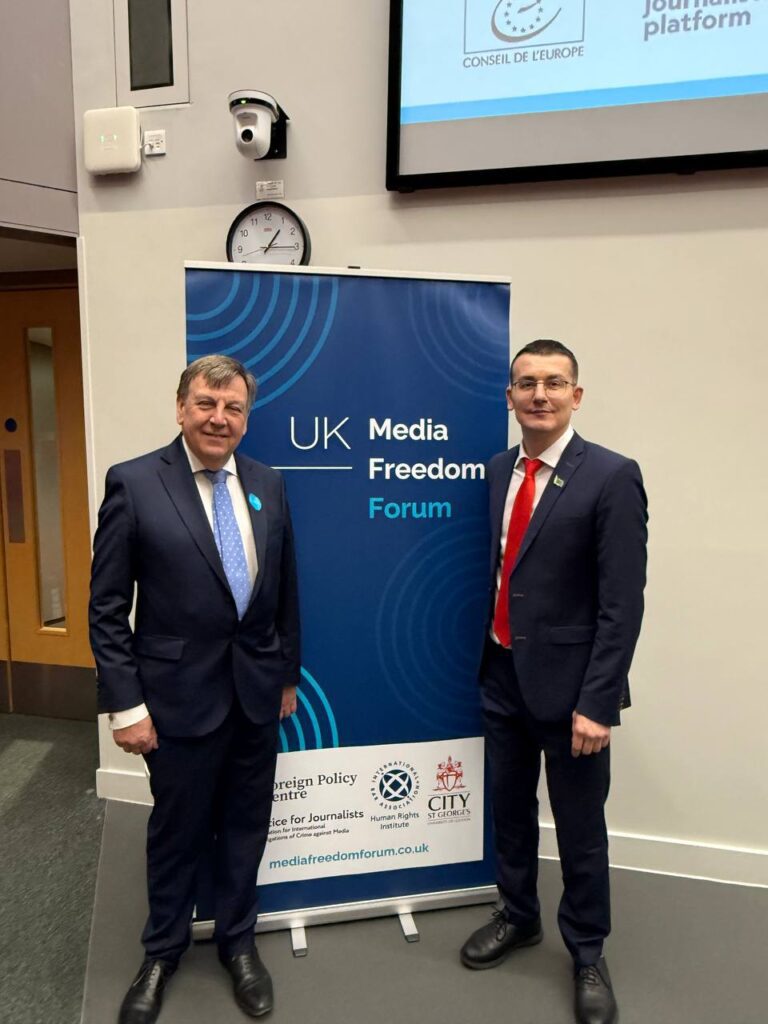
Photo from Facebook / Sergiy Tomilenko
NUJU Information Service









Discussion about this post